- Thursday, 30 April 2026

Ranjit pays off sugarcane farming losses with vegetables

By Hari Prasad Koirala,Urlabari (Morang), Jan. 18: After suffering continuous losses in sugarcane farming, Ranjit Gupta of Dhanpalthan Rural Municipality-6 in Morang started commercial vegetable farming.
Not only did he start commercial vegetable farming, but he has also managed to repay all the loans he had taken for sugarcane cultivation within five years.
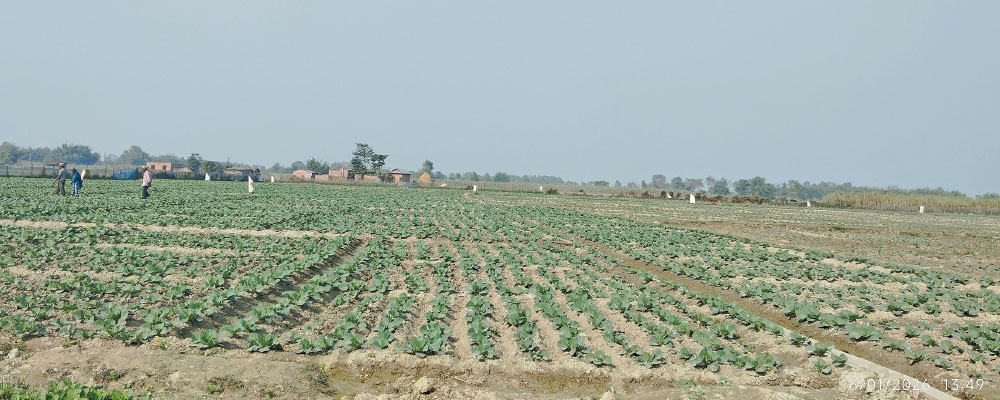
According to him, he cleared sugarcane from his land and planted vegetables on four bigha and 15 katthas.
Gupta, 38, who has planted cabbage on all the land, said, “If it is sold at an average rate of Rs. 8 per kilogram, it will save at least Rs. 300,000.”
The vegetables are harvested in three months and can be sold continuously for almost a month.
Gupta added that cabbage, which initially sold for Rs. 8–10 per kilogram, fetches a good price in the first week of Chaitra.
This season, he has planted different varieties of cabbage and has spent around Rs. 200,000 on vegetable cultivation.
He said that around 14 people get daily employment during planting, tilling, irrigation, and transporting the produce to the market.
Gupta explained, “There were huge losses in sugarcane farming. I did not receive the money on time. I cultivated sugarcane with loans, but even after paying interest and installments, the mill did not pay me. Agricultural labour is also expensive in sugarcane farming. That is why I stopped growing sugarcane and started cultivating vegetables.”
He added that he used to pay an annual rent of Rs. 200,000 for the land. Last year, the ward office helped install a boring, motor pump, and irrigation system, which further reduced his expenses.
Gupta said that if fertilisers, seeds, and water are supplied on time to farmers across the country, it is possible to produce the foods and vegetables required for Nepal.
However, he complained that government subsidies in India allow products to be sold at cheaper prices there, which affects Nepali farmers when those products enter the domestic market.
He also noted that cabbage is imported from India, and Nepali products often struggle to find a market.
The main markets for vegetables from his farm are Birtamod, Damak, Dharan, and Biratnagar.