- Thursday, 4 June 2026

An Iconic Voice Of English Fades Forever
 Bharat Chand
Bharat Chand
Bharat Chand
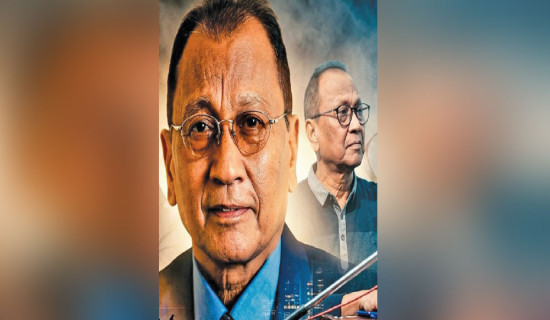
“This is Radio Nepal. The news is read by Harish Chand.” The charismatic voice that we passionately heard while listening to the news at 8 PM on Radio Nepal is no more, leaving an indelible mark on the history of English news reading in Nepal. His passing away is not only a huge loss to the media fraternity but also to the public who idolised him as an iconic figure of the English language. Anyone who had a penchant for improving their English used to take his name as an ideal – whether inside classrooms or in media talk shows and panel discussions.
My English teacher, under whose influence I became immersed in English during my school days, often mentioned him, urging all of us to “make English like that of Michael Chand.” Owning a radio at that time was a privilege for most families. However, the Philips radio my father owned allowed me to listen to the very voice we were repeatedly encouraged to follow. The routine of tuning in to the radio that my father practised then is still vividly imprinted in my mind. He would most often listen to Ghatana ra Bichar, a very popular programme that aired news and commentary on various issues at 7:20 PM, right after the 7 PM Nepali news on Radio Nepal. If he missed that programme, he would tune in to the English news at 8 PM.
Improving English
On those evenings, my elder brother and I would hear either the voice of Harish Chand or Robin Sharma. The voice we were advised to listen to in the name of improving our English was not easy to follow. Yet, whenever we got the chance, we tried to copy his style of pronunciation, mimicking the way he articulated each word on the radio. Our attempts at imitation often ended in bursts of laughter, as we failed to come anywhere close to a perfect replication.
After arriving in Kathmandu for higher studies, the urge to make my English sound like his never faded from my mind. Teachers would frequently take his name whenever pronunciation came up in college discussions.
Learning a few rules related to English pronunciation, especially those connected with IPA (International Phonetic Alphabet) symbols — helped me understand, at a surface level, how words containing monophthongs, diphthongs, and triphthongs are pronounced. Over time, professors such as Abhi Subedi, Arun Gupto, Sanjeev Upreti, Jai Raj Awasthi, and several other prominent figures from the faculties of English Education and Arts instilled in me the importance of content over pronunciation. As the ladder of academic achievement continued to rise, I gradually began to value what was being said more than how it was pronounced.
A very typical coincidence that I witnessed long ago at a panel session of a literature festival held in Kathmandu is worth mentioning here. A boy, who appeared to be pursuing his studies at the plus-two level, asked Professor Abhi Subedi a question while listening to him speak on pronunciation. “Being a professor, your pronunciation is not up to the mark compared to what we hear native speakers speak on various forums or media across the world,” he said. Responding to the question, Professor Subedi produced utterances similar to those of native speakers, allowing the boy to realise that he could indeed pronounce words in the way he wished to hear. What matters most for a second-language speaker, he explained, is content rather than merely emphasising pronunciation to sell oneself in the global market.
Sushil Kumar Pandey, with whom I had the opportunity to study International Relations while pursuing my M.Phil. in English at IACER, once spoke about his connection with Harish Chand. Professor Pandey, who was later appointed as my thesis supervisor, shared how he knew Harish Chand, knowing that I hail from Baitadi. According to him, they were classmates at Padmodaya High School, and Harish Chand’s academic performance was excellent, particularly in English. Being educated at one of the finest schools in Kathmandu at the time helped shape Harish Chand into the voice of his era, broadcasting news in English. Yubraj Gautam, a senior journalist, recently wrote on Facebook about how Michael Chand and he became connected as journalists at Radio Nepal.
Fascinating moment
A marriage ceremony of my relatives held three years ago in Kathmandu became a fascinating moment for me when I learned that Michael Chand, along with his spouse Bhuwan Thapa Chand, was scheduled to attend the ceremony from the bridegroom’s side. At the party palace, the relatives and I stood ready to welcome the bridegroom and his entourage, and right behind him appeared Michael Chand with his spouse, his silky hair flying in a burst of air. The most elating moment came when I personally got the chance to tell him how I had been hooked on his pronunciation since my childhood. We interacted on subjects ranging from the English language to the evolution of Nepal’s film industry.
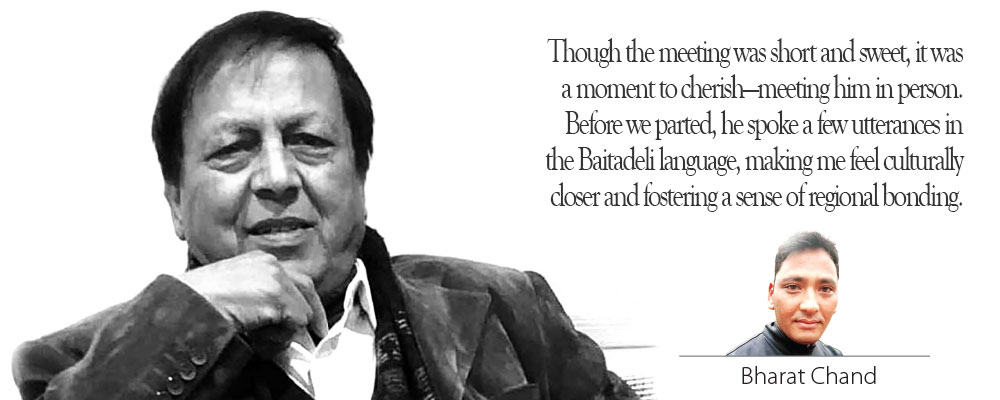
Though the meeting was short and sweet, it was a moment to cherish—meeting him in person. Before we parted, he spoke a few utterances in the Baitadeli language, making me feel culturally closer and fostering a sense of regional bonding. Owing to the need to manage arrangements at the ceremony, I could not sit with him for more than half an hour. We took a few photographs before departing, and this remains one of the most unforgettable moments of my life with the iconic voice I had grown up listening to since my school days. May his departed soul attain mokshya and rest in peace.
(The writer is a freelancer.)

-square-thumb.jpg)