- Sunday, 24 May 2026

Schooling Beyond Language Barriers
 Ambika Khadka Thapa
Ambika Khadka Thapa
Ambika Khadka Thapa
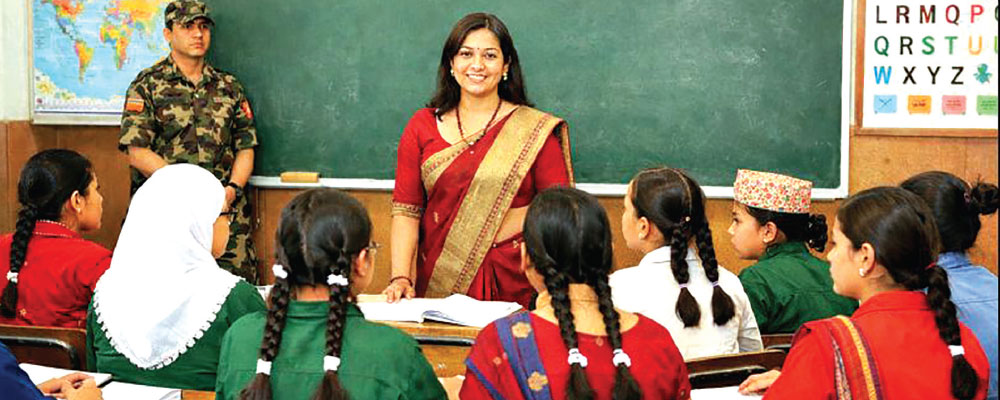
This is the experience of a teacher who has been working as an English language teacher since 2005. Talking about the background of my institution, it is the one and only girls’ school run by the Nepal Army with the motive of women empowerment. Students from diverse cultures, multilingual backgrounds, different economic statuses, and varied learning abilities study here.
In my career, I have encountered students from all over the country. I am sharing one of the most heart-touching experiences of my teaching career—about the twin sisters Anuska and Aarati (pseudonyms), daughters of a Nepali soldier who was killed during a mission. They were brought up by their mother until they were five years old. It was difficult for her to take care of them as an uneducated single mother. Since she was seeking support, she approached our school, which has a protocol of providing benefits to martyrs’ families as per the provision of the Nepal Army Welfare Directorate, 2022. Consequently, these little girls were provided with a full scholarship and hostel facilities until they graduated from high school.
However, their journey—filled with challenges, joy, and sadness—began in 2079 B.S. when they joined our school as grade one students. When they first joined the school, they faced significant language barriers. They were not proficient in either Nepali or English, as they were from one of the remote areas of Bajura district. In Bajura, people speak their own dialect. Likewise, it was difficult for them to understand the dialect spoken in Kathmandu. As a result, communication, learning, and comprehension were challenging for them in meeting grade-level expectations.
To support their learning and integration into the classroom, several strategies were implemented. To ensure their learning journey and personal development, I personally decided to step in and walk extra miles to see smiles on their innocent faces.
After observing them for several weeks, I learned that they had difficulties learning English, especially phonics and reading. This required targeted, patient, and multisensory strategies. Thus, our journey of teaching and learning began. Both the students and teachers were very enthusiastic.
We began with phonological awareness. They needed help hearing and identifying sounds in words before they could read them. We conducted activities such as (a) rhyming games (cat–hat, pen–hen), (b) sound segmentation (breaking “cat” into /c/–/a/–/t/), (c) blending sounds to make words, and (d) clapping syllables in words. The tools I used for practice included picture cards, clapping, and tapping on desks to make learning more kinaesthetic.
Similarly, we focused on explicit phonics instruction, which involves teaching phonics systematically and directly rather than through mere exposure. For instance: (a) synthetic phonics, where students build words by blending individual sounds, and (b) reinforcing frequently confused sounds such as b/d, p/f, and v/w.
Likewise, we emphasised multisensory teaching techniques, which engage multiple senses—seeing, hearing, touching, and movement. For example: (a) visual—letter cards and colour-coded sounds; (b) auditory—saying sounds aloud and having students repeat them; (c) kinaesthetic—air writing or tracing letters in sand; and (d) tactile—using clay or textured letters to form words. For instance, when teaching the sound /s/, I asked them to trace the letter “s” in sand while saying “sss”.
With regular and separate classes and consistent effort from the children, myself, their class teacher, and subject teachers, it was overwhelming to witness their gradual progress. Through regular reading and writing practice, they began recognising letters, then words, and eventually forming simple sentences. Collaborative work helped them learn from classmates and grow more confident. It was heartwarming to see their eyes shining with enthusiasm and their hesitation fading away.
Demonstrations using educational materials made it easier for them to grasp concepts and improved their level of understanding. Gradually, they began participating in class activities and interacting with teachers and peers. It felt like a victory for all of us—most importantly for the two little girls who had placed their hopes in us.
We also encouraged them to deliver impromptu speeches on simple topics to enhance their speaking skills. This helped them face an audience without hesitation and approach challenges more confidently.
This year, they are in grade four and have grown into very courteous, hard-working, and enthusiastic girls. I teach English Literature in their class, and recently we were reading Chapter 3, “The One That Got Out.” In that chapter, their English teacher, Cooper, asked students to bring something interesting to class and talk about it. In a similar manner, I also asked them to bring items they found interesting.
To my surprise, Aarati presented the most meaningful and heartwarming item—a small wooden tree engraved with the names of her family members. It was very close to their hearts. She explained to the class that it was brought by their father from Congo during his mission when they were newly born. Their mother gave it to them as a token of love when they left their home. I was filled with tears as I listened to her explanation. No doubt, I was emotional—but above all, I was immensely proud of my little girls. This journey will continue until they graduate.
(The author is a TESOL-certified teacher.)
-original-thumb.jpg)