- Sunday, 3 May 2026

NC splits after expulsion of general secretaries
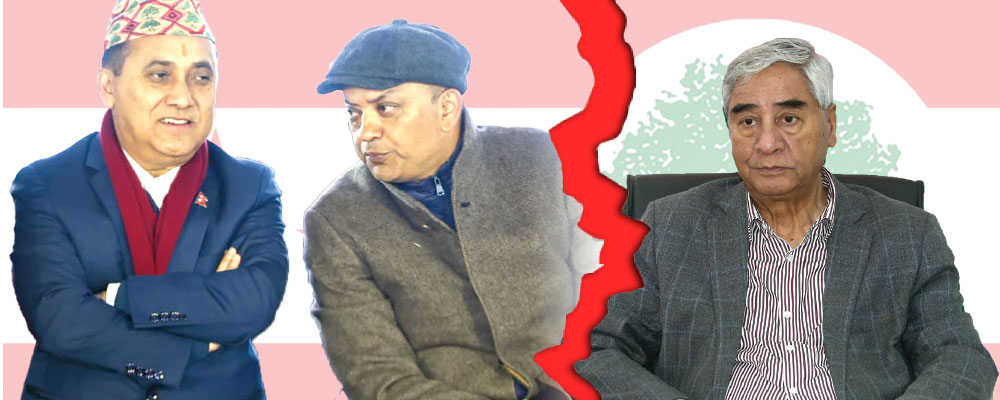

By A Staff Reporter,Kathmandu, Jan. 15: Nepal’s oldest democratic force, the Nepali Congress, has suffered yet another division after its central leadership expelled its two powerful sitting general secretaries--Gagan Kumar Thapa and Bishwo Prakash Sharma—and joint general secretary Farmullah Mansoor on Wednesday afternoon.
The decision of the party establishment to expel the three leaders without seeking any clarification from them has deepened a power struggle that is also likely to disrupt the country’s fast-approaching parliamentary elections.
The party’s Central Working Committee, on Wednesday, met in Sanepa under the chairmanship of Acting President Purna Bahadur Khadka took disciplinary action against General Secretaries Thapa and Sharma, along with Joint General Secretar Mansoor. The three leaders were expelled from party membership for five years on charges of violating the party statute and acting against organisational discipline. The main charge they were labelled was to organise the party's Special General Convention, demanded by 54 per cent of the General Convention Representatives.
The decision taken when the Special General Convention was still underway has effectively split the Nepali Congress into two rival camps, each claiming legitimacy.
Party leader Min Bishwakarma, talking to the press after the meeting, informed that the action was taken after the establishment faction concluded that the three office bearers had led and legitimized a so-called Special General Convention without authorisation from the Central Working Committee. The leadership accused them of advancing an alternative convention process, forming an election committee, publishing an election schedule, and even filing candidacies for top posts, all in defiance of earlier party decisions.
Despite the expulsions, the rival faction has pressed ahead with the special general convention at Bhrikutimandap in Kathmandu, which began on January 11. The gathering, attended by more than half of the party’s delegates, has already elected new leadership, with Gagan Thapa as party president, and Bishwaprakash Sharma and Pushpa Bhusal as vice presidents, and Pradip Paudel and Gururaj Ghimire as general secretaries. Supporters of the convention argue that decisions taken by a majority of delegates at the party’s highest body are automatically valid under the statute.
The establishment faction strongly disputes this claim, insisting that no Special General Convention was legally convened. It maintains that the party had already scheduled a regular general convention for May 11 and that any parallel process amounts to indiscipline. Following Wednesday’s meeting, the Deuba-aligned Central Working Committee wrote to the Election Commission, demanding action against the expelled leaders and asserting that the party remains intact under its authority.
Before expulsion, several rounds of meetings were held between the representatives of Thapa and Sharma and the establishment faction.
However, as the establishment rejected their proposal for a leadership change, the talks failed, culminating in the expulsion and the party split.
However, Thapa, Sharma and Mansoor, addressing the crowd in Bhrikutimanda said that the party has not yet been separated and the Special General Convention will choose the new central committee. They claimed that the party does not belong to anyone but Nepali people and Nepali congress cadres.
“This party has not split. This is the party. The Nepali Congress Party is currently in the process of its convention. This evening, the chapter of its convention will end. Whatever decision this convention makes, that decision will move the party forward,” said Thapa.
“You will return to your homes from here, to your villages. Everyone will ask you questions. Not a single person will bow their head when you say that you attended the Special General Convention,” he added.
Similarly, Sharma reminded everyone present that the special convention took place because of delegates and cadres. “Gagan Thapa and I are both determined to change the Congress and the country. The Special General Convention in accordance with the constitution has given the country the right vision, now it will give the right leadership,” he said.
The Special General Convention concluded late Wednesday night by electing Thapa as the new party president and Sharma as vice president. However, the names of other office bearers were not announced officially by the time this news story was filed.
The NC dispute has now landed at the Election Commission, which has confirmed receiving letters from both factions. More than 60 per cent of the convention delegates aligned with the Thapa–Sharma group have petitioned the Commission, seeking recognition of the new leadership. At the same time, the establishment camp has urged the Commission to reject the convention outright.
Commission officials say the issue is being examined urgently, given that direct nominations for House of Representatives elections are due to be registered within days. Although Thursday is a public holiday for Maghe Sankranti, the Commission has indicated it remains operational during the election period. Assistant spokesperson Sita Pun Shrestha said commissioners were meeting regularly and would take up the matter without delay.
Under existing law, the Commission may determine legitimacy either by assessing the majority in the central committee or by recognising changes endorsed through a lawful general convention. If a decision is delayed, election officials warn that nominations could be thrown into confusion, with rival Congress candidates filing papers in the same constituencies.
As the election calendar tightens, the Commission faces mounting pressure to resolve the Congress dispute swiftly. Whatever decision emerges, it is almost certain to be contested, potentially in the Supreme Court, ensuring that the fallout from the Congress split will reverberate well beyond the party itself.
This is the third split in NC. The party first split in 1953 due to a tussle between BP Koirala and Matrika Prasad Koirala. It was divided again in 2002, and Deuba formed Nepali Congress (Democratic), which he merged with the mother party in 2008. This time, too, Deuba chose to divide the party by taking action against the two general secretaries instead of quitting leadership as demanded by them.

-original-thumb.jpg)