- Saturday, 6 June 2026

Resolving Crisis Of Political Culture, Values

Politics espouses the law of realism, not rationalism and science. Politics unveils its ultimate motif, power lust rooted in human nature, not the civic means. The latter is a source of political culture. Still, the utility of politics is judged by democratic principles, values and outcomes for the people. Classical politics has offered a normative compass to produce good citizens for a good polity. The advisors of leaders provided light of truth, not fire and fury. Sages and Rishis were the roaming individuals of wisdom with humble simplicity, unbending austerity and plain life despite their superior rank over state leaders who followed their Archimedean insight, social philosophy and policy prescription.
They earned the trust of people for the adoration of their purely scholarly delight, faith to liberate them from the state of nature and the eternal torment seduced by the gleam of exclusive material modernity. As a result, leaders were self-aware of their vision of duties that sought to dispel people’s misgivings about their motives and actions and perfected their faultless performance. The functions of democratic leaders and institutions in Nepal are evaluated from the constitutional principles, their application in the personal lives of leaders, public authorities and people, and their ability to create a modicum of political stability and order. This elevates their ability to uplift the standards of the Nepalis through the distribution of public goods and essential services.
Technological rationality
Leaders exclusively motivated by ideology or technological rationality create the same kind of delusion in public life as both fail to capture the universal human impulses of politics— reputation, passion, emotion, feeling, purpose, ambition and aspiration. Democratic politics seeks to put a tab on these impulses with the cognitive and normative order of tradition, constitution, institutions and public interests. The modern genius of leaders, however, is saturated by information glut and emotion stepped in a phony intimacy with the state and people. It is vital to create a shield against the diffusion of personalised authoritarianism, factionalism and corruption like mushrooms during the rainy season, whose effects cannot be unseen in the electoral process.
The majority of political parties are preparing for the election of a new parliament, which may renew the legitimacy of governance. Election laws and codes can set a normative frame for fiscal expenses and conduct of leaders and cadres but it is hard to control them as the flow of money and clout follows a secret loop. Whether the leaders emerging from the electoral outcome can fertilise their nobility of mind and social conscience needed for building a common ground for all political forces for the resolution of complex national problems or only veer to a new political polarisation thus opening a new cycle of conflict, is less clear.
The imperative is not only to change leadership but also to make it value-based so that, like freedom, they can translate the egalitarian spirit of the constitutions attuned to the spirit of the age. The majority of ex-legislators are awaiting the verdict of the Supreme Court on a petition demanding the restoration of parliament. The CPN-UML has raised the question of security and an election-friendly milieu as 4,542 criminals who broke various jails during the youth revolt have yet to return and arms looted from police are far from fully recovered. It is opting for the removal of government through movement shows less fervent desire for the election and raises questions about the neutrality of some ministers who are already thronged in the partisan electoral fray, which the Prime Minister dislikes.
The history of Nepal’s political trajectory indicates that each political change was evocative of idealistic delusion, something unworthy of democratic leadership. The growing size of the critical mass of people wants to bridge mounting gaps among democratic theories, practices, powers, plenty and poverty. As all political parties - old and new - are increasing their clout by clubbing together whoever is available in a catch-all style. They revisit the same pattern of a syndicate regime without re-imagination of and commitment to a better future. Media judge their actions according to democratic values, not nature, style, promises and drive.
For ordinary Nepalis, elevating democratic values to a larger scale of abstraction without practical utility resembles an eternal hunt of a mediocre priest for Brahman, not easy to perceive and realize. Only an institutional culture of accountability can control their wild maneuver and redress the unfairness in social, gender and inter-generational equity. The proportional allocation of seats by leaders in the party list signifies not national social mosaic but reaps the constituency consolidation of powerful leaders. It robs the reason for its provision to include those social strata that are left behind, left out or stepped over. This marks the continuity of parochial political culture, which submits the minorities and marginalised in silence to a neo-feudal habit.
Patronage politics stabs the beauty of proportionality and torments the hope of those who believe that proportionality can democratise the social base of representation. Party conventions have only jolted the desire of leadership to maintain the status quo as they have continued the practice of negation of rivals, not promoting the democratic values of tolerance and housing of nonconformist voices. Organisations of political parties, civil society, media, business and people are the driving forces of politics where leaders are in a steering position. If they conform to moral laws, the constitution and the rules of the game, peaceful change cannot be far off.
The history of Nepal’s political change has not only awakened people about the transfer of power from one type of elites to the others but also exposed them to the values of freedom, justice, livelihood, patriotism, national sovereignty, democracy and dignity of life. It has also oriented people to return to themselves, their own norms, values and spirit of national independence. The Nepali constitution forms a compromise among powerful political parties but it is stripped of their ownership. It has imposed an undue burden on the state in its full execution, with basic reforms often echoed by them. But no one knows where, how and when to reform and anticipate its cost, which might open a Pandora’s Box of political uncertainty.
Ironically, continuing domination of Nepali political parties in the polity and the state has turned democracy flawed as leaders cobbled the axis of governance while stripping its splendor of constitutional constraints. Functional democracy is cramped by the evolution of an uncompetitive party system, ridden with deep cultic traits which have offered only personalities, not alternative policies and programmes. Weak parties without proper institutionalisation and democracy in internal life have fragmented electorates, implying a shaky polity that only promises but does not deliver what people urgently need to ease their lives.
As a result, the Nepali state has been unable to execute the rule of law in the entire society and enable constitutional bodies to act fairly, thus building the trust of people in authority. Trust is vital for political stability. But the constitutional ideal of equality collides with the condition of inequality and skewing the accessibility of freedoms and social peace to the poor. They are dictated by the law of necessity. Ordinary Nepalis in every change expected a better outcome without the corruption of public power.
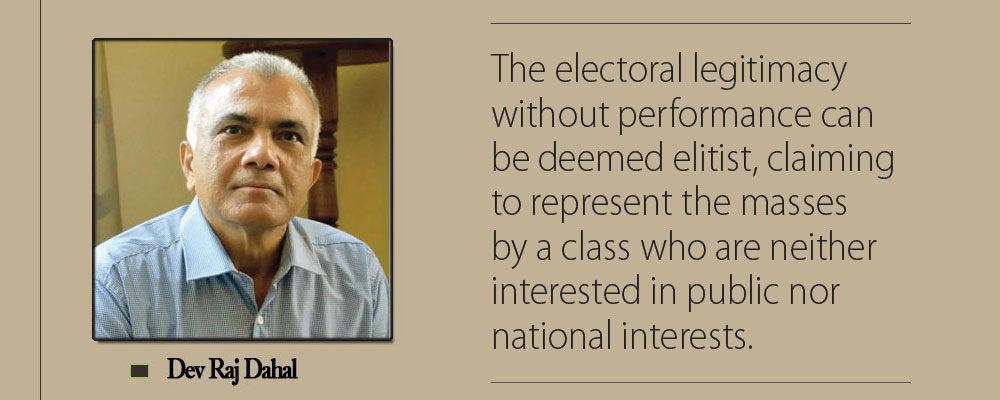
The electoral legitimacy without performance can be deemed elitist, claiming to represent the masses by a class who are neither interested in public nor national interests. It only enjoys the warmth of power, privilege and impunity. Popular sovereignty, communication revolution and human rights have stirred direct participation of people in the selection of leaders, policy deliberation and accountability of administration and finance. This will likely shift macro politics from hitherto top-down to bottom-up, from centralisation to decentralisation and control to self-rule.
There is a general value shift in society. In micro-politics, even ordinary Nepalis enthused by self-awareness espouses inner light of thought, feeling, belief, judgment and organize cooperative action. They are expecting to make politics value-oriented, not just changes in leadership with a political culture of hankering for power through negation, rhetoric and manipulation. The diversity of Nepalis has offered varied insights and formed political parties for collective action. This will certainly demand a change in behavioural and institutional culture where legitimacy is earned not only through charisma, ritualised election and heredity but through performance.
The formal forms of legitimacy have become an unsatisfactory ground for political stability in Nepal. The habit-driven politics based on privilege and profit has spiked the motivation of each to join politics and rise in power. Joining politics without qualifications and skills to serve the public has become a public misfortune, provoking youth revolt. A politics devoid of qualification requirements spurs a wild boom of political sects. This has forced top leaders to cluster together to regain political warmth and limit the leverage of rivals rather than becoming initiatory.
Untested leaders
Nepal’s political landscape now is dotted with many untested leaders. In the name of social inclusion, the nation is witnessing the high offices of the state filled with many ill-bred politicians devoid of the ability to craft policies and run statecraft. It has diluted the vigor of democracy to perform and even serve the poor. The cognitive ability is important for leadership to rise up to the critical challenges Nepal is facing. But it must represent the reality of the national circumstances rather than ideological pothole, social blindness or partisan lens.
This means pragmatic leaders with meritocratic orientation must not create walls with scholars, researchers and media but should build bridges with them so that they can receive creative inputs for building a normative and constitutional frame, explore alternatives and select the best ones for optimisation of decision making. Application of creative insight, values, inspiration and wisdom requires transcending disciplinary and partisan silos, thinking through the problems and seeking long-term solutions adaptable to changing circumstances. It requires the maturity of leaders and people. Will Durant rightly says, “Progress is the elimination of chaos by mind and purpose, of matter by form and will.”
(Former Reader at the Department of Political Science, TU, Dahal writes on political and social issues.)