- Saturday, 6 June 2026

Youth Empowerment For National Prosperity

Nepal has always been known as the queen of the Himalayas, the birthplace of the Light of Asia – Gautam Buddha – and the paradise on earth. And now we stand at one of the most decisive moments in the modern history of the country, with our greatest resource, the youth, slowly drifting away. Each year, many youths leave Nepal, seeking higher education, jobs, or bigger dreams they feel are unattainable at home. Urbanisation has emptied villages, and classrooms are filled with dreamers waiting to depart. Leaving Nepal is widely seen as a success. In spite of this exodus, some have decided not to leave and become part of the solution. They have chosen to stay, not because staying is easier.
It is now time for the youth to realise that Nepal’s future revolves around them and step up, not just as the beneficiaries of policies, but as partners in shaping them. We need to start visualising Nepal with a creative blend of our unique culture and our young energy into a model of development. The simple underlying principle is simple yet profound: youth are not the future of Nepal; they are the present. A systematic reform is a must across education, health, governance, entrepreneurship, and culture, where the youth are not just the consumers of those services but are architects and implementers.
Education beyond classrooms
It has been well established across the world that education is truly the greatest weapon to change the world, so when we talk about changes, education is the laid foundation. Students are to be prepared for life, not just for exams. Innovation and creativity are shadowed, and textbooks dominate learning. Education should never be limited to the classroom or textbooks. A transformation of the foundational education into a living ecosystem is the need of today, where our unique culture blends with the young energy, creating an impact in society.
Let’s imagine a centralised digital educational platform where educators across Nepal, from urban Chitwan, suburban Dang to rural Humla, are provided with real-time resources, from trainings and methodologies to lesson plans. Let us paint a picture where students across the country are not just taught Math and English, but also Sanskrit and vocational studies, ensuring our unique culture, tradition, and discipline are not lost in the name of modernisation. This is how education becomes empowerment. It will instill confidence in the youths and enable them to compete in the global arena without losing their identity.
A healthy nation is a wealthy nation. It is another fundamental prerequisite of development but our rural communities lack infrastructure, while urban communities have it as a privilege. A centralised national health system, through which citizens can reach out to the hospitals, clinics, insurance programmes, blood banks, and vaccination centers, can seek to bring an end to this imbalance. Health cannot be limited to just curing illness, but also ensures a healthy future for the country. When young people are healthy, the motivation to become productive, impactful, and the capacity to dream big become a reality.
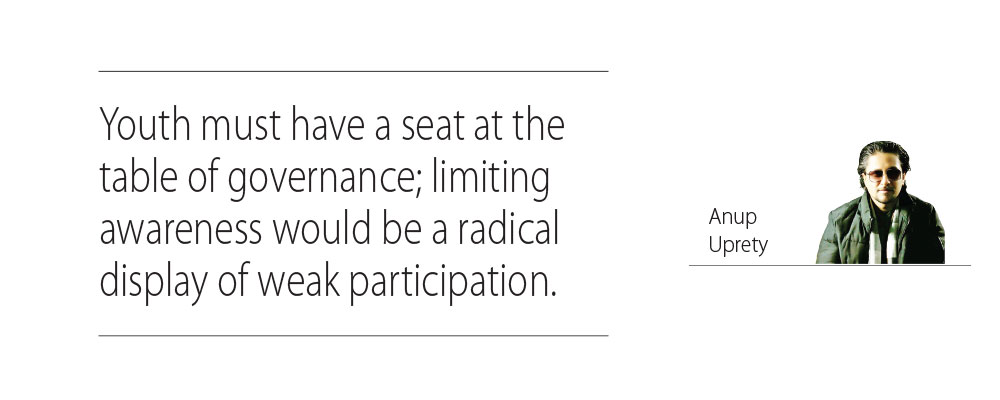
Democracy hasn’t yet matured in Nepal; thus has been an endless battle of power struggle. It is not politics but policymaking; it could be reframed not as a battlefield but as a tool for ensuring policies and their proper execution. Youths must be educated on how a country’s governance works. It is important to build trust between citizens and policymakers, where a citizen is a partner in governance and is not limited to a distant observer. Youth must have a seat at the table of governance; limiting awareness would be a radical display of weak participation.
Education, health, tourism, foreign affairs, where youth leaders research, learn, unlearn, recommend, and even monitor the formation to execution of policies. This does not undermine politicians but strengthens them as it strengthens the youths and the future policymakers. Leaders may not be able to study every nook and corner of this nation, but these similar networks of youths can. Providing data, information, insights, and pressure through the energy that the government lacks can turn out to be a crucial point where this partnership has the potential to transform the way of governance.
Building economy
The core of youth empowerment is economic opportunities. Without them, the negative synergy will cause even the finest policies to fail. Incubation centres in each province, with an emphasis on IT, agriculture, renewable energy, and tourism, would turn out to be the biggest investment. When youth are provided a favourable environment, seed funding, mentorship, and markets, they create opportunities not only for themselves but also create a wave of impact across the country. Similarly, Nepal can establish itself as a centre for nomads and a hub for IT outsourcing.
Our young people can serve international markets from within Nepal with training in AI, data science, and emerging technologies. Tourism, with the sky being the limit, can expand beyond trekking circuits and adventures, incorporating health, education, and agriculture tourism, and diversifying what Nepal has to offer to the world. Let us all visualise a Nepal where empowered youth take on leadership, shaping and representing Nepal at home and on the global stage. The path to a stronger Nepal begins with youth at its core.
(An MBA graduate, Uprety is the founder of Merosiksha)