- Sunday, 3 May 2026

Jayabageswari to return to its original beauty
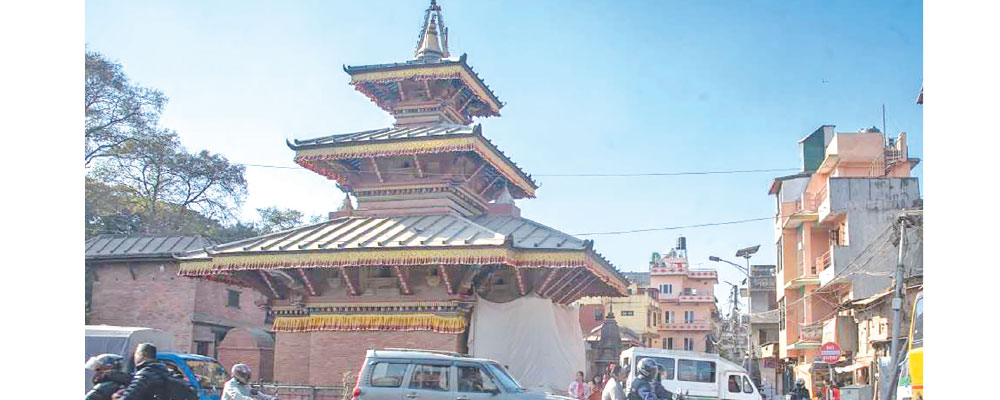

By A Staff Reporter,Kathmandu, Jan. 10: Kathmandu Metropolitan City’s Ward No. 8, Jayabageshwari area, is set to be restored to its original form, with 75 buildings undergoing renovation.
A contract worth Rs. 90.4 million has been signed after selecting a construction company through a bidding process. The estimated cost of the project is Rs. 109 million.
Under the project, the street-facing facades of houses on both sides of the 290-metre road from Jayabageshwari Temple to Setodhoka will be renovated and given a Malla or Rana-style appearance.
Ashaman Sangat, Chairperson of Ward No. 8 and Coordinator of Kathmandu Metropolitan City’s Heritage and Tourism Committee, said that in the Malla architectural style, elements such as the roof, cornice, balensi, pakha or pali, and thatched roofing are significant. He added that the bricks used on the house facades remain visible from the outside, and that traditional windows come in single, triple, and five-sided forms with uniquely carved buttresses.
He further said that a typical Malla-era house consists of four storeys with a roof, and that the project aims to reintroduce this style into modern structures.
Around 250 households are connected to this road section. The appearance of the house fronts visible from the road or open spaces is being modified, said Chairperson Sangat.
The road section contains structures of religious, cultural, and social importance, including the White Door (Tuyu Dhwakha), Dhokasingh Narsingh Phalcha, Tamreshwor Phalcha, Tamreshwor Mahadev Temple, a traditional well within the temple premises, Dhoka Che Phalcha, Bachchhaleswari Davali Phalcha, Gamti Mahadev Temple with idols, and another traditional well within the temple complex.
Other tangible heritage sites associated with devotion include Buddha Chaitya, Brahma Temple, Narasimha Temple, Navadurga Phalcha, Navadurga Dabali, Jayabageshwari Temple, Sundhara and others.
The Machati Jatra (Trishul Jatra) is a traditional festival observed in the area, along with religious sites such as the Dhanvantari Temple, Umamaheswar Temple, Shri Krishna Temple, Suryanarayan Temple, Indreshwar Mahadev Temple, traditional wells, Taleju Bhavani Temple, Ashtamatrika Temple, Nityanath Temple, Tupek Bhairav and Ganesh Temple, and Nirmeneshwar Mahadev Temple.
Festivals such as the Nava Durga Dance, the 12-yearly Harisiddhi Dance, Trishul Jatra, Bachchaleshwari Jatra, Shri Krishna Jatra, Gaijatra, Khadga Jatra, Ropai Jatra, Yalan Parva and Gunla Parva are celebrated in this area.
Rituals including Deshodwar Puja, Kumahamacha (Kumar and Kumari Puja) and the sowing of Satbij on Bala Chaturdashi begin from this locality. It is customary to bring religious and cultural activities conducted in the Pashupatinath region to this area.
Gwal De: was once a separate state of Kantipur, known for its tantric traditions and the symbolic use of the number nine in ancient times. The area comprises nine ponds, nine stone water spouts, nine wells, nine gates, nine Shaktipeeths, nine patipauwas, nine dawalis, nine toles and nine caste groups. There are also nine traditional Si Guthi Khals preserving the area’s antiquity.
These Guthis train the youth in playing traditional musical instruments, performing rituals and chanting Dafa Bhajans at the Phalcha.
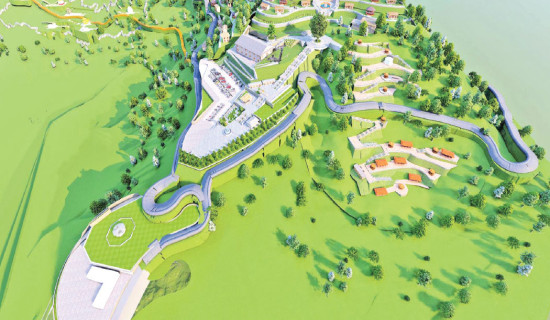
As a city dating back to the Lichchhavi era, the primary objective of the plan is to preserve its heritage and pass on its original form to future generations. As part of this effort, the ward is reconstructing Yapukhu (the “favourite pond”), spread over an area of approximately three ropanis.

-square-thumb.jpg)