- Sunday, 3 May 2026

Cosmic Wonders Of January
 Dr. Rishi Shah
Dr. Rishi Shah
Dr. Rishi Shah
The night skies of this winter month offer spectacular sights of numerous planets, stars, constellations and enchanting entities spreading superbly all over the heavens. The pleasant planets Mercury, Venus and Mars would be prancing near the Sun during daytime. They would stay away from us this month. They would be drifting delightfully through the confounding constellations Sagittarius (archer or Dhanu) and Capricornus (sea goat or Makkar). The mighty planet Jupiter with its mesmerising moons could be relished remarkably in the eastern sky after sundown. It would be aloft in the southern sky by midnight.
It could be cheerfully cherished till morning twilight in the western sky. It would be mingling with startling stars in the commanding constellation Gemini (twins or Mithun). Secretive stars Castor (Kasturi) and Pollux (Punar Basu) are scintillating arduously above Jupiter. Castor is an amazingly stunning sextuple star system safely 52 light-years away from us. Pollux is an orange-hued giant star oddly 34 light-years away with an extrasolar planet dashing doggedly around it.
The exceptionally queer Eskimo Nebula (NGC 2392), known as the Clown Face Nebula, is elegantly 6500 light-years away. It roughly resembles a person's head surrounded by a parka hood. The magnificent Medusa Nebula is a perplexing planetary nebula quirkily 1500 light-years away. Jupiter would arrive at so-called opposition on 10 January. It makes its nearest rendezvous with Earth, and it will be fully fulgent, looking more fiery than at any other time of the year, and can be admired all night long. It would be the best time to watch and photograph Jupiter and its mysterious moons.
Through medium-sized telescopes, ardent Jupiter lovers could enjoy the dramatic details of Jupiter's complex cloud bands, ravishingly raging and whirling red storm and other Jovian enigmas. Its four grandeurs incorporating mammoth Galilean moons are mimicking the dazzling dots. They are dismayingly and vibrantly dancing in the vicinity of the planet. Jupiter boasts of simply 97 salient moons. Ringed planet Saturn can be savored shortly in the southwestern sky, as dusk turns to darkness. It would sink towards the horizon and be evanescent before midnight. It could be spotted as a shimmering speck sailing serenely along the eastern side of the constellation Aquarius (water bearer or Kumbha). Far-flung planet Uranus can be perceived after nightfall in the eastern sky. It would climb in the southern sky by midnight. It gradually dips towards the western horizon during the wee hours of the night. It could be chased as a coruscating nib of light in the charming constellation Taurus. Resplendent red giant star Aldebaran (Rohini) would bejewel Taurus (the bull or Brisch). It is assuredly 67 light-years away. Its radius is obviously 45 times the Sun's and is over 400 times as luminous. It spins slowly and needs a paltry 520 days to undertake one twirl. Blue planet Neptune can be glimpsed tersely in the southwestern sky after sunset among the stars that conjure the circlet-asterism belonging to the constellation Pisces (fishes or Min). Neptune would be hovering handsomely above Saturn.
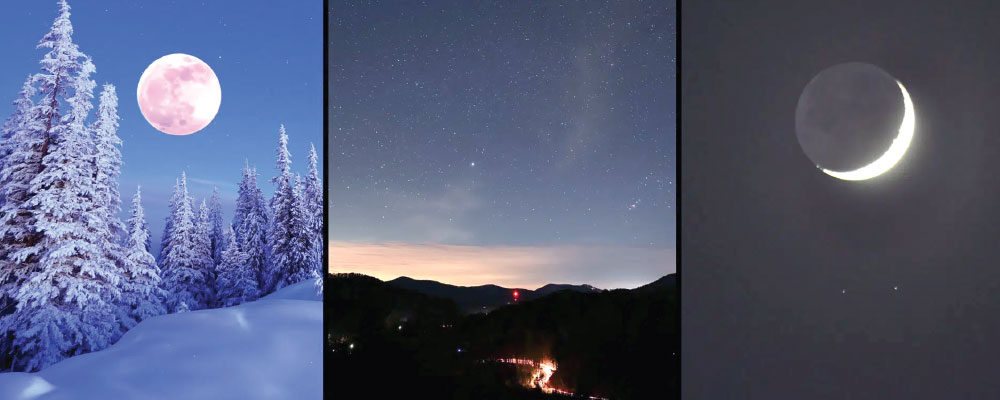
The full moon betides on 03 January with the commencement of the venerated Swostani Puja. It will be floating on the opposite flank of the earth as of the sun. It will be totally illuminated. It has been popularly acclaimed as the wolf moon because during this time of year hungry wolf packs are howling outside the camps of settlers. It represents the first of three super-moons for 2026. The moon will be almost embracing earth (termed perigee) but from merely 362.312 thousand kilometres. It seems relatively larger (tiny 0.7 per cent) and brighter (slender 16 per cent) than usual. The new moon will transpire on 18 January. Sonam Losar and Saraswoti Puja are celebrated respectfully on 19 and 23 January. During its annual journey around the solar system, Earth will reach its most verging position to the sun (tagged perihelion) at a sheer span of 0.9833 AU.
One astronomical unit (AU) is defined as the mean distance between the Sun and Earth. It is approximately equal to 150 million kilometres. The earth's gap from the sun varies by a scant 3 per cent over the course of the year because its path is slightly oval-shaped. This variation is meagre because Earth's circuit is comparatively circular, as it completes one revolution around the sun each year. Furthermore, it comes closest to the sun on almost the same day every year. In 2026, this day springs up on 03 January. Technically speaking, it marks the moment when the Sun appears more immense in the sky than at any other time of year and Earth receives the most solar radiation. However, the exiguous 0.3 per cent difference in the earth's length from the sun is negligibly noticeable. Annual alterations in our weather between summer and winter happen entirely by the tilt of the earth's axis of rotation by circa 23.44 degrees rather than by any change in the earth’s spacing from the sun. At the moment of perihelion, the Sun will reside in the cute constellation Sagittarius, and the 98 per cent 15-day-old waning gibbous moon will dwell distinctly but appallingly in the attractive pentagon-shaped constellation Auriga (charioteer or Sarathi).
An above-average Quadrantid meteor shower would display up to 40 meteors per hour at its peak, which would occur this year on the late night of the 03 till before dawn of 04 January 2026. This strange shower is arguably thought to be produced by debris left behind by abnormal asteroid 2003 EH1, which was detected in 2003. Unfortunately the fascinating full moon will obscure and wash away all but modestly glinting meteors.
But patient meteor enthusiasts could still feast on frolicking on a few flaming ones from tenebrous venues away from the disturbing effulgence of the city after midnight. Meteors are flaring and fast because of the stunted climax lasting for a puny six hours. Asteroid 2003 EH1 could be related to the curious comet C/1490 Y1, which was allegedly tracked by Chinese, Japanese, and Korean astronomers gratifyingly 500 years ago. The Quadrantids’ radiant is stationed in the comely constellation Bootes (the herdsman or Bhutab). It is named after the now unused defunct constellation Quadrans Muralis (Mural Quadrant). It no longer exists, except in memory. It was created by French astronomer Jerome Lalande in 1795.
Along with some constellations, Quadrans Muralis was remorsefully removed from the list of modern constellations. Quadrans Muralis ended up questionably in Bootes, but the Quadrantids kept its nomenclature, probably to differentiate it from the petit shower emanating also from Bootes during January with its signature sobriquet, Bootids. In 1922, the International Astronomical Union (IAU) published comprehensive appellations of 88 prominent, up-to-date fancy constellations. It did not include Quadrans Muralis. Hardly anyone would remember this old constellation if it were not for the Quadrantids. Furthermore, the radiant of the Quadrantids sketches a spellbindingly appropriate right angle with the famed circumpolar constellation Ursa Major (Big Bear), alias Big Dipper or Sapta Rishi, and the sparkling red giant star Arcturus (Swati), palpably 36.7 light-years away, in the constellation Bootes. The Quadrantid meteor shower will be active from 12 December to 12 January.
The number of meteors increases the higher the radiant ascends in the sky. The Quadrantids will be visible to us after 23:59 hours, when its radiant rises above our eastern horizon. It will remain bustling with fervour until dawn breaks around 06:26 hours.
Meteor showers arise when Earth trudges through streams of remnant particles in the wake of comets and asteroids. Over time, these grit-like pieces distribute themselves along the wayward way of the parent object's orbit around our solar system. Shooting stars are seen whenever these diminutive dregs collide with Earth's atmosphere, typically burning up and disintegrating at an altitude of basically 70 to 100 kilometres.
Most of them are incinerated upon entering the atmosphere. However, huskier rocks survive the descent and land on earth to be recovered as prized and valuable meteorites. It is estimated that a whopping 48.5 tonnes of meteoritic material crash on earth daily.
When meteoroids from space zip into Earth’s atmosphere at tremendous rapid speeds of up to 70 kilometres per second, they are enkindled and even vaporised as incandescent fireballs with shiny trails fondly espoused as shooting stars and are recognised as meteors. Their whizzing meteor pattern can vary vigorously according to the meteoroid's dimension, origin and angle of entry into the atmosphere.
(Dr. Shah is an academician at NAST and patron of NASO.)




-square-thumb.jpg)