- Sunday, 3 May 2026

Rules-based Order In Tatters

Powerful countries do not often clash with their rivals on the real battlefield; instead, they send a message of their dominance through unexpected theatrical acts. The United States did just that when it mounted a military raid on Caracas, capital of Venezuela, on early Saturday and whisked away Nicolas Maduro and his wife to New York to make them face the charge of running drug cartels against America. As expected, the US act is now facing global condemnation as a blatant violation of international law and the Charter of the United Nations. China denounced the raid as the "law of the jungle," but Fox News analyst Will Cain swiftly refuted, saying," So be it, we are the lions.
The US government has defended its military action by claiming that Nicolas Madhuro was running a cartel which was responsible for the illegal supply of cocaine and fentanyl into the USA, a charge which the Venezuelan government has vehemently denied. Statistics on drug production and trafficking show that Venezuela does not figure on the list of countries significantly producing and smuggling illicit drugs. Columbia, Bolivia, Mexico and Peru produce and sell more narcotics than Venezuela, which is only a transit country with 24 per cent per cent of drugs passing through its territory.
Usurping resources
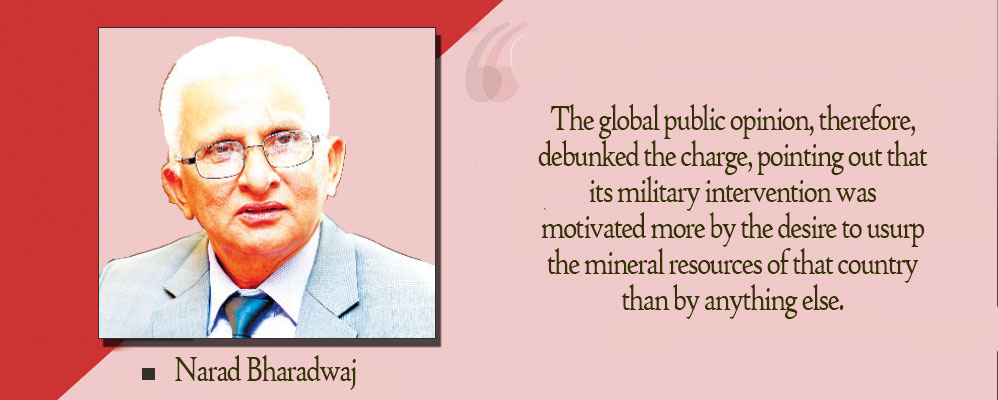
The global public opinion, therefore, debunked the charge, pointing out that its military intervention was motivated more by the desire to usurp the mineral resources of that country than by anything else. Venezuela is endowed with one of the largest reserves of petroleum and a sizeable deposit of gold, diamonds and other rare earth materials. This has been made clear by President Trump himself. Immediately after the raid, he said that the US was set up to run Venezuela and it was free to extract and sell Venezuelan fossil fuel for enriching America.
Israel and some pro-Latin American countries are glorifying the US for attacking and capturing Madhuro, citing it as evidence of unchallenged America's military superiority while raising questions about the capacity of China and Russia to provide defense capacity to their allies in Latin America. However, the unilateral military action of the USA can never be legitimised, as is seen from the fact that it has drawn more condemnation than kudos from different countries and institutions. The Secretary General of the UN, Antonio Guterres, has expressed deep concern at the incident, saying that this act "sets a dangerous precedent". Similarly, the UN Human Rights Office has also categorically denounced it as a violation of international law.
Russia has reacted to the US military action against Venezuela as a "blatant neo-colonial threat and foreign armed aggression. Russian Foreign Minister Sergey Lavrov said that "Venezuela must be guaranteed the right to determine its own destiny without any destructive external interference. China has condemned the US military action as "illegal and hegemonic, demanding the immediate release of Maduro and his wife. Strangely, however, the EU countries and India unusually soft-paddled their response to the US military operation. The EU called for exercising restraint and to show respect for international law, while India expressed its concern about the incident and wished for the well-being and safety of the Venezuelan people.
In fact, the unilateral military action of the US against Venezuela not only further intensified multipolar rivalry among great global powers, but it is likely to polarise the countries in South America into camps, as is already seen. Argentina, Peru, Ecuador, and Paraguay have supported the USA, while the rest of the countries have either stayed neutral or have openly supported Venezuela, which has been taking a firm stand against foreign domination. It is one of the countries that was freed from Spanish colonialism under the leadership of Simon Bolivar in the 19th century. It is from his name that this country is also referred to as the "Bolivarian Republic".
The USA-Venezuela conflict has not erupted suddenly. What happened on Saturday night was only the culmination of differences simmering between the two countries from the time of Hugo Chavez, the predecessor of Maduro. Madhuro had come to power through a controversial election after Hugo Chavez died in 1013. He angered the US by continuing his predecessor's policy of nationalizing oil industries and resisting US sanctions by selling oil to China, Iran and Russia. The USA tried to bring about regime change in 1919 by using Venezuela's National Assembly Chairman, Juan Guaido, who declared himself president and obtained recognition from the USA and many other European countries.
Regime change attempts
However, this project failed as Guaido did not have enough domestic support despite massive external backing. When every covert operation for regime change failed, the US government took the path of direct military intervention. With the use of overbearing power against Venezuela, the USA has signaled that it cannot and will not accept the challenge of the competing global powers lying down, let alone condoning their involvement in the management of commerce and security affairs of the South American continent, which it considers its backyard.
President Trump has already invoked Munroe Doctrine, a 19th century colonial rule book, to defend its dominant role in the Southern Hemisphere. However, in the 21st century, when countries, irrespective of size and strength, want to reassert their sovereignty and exercise their right to self-determination, whether invoking an obsolete colonial doctrine or the use of overbearing power is a viable way out, is altogether a different matter.
(Dr. Bharadwaj is a former ambassador and former chairperson of Gorkhapatra Corporation. bharadwajnarad@gmail.com.)


-square-thumb.jpg)