- Thursday, 14 May 2026

Collective Fight Ends Gender Inequality

One of my college students asked me, out of the blue, 'Ma'am, does patriarchy still exist in Nepal?' I thought she was simply curious about the issue, so I responded in a normal tone, 'Yes, of course! You'll find a lot of examples of this if you observe our society closely.' Then she opened up about how she was discriminated against by her employers in her workplace, only based on her gender. Her story made me think about the issues of gender balance or gender equity. Luckily, she is a strong-headed girl, so she fought for her rights and raised her voice high to teach a lesson to those handful of biased people. Unfortunately, not all Nepali women may not have the guts like my student to stand for themselves or speak up when they experience gender differences.
We find gender equity only on paper but in reality, there is still a practice of male chauvinism in most of the cases in Nepal. Since historically, culturally and socially, Nepal has been a patriarchal society, it seems to be very hard to maintain gender balance. Apart from in some exceptional situations, people have a deep-rooted belief system that men are superior to women in every sphere of life, and this belief will not go away easily. Some examples of discrimination between girls and boys include chhaupadi, dowry system, rape, property rights, domestic roles, gender-based violence, citizenship hurdles, limited political representation, limited economic participation, workplace harassment and many more.
Constructed differences
Although the law has protected women's rights, the implementation side has not been working effectively. A research study, conducted by Pranab Dahal, Sunil Kumar Joshi and Katarina Swahnberg in 2022, also confirms gender inequality in Nepal. Their findings suggest that the subjugation of women occurs due to practices based on gender differences, constricted life opportunities, and internalisation of constructed differences among women. They have developed a concept of power-play, which is identified as a cause and consequence of women's subordination and violence. This means that the ultimate power needed to run the Nepali society is still in the hands of men.
Women have been struggling to share that power for a long time; for this, they have even sacrificed their lives. Yogmaya Neupane (1867 - 1941 AD) is a great example who is considered Nepal's first revolutionary woman. Yogmaya was a spiritual leader and social reformer who ended her life along with 68 of her followers in protest against the social conditions of her time by jumping into the wild floods of the river Arun. Her protest was directed against the social practices that had been highly divided along gender and caste hierarchies.
Nepali women, at different times, have pushed for changes around them, winning small battles, one at a time but they have not succeeded yet. Currently, there are many women, such as Anuradha Koirala, Bandana Rana, Uma Devi Badi, Durga Sob and others who are working tirelessly in the field of gender equality.
While I was reading an essay by Bonnie Smith-Yackel, I just thought about women in our society. In her narrative essay, 'My Mother Never Worked,' Bonnie, an American author, has depicted her homemaker mother's picture very beautifully. The writer wants to make her readers aware of how a society devalues unpaid household chores and farm work. Her mother, who devoted all her life to taking care of the house, raising her children and doing difficult farm work, was sadly deprived of Social Security benefits. According to federal law, only those workers are entitled to such benefits who have a paid job.
Although the author tries her best to convince the Social Security officer by saying that her mother worked harder throughout her life than anybody else, so she must have got death benefit, the officer does not budge. Instead, she responds, 'Well, that's right. Your mother didn't work, you know.' This response breaks a reader's heart. In the same vein, another American writer, Sandra Cisneros, has written an essay 'Only Daughter'. In this essay, she has shown how difficult it is to be a daughter in a Mexican family where there are already six sons. Her brothers did not want to play with her in public because she was a girl, so Sandra was isolated throughout her childhood.
Her father used to believe that she was going to be someone's wife. She recalls how h e thought college was good for girls to find a husband but not to gain knowledge or education. However, Sandra was determined to make her father understand that his daughter is a writer; she worked hard to make him proud but he did not seem to value her. She writes, '...Everything I have ever written has been for him, to win his approval even though I know my father cannot read English words.'
Women's struggles
I am using these essays to make a point that not only Nepali women are struggling to get recognised but women around the world are also facing the same problem. There are different movements in world history to secure women's rights or gender equality. For instance, the Women's Suffrage Movement (also known as the first-wave feminist movement), second-wave feminism, third-wave and networked feminism. The UN is also working in the same direction.
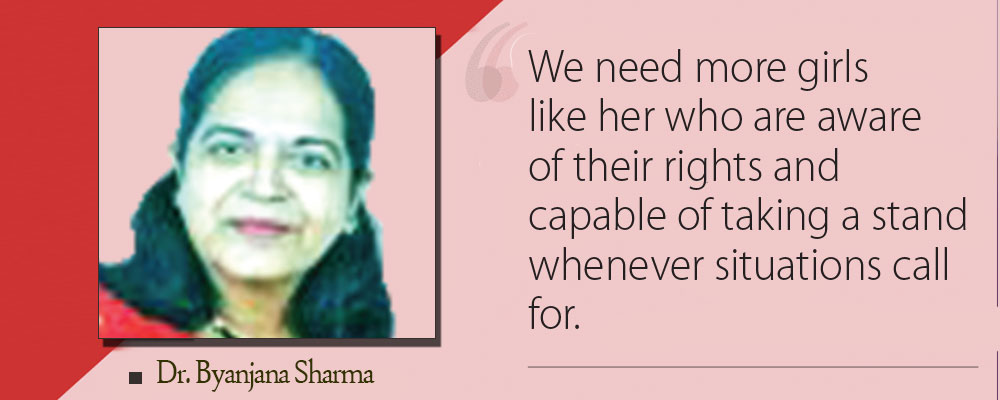
An Asian Development Bank report highlights that Nepal has taken progressive steps toward greater gender equality throughout the past five decades of planned development. Important legal amendments have been made to strengthen women’s rights in key areas such as citizenship, inheritance, and anti-trafficking. Yet, there is gender-based discrimination in all walks of life. So, we must fight against this problem collectively. Thanks to my student who stood up for herself and fought against gender-based discrimination at her workplace. We need more girls like her who are aware of their rights and capable of taking a stand whenever situations call for.
(The author is the director of Vidya Shilpa Academy, Damak, Jhapa.)