- Sunday, 3 May 2026

Women candidates sidelined in Karnali
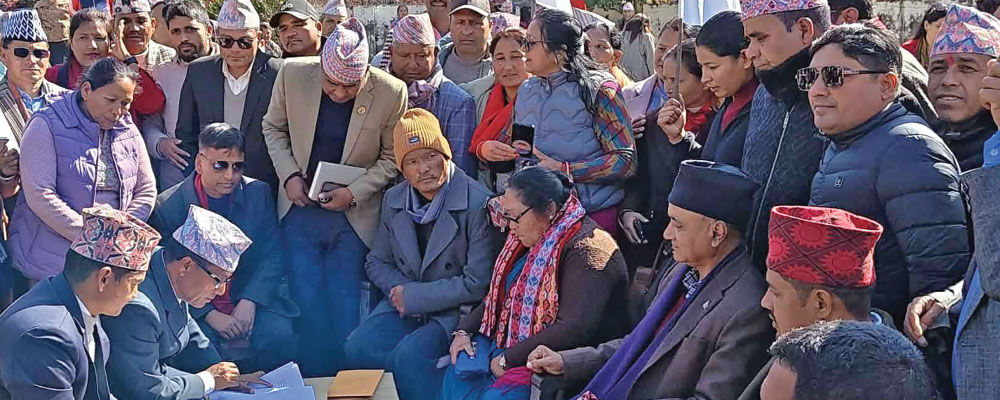

By Rajani Yogi,Surkhet, Jan. 8: Major political parties in Nepal’s Karnali Province have once again sidelined women in the process of selecting candidates for the forthcoming parliamentary elections. It has highlighted disparities in women's participation in electoral representation.
With the House of Representatives elections set for March 5, party district committees are currently recommending potential candidates for various constituencies.
Yet, a review of the lists submitted so far shows that female aspirants have been largely ignored in the first-past-the-post electoral category.
The CPN-UML has forwarded only male names from both constituencies in Surkhet district.
Dhruba Kumar Shahi has been recommended unopposed from Constituency-1, while Kulmani Devkota is the sole nominee from Constituency-2. This leaves no room for women, even at the preliminary stage of the electoral process.
Likewise, the Nepali Congress has fared little better. Acting president of NC, Purna Bahadur Khadka, has been recommended as the only candidate from Constituency-1, while in Constituency-2, the party forwarded six names, including just one woman, Basanti Basnet GC, alongside five male leaders.
The Nepali Communist Party (NCP) has also advanced exclusively male candidates for both constituencies of Surkhet, recommending Jit Bahadur Rana and Jhakka Bahadur Malla. When single names were recommended for both positions, female aspirants failed to make it onto the recommendation list.
Similar patterns have been witnessed across the province. In Dailekh Constituency-2, UML held internal elections to choose its direct candidate, but all four contenders were men. Bishnu Rijal secured the highest votes and was recommended accordingly.
Women leaders have criticised the process as deeply discriminatory. Padma Khadka, UML central committee member, accused party leadership of maintaining male dominance and deliberately blocking women from advancing.
“Even capable and qualified women are denied tickets on various pretexts,” she said.
Janaki Singh, a central member of the Nepali Congress, acknowledged that women receive fewer opportunities despite their competence.
She pointed out that the legally mandated 33 per cent inclusion rule has forced parties to recommend women in some areas, but added that this requirement applies only to the proportional representation system.
Unless parties change course, Karnali Province is likely to witness zero women candidates contesting direct parliamentary seats in the upcoming election, a scenario that threatens to undermine Nepal’s broader commitments to gender equality in political leadership.

-square-thumb.jpg)