- Tuesday, 9 June 2026

People Prefer Delivery To Rhetoric

Delivery, not popular rhetoric, has caught the imagination of the public worldwide. Nepal is not an exception to it. Nepali people have enough of the promises and pledges pronounced by political leaders elected by them time and again. But as the pledges made to them have not been implemented or realised, people are disenchanted and frustrated with the situation. The Gen Z movement illustrates the burst of popular frustration in Nepal. Delivery, in fact, makes more sense to the people than the outpouring of pledges. When democracies fail to deliver, people tend to nurse grudges against the leaders and political establishment.
When the world was hit by the COVID-19 pandemic almost six years ago, many Asian countries, such as China, Singapore, and the Republic of Korea, were found to be relatively more effective than the western democratic countries in responding to the global crisis. This provoked a broader discussion on the relatively sluggish performance of Western democracies in fixing the problem and delivering as compared to the Asian countries. China was reported to have constructed a 10,000-bed hospital within a fortnight to tackle the crisis, whereas the US lost a larger number of people allegedly due to a tardy response to the issue.
Frustration with democracy
There is growing concern over the fact that Western democracies are underperforming relative to some non-Western countries like China, Qatar, Dubai, Singapore, especially in the provision of large-scale public goods, such as infrastructure and the capacity to deliver economic growth, reduce poverty, and unemployment. The Pew Research Centre – a well-known US fact tank – published survey data the other day that global dissatisfaction and frustration with democracy is connected to poor performance in economic delivery and development.
The survey results show that the citizens' confidence in government is low in established democracies such as France, Germany, the US, and the UK. But it is stronger in the so-called authoritarian countries, such as China, Saudi Arabia, Singapore, and the United Arab Emirates. Various empirical studies have connected service delivery and economic performance to winning the hearts and minds of citizens across different types of regimes. Studies show that the societies with the most political trust also have some of the highest GDP growth rates, including countries such as China, Qatar, Rwanda, and Vietnam. Those with the least political trust include democracies such as Greece, Italy, Japan, and Spain.
Delivery and development are important conditions for democratic legitimacy and popular satisfaction. Francis Fukuyama, a world-renowned political analyst, in an article published in the Journal of Democracy not very long ago, argues that legitimacy requires that government uphold its side of its implicit contract with citizens through delivery of the provision of goods and services, fair processes in policy determination and implementation and a demonstrable administrative capacity. However, public-service delivery is not the only way that governments can build trust among their citizens; they should also be honest and dedicated.
Government policy decisions can have large, tangible, and direct impacts on individual livelihoods. So when poor economic management leads to major crises, the public often loses faith in political leaders and the political system as a whole. Oftentimes, it has manifested into widespread protest, unrest, and outbursts. Larry Diamond – a famous democracy expert – stated that a long record of effective performance in delivering economic growth and opportunity, reducing poverty and inequality, providing social services, and controlling corruption alone can make a political system legitimate and trustworthy."
The government needs to perform to inspire hope and optimism in the people to earn legitimacy. When a government makes tall promises but fails to deliver to address the basic minimum aspirations of the people, popular disappointments and disenchantments are bound to grow and burst on the streets. The transformative promise of federal governance embodied in the constitution appears more or less overlooked and neglected in Nepal. Not only at the federal level, but also at the sub-national level, have political functionaries gone overboard to serve their own vested interests.
Poor performance
Not only poor performance at the federal level, but also local villages in the far-off districts in different provinces have been allowed to suffer and languish in deprivation due to highhandedness and parochial interests of the dominant local politicians who work in collusion with local contractors. In a report published not very long ago, it is said that road building caused the destruction of a host of local environments and fragile ecosystems. As a result, the rural livelihood system has been badly impacted. Hundreds of families are thus left to fend for themselves because of destructive and unsustainable road-building practices clamped down in the villages without regard to the natural drainage pattern and ecosystem.
The badly planned construction works have been unleashed by federal, provincial, and local agencies to consume the available resources without giving consideration to the quality and sustainability of the projects. This interim government led by Sushila Karki should be aware of the pitfalls and shortcomings seen in the performance and delivery at all levels over the years through course correction measures and infuse new hope and inspiration among people who are now feeling duped by the political leaders and government officials bent on making tall promises but failing to deliver.
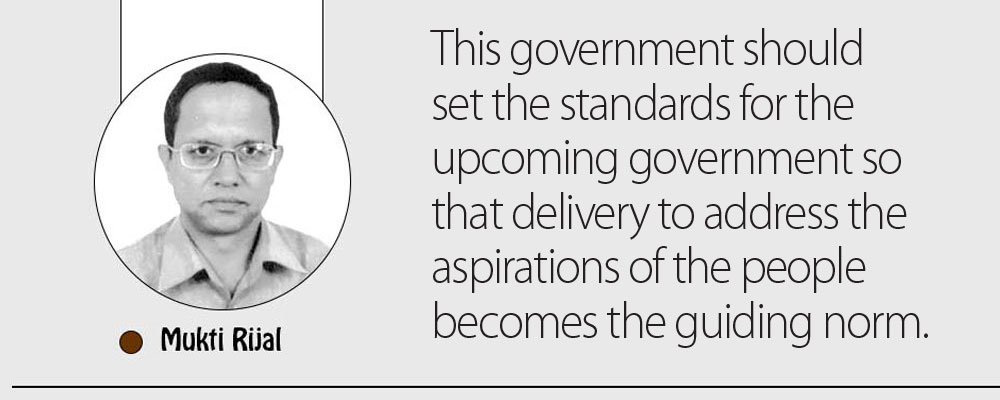
This government should set the standards for the upcoming government so that delivery to address the aspirations of the people becomes the guiding norm. This alone can ensure the legitimacy of the democratic system. Given the current state of affairs, characterised by growing civic fury and frustration, the government is expected to carry out the actions that meet the needs and aspirations of the ordinary masses.
(The author is presently associated with Policy Research Institute (PRI) as a senior research fellow. rijalmukti@gmail.com)