- Monday, 8 June 2026

Commercial Bank Discipline Key To Reform

Economic systems persist through necessity. While growth appears and disappears, function is the only thing that endures. When function weakens, activity may continue while relevance thins. This distinction matters when evaluating financial reforms framed as pro-investment. Some reforms stimulate activity without restoring function, others appear procedural on the surface, yet correct structural misalignments that determine long-term persistence.
The recent foreign investment reform introduced by the Nepal Rastra Bank (NRB) belongs to this latter category of structural adjustment rather than stimulus. Their significance lies in how they alter system behaviour, not in the volume of activity they immediately generate. The reform brought by Dr. Bishwo Poudel-led NRB is comparable to the institutional shift undertaken by Dr. Raghuram Rajan-led Reserve Bank of India, where credibility is rebuilt not by loosening control, but by relocating it from discretion to rule-bound execution. NRB is signalling a similar maturity: control preserved, precision improved.
Foreign capital flows
The reforms modify the execution of foreign capital flows. Profits, dividends, sale proceeds, liquidation residuals, royalties, and lease payments are not repatriated through licensed commercial banks under existing foreign exchange (FX) rules. Documentation thresholds have been recalibrated. Audit requirements for smaller transactions have been eased. Limited outward investment, particularly for IT firms, has been permitted within defined bounds. These changes leave the capital-control framework intact but change how that framework is applied.
Individually, each measure appears narrow. Collectively, they address a structural asymmetry that shaped capital behaviour in Nepal. For the longest period, investment policy emphasised entry. Capital was encouraged to arrive, but the realisation mechanics remained concentrated at the centre. Repatriation required discrete validation, share transfers triggered reviews, smaller transactions carried procedural weight disproportionate to their economic scale, and outward investment remained operationally exceptional. While these features did not block activity, they increased the institutional cost of circulation.
Nepal operates within a constrained capital regime defined by FX scarcity, a currency peg, and high compliance sensitivity. Within such regimes, capital governance is evaluated by durability. Centralised validation emerged as a stabilising mechanism under those conditions, concentrating risk control at the system’s core. Over time, that concentration increased the execution burden of routine flows. Institutional effort expanded faster than the marginal risk being managed. Friction accumulated at points where transactions were bounded, intermediated, and repetitive.
The reform recalibrates the location of control. Authority shifts from transaction-level pre-approval to supervised intermediation. Risk remains contained at the system level. Execution moves to institutions already subject to prudential oversight. This reallocation matters because controlled economies depend on precision. Control must scale with materiality. When applied uniformly, it weakens throughput and supervision.
The reform also carries a signalling function. Foreign capital evaluates regimes through internal coherence. In capital control systems, credibility derives from rule-bound execution. Bank-mediated repatriation establishes a stable procedural boundary, which allows the system to be modelled as constrained and intelligible. Ambiguity at realisation increases volatility premiums and raises the cost of capital. Reducing ambiguity improves investability without relaxing constraints.
The fragility of this reform will now be its execution quality. The fault lines are now shifted to commercial banks as they assume responsibility for applying rules consistently under supervision. Under a supervised intermediation regime, commercial banks are now custodians of system credibility. This role carries non-negotiable minimum standards. Transactions must be processed “rule by rule,” not “relationship by relationship. Decisions must be defensible ex post; however, the burden of bureaucracy should only be as imagined by the policy. Anti-Money Laundering (AML) and FX controls must be enforced across clients, transaction sizes, and counterparties. The central pillar of the reform is the commercial bank’s professional execution.
The fault lines are clear. Over-compliance slows legitimate circulation and pushes activity towards informality; under-compliance creates leak paths that weaken the reform, attract regulatory retaliation, and collapse trust. Selective enforcement will introduce moral hazard and reputational damage that the central bank won't be able to offset. Political influence, rent seeking, or procedural arbitrage at the bank level will force control banks to the centre, this time under greater scepticism and tighter constraints. In a controlled economy, delegated authority only survives when intermediaries prove that they can be clean, precise and institutionally reliable. This reform will only endure if Nepali commercial banks are up for the task of meeting the standards. It will reverse if they do not.
Master stroke
This reform represents a master stroke by NRB in terms of institutional design. It preserves macro discipline, strengthens control, and restores functional circulation within Nepal’s constrained economic reality. If executed as intended, its benefits will compound quietly across investment behaviour, institutional credibility, and system resilience. The failure condition is narrow but well defined. It does not lie with policy intent or regulatory design. It lies with the intermediary conduct and professionalism of the commercial banks.
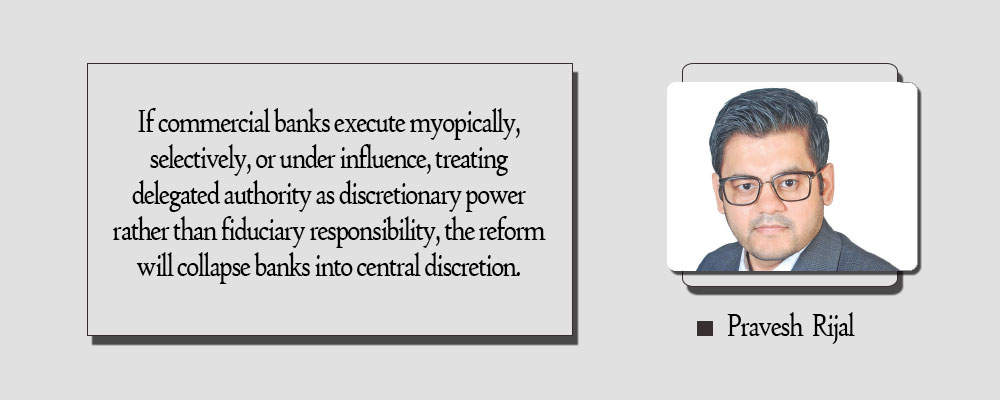
If commercial banks execute myopically, selectively, or under influence, treating delegated authority as discretionary power rather than fiduciary responsibility, the reform will collapse banks into central discretion, this time with reduced trust, higher constraint, and Nepal as a whole will pay a high price. Nepal as a country gains materially if banks act cleanly, professionally, and rule-bound. It loses credibility if its banks don’t. We finally have a central regulator that has trusted the integrity and professionalism of the banks wholeheartedly. It is now up to the banks to do justice to that trust. The outcome of this policy squarely rests with execution – no pressure!
(Pravesh Rijal is a New York-based global banking executive with deep expertise in finance and capital markets.)

-square-thumb.jpg)