- Sunday, 3 May 2026

Poet Gauchan's statue unveiled in Lumle
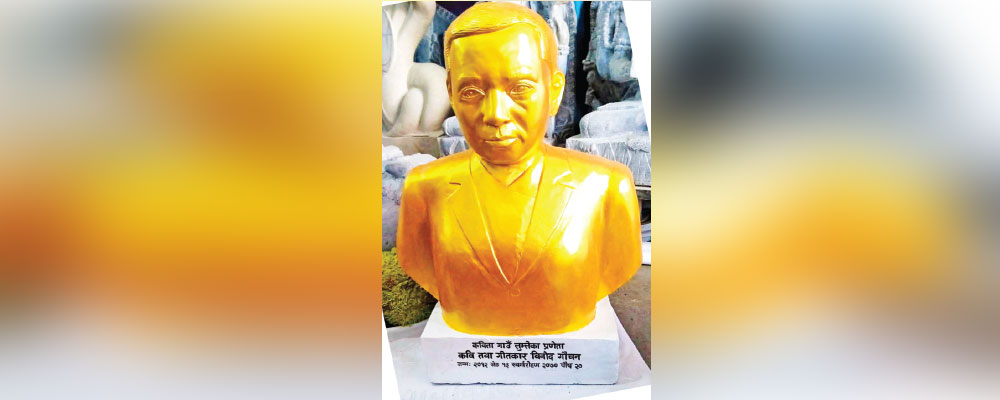
Photo: RSS The statue of poet Vinod Gauchan.

By Phadindra Adhikari,Lekhnath, Jan. 4: Lumle in Kaski has established itself with a distinct reputation as 'Kabita Gaun', meaning poetry village. A part of Annapurna Rural Municipality–6 was declared a 'Poetry Village' on March 28, 2009, under the leadership of poet and lyricist Binod Gauchan.
A statue of noted poet and lyricist Gauchan is set to be unveiled at Lumle in Kaski district on the occasion of his memorial day on Sunday. According to Bharat Devkota, chairperson of Lumle, around Rs 1.3 million has been spent so far on infrastructure development, including a poetry park.
Social worker Chin Bahadur KC donated the land for the park, while Rs 1.2 million was raised for park development through the initiative of social worker Bishwo Mohan Gauchan.
“We plan to build a park, a multipurpose building and a library here,” Devkota said, adding that the aim is to develop Lumle into a must-visit literary and tourism destination.Ward chairperson Eak Dev Devkota of Annapurna Rural Municipality–6 said the local government has been working closely to support infrastructure development and literary activities at the Poetry Village.
“It is important to establish this place as a centre to pass on culture and values to future generations,” he said.Although Pokhara and its surrounding areas are rich in natural beauty, Gauchan once titled his poetry collection, “Pokhara ma Phool Fuldaina”, (Flowers Do Not Bloom in Pokhara). Literary critic Asaphal Gautam said the title should be understood symbolically. “Although Gauchan had a home in the city, he preferred village life. The title reflects his view of urban life as hollow,” Gautam explained.
Born on May 27, 1955, Gauchan also published another poetry collection titled ‘Dhungesanghuko Melama’. Writer Usha Sherchan, who knew Gauchan closely, remembers him as an introverted and deeply thoughtful poet.
“He once quietly sent one of my poems to Gorkhapatra without telling me. I only found out when it was published,” she recalled, adding that despite his reserved nature, Gauchan was practical and generous.
Gauchan gained widespread recognition at the age of 23 with the song “Jati Maya Laaye Pani”, which helped establish singer Arun Thapa’s identity.
He wrote several popular songs, including 'Tagaroma Rumal Rakhi Bato Chhekyau Timile' and 'Kasto Thaunma Phulyau Timi Tipnai Gahro Bho.'During his 58-year life, more than a dozen of his songs were recorded. Musician Sunil Thapa, who composed music for several of Gauchan’s songs, said some of his works remain unreleased.
“I completed the tune for the refrain and one verse of 'Annapurna Himalmuni Gangapurna Taal', but he passed away before the rest could be done.
His sister Basanti Lalchan and I later completed it,” Thapa said, describing Gauchan’s writing as simple in words yet profound in emotion.A leading figure of the Conservation Poetry Movement, Gauchan often travelled to villages around Pokhara, including Dhampus, Ghandruk and Panchase, drawing imagery from rural life for his poems and songs.
His song, inspired by a Gurung cultural practice from Panchase, became widely popular after being sung by Kandara Band’s Bibek Shrestha. Twelve years after his death, Gauchan continues to be remembered for his lasting contribution to Nepali literature and music.
On his memorial day, a bust-sized statue carved from Kali Gandaki stone for Rs. 180,000 will be unveiled near the Poetry Village, honouring his legacy.