- Friday, 5 June 2026

Civil Service As Shock Absorber

Political scholars and academicians opine that Nepal is a country living in a state of constant political instability. The reason for this is the frequent changes of government since 1990. Nepal witnessed approximately 36 changes of government with 15 different political leaders serving as prime ministers during 1990-2024. No elected government has governed the country for a full term of five years. Unlike elected governments, which come and go with remarkable frequency, the bureaucracy, as an institution of selected individuals on a merit basis and known as the permanent government, bears all types of responsibilities underlined by the Constitution and domestic laws.
Nepal has experienced many devastations and disruptions due to natural disasters such as earthquakes and the COVID-19 pandemic, as well as a decade-long Maoist conflict, violent protests, economic blockades, and geopolitical pressures, which have shaken the roots of economic development and societal values. Under such circumstances, the bureaucracy has been the only institution capable of managing these challenges adroitly in a quieter manner. Beneath the impinging smoke of political ups and downs, civil servants have functioned effectively, but have been considered the most underrated shock absorbers.
Presence of government
During the Maoist insurgency period, civil servants working in Maoist influenced areas demonstrated the presence of the government despite risking their lives. At that time, the presence of political parties in the conflict-ridden districts had almost disappeared. Civil servants – whether from administrative or security services – demonstrated their adroit ability by turning tense situations into productive conclusions. Thousands of administrative and security personnel were killed but they never abandoned their duties. Even in times of disaster, the bureaucracy was the organisation that handled the situation effectively and efficiently, working day and night.
Theoretically, a shock absorber, in its real sense, does not prevent shocks; but rather, it prevents the state functions from being collapsed. In this context, Nepal's bureaucracy has absorbed impacts, dampened volatility, and enabled the governance system to continue functioning. It has played this role precisely but invisibly. However, its role may not have been carried out with full perfection, but the way it has worked and continues to work deserves appreciation.
Frequent changes of the prime ministers lead to political instability. During these changes, not only ministers are rotated, but public policies and development slogans are also reset and re-registered. In this scenario, if governance depended purely on political leadership, the government might repeatedly rearrange state affairs to zero. But it does not happen so. The reason is that the bureaucracy continues to work to implement the policies as outlined by the law.
All the government employees, from the chief secretary to office assistants, continue their work regardless of which political party sits on the chair at Singh Durbar. It is the bureaucracy, which implements the budget, delivers public services, enforces the law, executes development works even when the Council of Ministers is dissolved and functions as a caretaker government. This type of administrative continuity manages the tremors of political turbulence.
Despite fulfilling the responsibility of strengthening state affairs on a regular basis, the bureaucracy has not been untouched by public criticism. The Nepali civil service is often viewed through the eyes of 'inefficiency'. Conceptually, two major factors play a leading role to justify this perception: inadequate skills among civil servants and a corruption-oriented mindset. If civil servants lack the proper skills to perform their duties effectively, the ultimate result of such performance becomes inconsequential. Similarly, if they have the mindset of earning money through unethical practices for personal gain, their work fails to build better public trust in the bureaucracy.
There is also a widespread perception that most civil servants are corrupt. Truly speaking, this observation is totally incorrect. Within the bureaucracy, only a small and negligible number of officials engage in unethical practices, but the actions of the few have tarnished the image of the entire civil service and weakened the public trust. In reality, the vast majority of Nepali civil servants are honest, dedicated, and committed to fulfilling their responsibilities with full integrity. They have explicitly demonstrated their loyalty through actions during times of crisis and difficult situations that the nation has faced. It is unjust and unfair to judge the entire bureaucracy by the corrupt conduct of a few individuals. It needs to be kept in mind that no society in any corner of the world is entirely free from such corrupt persons.
Decisive crossroads
As the administrative spine of the country, bureaucracy stands at a decisive crossroads where public trust and development ambition are forged. Since the evolution of the Nepali administrative system, bureaucracy has been characterised as an institution of procedural inflexibility that only prioritises rules rather than solving public problems. Due to such a process-oriented mindset among government personnel, files move slowly inside offices with minimal results, obstructing efficient service delivery.
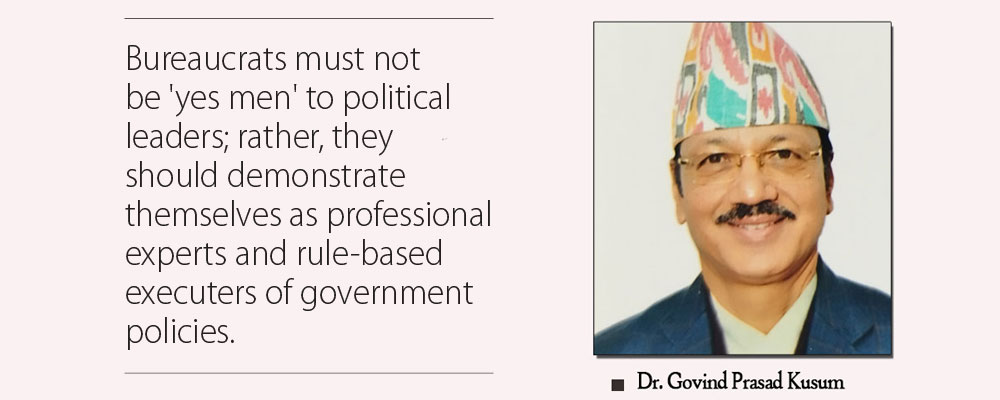
To make the government innovative, pioneering functions must be carried out by the bureaucracy. Bureaucracy should be driven by capacity transformation, institutional integrity, digitalisation of services, and procedure simplification. It must be fortified against political patronage and arbitrary interference so that it can function independently. Bureaucrats must not be 'yes men' to political leaders; rather, they should demonstrate themselves as professional experts and rule-based executers of government policies. Bureaucracy as a shock absorber, even at critical situation, must exhibit its skills and capacities to accomplish the focused targets tasked by the government, despite being underrated.
(The author is former secretary of Nepal government.)