- Saturday, 6 June 2026

Political Order Prerequisite For Prosperity

Political order stands as the government's rationality but the watchful and trustful eyes of the people on the regulation of societal life are no less salient. The writ of the state provides the government with space, laws, personnel, resources and institutions for governance. Political power provides consent and legitimacy for it and reduces the costs of governance. The system of rights and duties to people and all public institutions provides reciprocal obligations and recognition of each other’s jurisdiction, power balance and mutually beneficial dispensation where people sacrifice part of their liberty for security from the state.
But when laws, policies and rights are partially or arbitrarily implemented and public goods are distributed in a skewed manner, the natural course is resistance. The institutions of the state and polity are deemed impersonal ones. Political order is a public good whose general availability is precious to all Nepalis. Democracy mediates reciprocal interests and the power of two sovereigns: the state and its people. But when individuals are allowed to pursue their wild personal or partisan interests at the cost of public interests, the ability of the state to create public welfare and political order suffers.
Spirits of enlightenment
Young population of Nepal, driven by the spirits of enlightenment, information and technology, has organised a protest seeking digital freedom, corruption control and good governance, not regime change or parliamentary election. As the regime increased the cost of revolt with the death of 19 students, its effects turned disproportional. The unintended upshot of this revolt is a challenge to the majoritarian regime. It entailed a shift from electoral to performance legitimacy, leadership for life to intergenerational justice and a transactional model of regime to transformational vision with full integrity and efficiency of governance for fulfilling the mainstay of life.
Good governance presumes the unprejudiced performance of public authorities for the general welfare of Nepalis so that they can participate in the institutional resources, positions and truth-fertilising institutions of the state. Nepali leaders and institutions are deemed legitimate only if they can animate the commitments of directive principles and policies of the state. This musters the loyalty of people to the state and its institutions enable it to perform basic governance functions-security, rule of law, justice and opportunities. The constitutional status quo fails to settle the question of legitimacy, duty and obligation in a diverse society like Nepal, where no social class is in a comfortable majority to impose the rules of the game it likes on others for a hegemonic order.
Collective provisions and mutual advantage alone can create win-win games for the promotion of legitimate political order, discipline and cooperative potential of life. The state promotes positive freedoms of people, such as needs, rights, liberties and the conception of public goods, while the market promotes negative freedoms of non-interference in the economy and private life of people. It allows private property and personal profit. But it challenges the constitutional vision of an egalitarian society and serves as an antidote to the Nepali business tradition of shuva lav (ethical business practices of fair price), the constitutional vision of social justice and international obligation of due diligence on corporate sectors.
Nepal has adopted a welfare state and, therefore, it cannot allow the free market to operate neutrally under the necessity of supply and demand to be mediated by price mechanism without any consideration of constitutional provisions for equality of opportunity, market competition, efficient allocation of resources, fair prices and social justice — the vital tools to regulate the subversive craze of the market. Many of these criteria clash with the demand for equality of choice to be subsidized by assets, income and subsidies of the state on public utilities, health, education, technology, infrastructures and protection of the environment and the weak.
One irony of the Nepali economy is overemphasis on welfare promises relative to capital accumulation and underinvestment in productive sectors to generate employment opportunities so that youths do not have to escape to the global labour market to sustain their livelihood and contribute to the national progress. Deficit financing of public welfare or loans may impose a burden of dependence, thus stripping parliament of its policy-making autonomy and restraining the execution of misplaced priorities, which Nepal has been experiencing since the beginning of its unplanned development.
Property rights are a key to promoting civic autonomy of people but when nearly 20 per cent of them are below the poverty line and most of the youth have to migrate into the global labour market, how can they effectively exercise their rights and sovereignty and defend the political order? How can they make society, economy and politics dynamic and prevent the great inequality of benefits to the superfluous rent-seeking elites devoid of any responsibility for their power and wealth? The elites, on the other hand, secure most of the incentives and benefits subsidised by the tax, aid and remittance of people without giving something in return, thus muddying the cycle of anguish and anger, not the modicum of just political order.
This means monopoly, syndicate and economic image of politics do not conform to public interest. It makes the poor market drop-out, leading to powerlessness, unable to build civic competence. Mediation functions have to be performed by all intermediary organisations, including civil society, political parties, media, courts and public-spirited groups. Ironically, in Nepal, these bodies and human rights articulate negative rights of people against the already weak state overloaded with rights, redundant structures, personnel and lofty international obligations.
Even rational civil society organisations articulate the negative rights of people while forgetting about customary ethics of altruistic service, education for the perfection of societal standards, volunteerism and duty in the spirit of niskam karma (selfless service to the needy). As a result, even intellectuals confuse between highly projectised NGOs, careerist professionals, pre-modern and pre-rational associations and philanthropic civil society. A weak Nepali state has allowed the operation of all kinds of groups and sometimes equates them with civil society, though they fail to infuse ethics in politics and underline the sanity of political order for the exercise of freedom, dignity and peace.
In Nepal, it has become hard to attain constitutional goals because all the institutions of state, except the Nepali Army, are subordinated to powerful individuals of political parties. It has disabled them to perform with full autonomy, create sound regulatory indulgence and coordinate the roles of all actors of society for a rightful political order. Internal political order is also related to the nature of the international system, which is now in a state of disorder mixed by impulses of geopolitical struggles for supremacy, survival and collaboration depending on the definition of national interests. The utility of political parties, civic institutions and public organizations is judged in terms of outcome they produce for the people. The Nepali constitution and these institutions are the sources of public policies, authority and legitimacy.
The return of the regime change strategy of great powers to maximise the compatibility of values and geopolitical interests has infected the political order of many nations of the world. Nepal has accepted democracy as a device for organised life but it is caught between an elite model of representative democracy with some elements of social inclusion and proportional representation and a participatory model of democracy, affirming popular sovereignty requiring mass deliberation on policies and decisions and a self-governing polity. Nepalis have choices for varying degrees of participation in a number of institutions.
Ironically, public policies are hardly sanctioned by public opinion or legislative deliberation. This means even the voluntary consent of people to rule is not decided by mutually gainful cooperation between the ruler and the ruled but by partisan instinct. The outcome is a biased distribution of benefits to clients and loyalists. As Nepali politics has moved from constitutional choice and constitutional outcome to bargaining strategy of interest groups and powerful leaders, its political process is losing its rationality and validity, thus allowing various anomic groups to unsettle it. No political party fully owns the constitution; even its drafters want its reform without spelling out its stuff, thus drifting to its Achilles heel to unknown terrain.
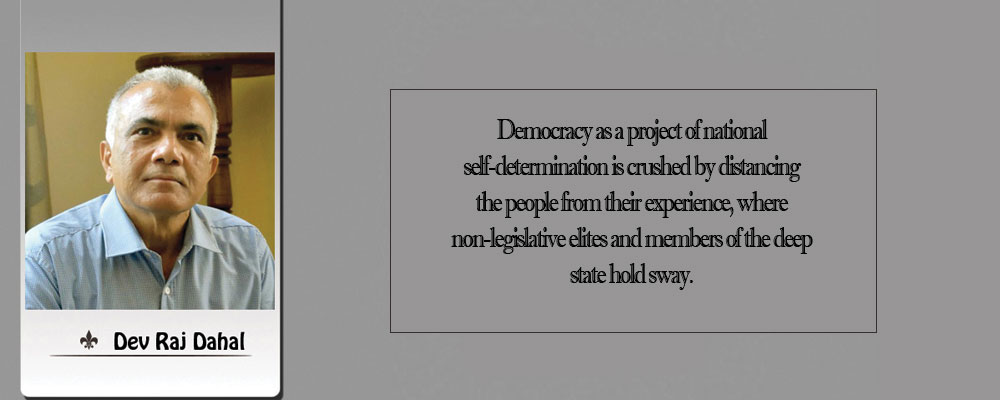
Knowledge, public policies and laws of Nepal are less indigenised and therefore people neither know their substance nor feel positive about them, thus lacking ownership for their success or failure. This means democracy as a project of national self-determination is crushed by distancing the people from their experience, where non-legislative elites and members of the deep state hold sway. They are not socialised in the constitutional vision either. How can Nepali state institutions create political order by imposing security and rule of law in the entire society and muster their loyalties when many political parties and interest groups uphold unconstitutional socialisation, orientation and action?
Normative compass
Political order in the nation requires normative compass and action of all actors of society, state, market institutions and civil society, where the state is autonomous of both deep state and geopolitical forces. Both corrode its lawful monopoly on power. The excessive use of money in electoral politics hints at the action of Gresham's Law. It can strangle ethics in politics and erode the democratic spirit of fair competition among the contenders. Samuel P. Huntington has forwarded the concept of political institutionalisation for stable political order, an order which needs the autonomy of institutions, complexity and consistency of roles and adaptability to changing times.
Nepali institutions precisely face a deficiency in these areas and suffer a mismatch between high participation of people and low institutionalization of norms, procedures and institutions. Nepalis' struggle for power for wellbeing can be captured in a paradox. The memory of leaders’ promises made in elections often collides with eternal amnesia and voting for the same leaders. Civic education is, therefore, vital for civic culture.
(Former Reader at the Department of Political Science, TU, Dahal writes on political and social issues.)