- Sunday, 3 May 2026

Myth Of Mahankal And Kaliyug
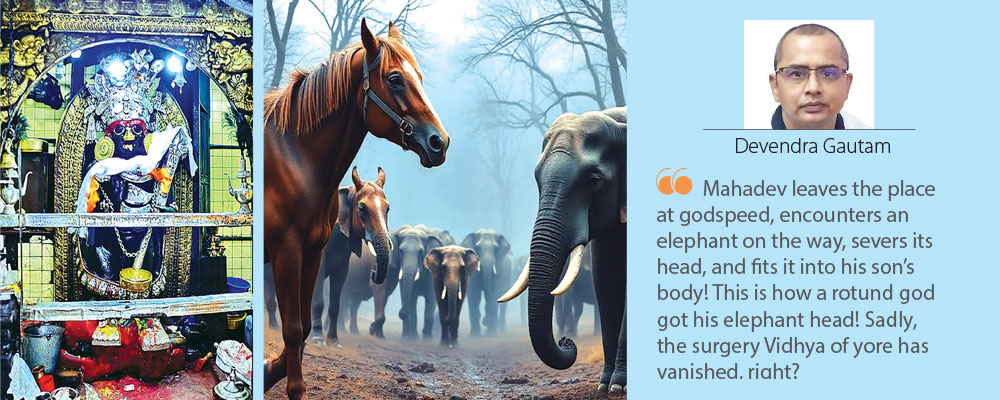

Ancient times in the ancient Valley of Kathmandu. Under a piece of high heavens over Tundikhel, one fine morning, an unnamed tantric is addressing nature’s call on the lap of Mother Nature, with a pitcher full of water by his side for cleaning. Here, one does not need the brain of a rocket scientist to imagine that the valley must have been sparsely populated at that time, with hardly any human activity early in the morning.
Perchance, the sapien happens to glance into the small vessel and sees a divine image inside — the image of some supernatural being passing by high in the sky. Very quickly, the occult practitioner cleans up and, using powers of sacred mantras accumulated through Sadhana, manages to get hold of the deity. The deity turns out to be Tin Mahankal, also known as Shani Mahankal. By the side of a sprawling Tundikhel and just opposite the Trauma Centre, there’s a huge image of the captured deity inside a pagoda-style temple.
Saturn god
The deity, whom many consider to be the Saturn god, is considered quite powerful and a proof supporting this belief is that his temple has withstood major jolts like the 2015 Gorkha quake that have rocked this country located on a seismic fault-zone over the past several decades. Every Saturday, devotees pour into the temple, offering the deity liquor, black-eyed peas and objects made of iron in a bid to appease him as he is associated with Adhaiya and Sadhesati (troubles that last 2.5 to 7.5 years, based on an individual’s birth chart)
Close by the temple and in the middle of the road, there’s a Peepal (ficus religiosa) tree where devotees pour in every Saturday to offer puja with the belief that this also reduces the harmful effects of the deity. As stated earlier, Shani is considered quite powerful. According to an ancient tale, even the all-powerful Mahadev had to hide himself under the trunk of a tree in the form of a woodworm to shield himself from the effects of Sadhesati for 7.5 long years!
As per another lore, upon insistence from Goddess Parvati, the mother of deities Ganesh and Kumar, and consort of Lord Mahadev, Saturn attended a function marking the birth of Ganesh. Quite aware of the harmful effects of his gaze, the god keeps his head lowered in the assembly full of supernatural beings, determined not to glance upon the newborn for the sake of the latter’s life. This predicament is not hidden from Goddess Parvati, who was perhaps unaware of the harmful effect of Saturn.
Also, Ganesh was such a sweet child and a guest not looking at her child and appreciating his cuteness probably hurt a mother’s pride. So, the goddess calls Saturn not to put on such a sad face on such a joyous occasion, and see how beautiful the baby was.
The Saturn tries to convince Parvati that even a glance could prove fatal for the baby, but she would have none of the excuses.
Left with no option, the Saturn looks at the child and the effect is so powerful, it beheads the baby then and there, leaving the divine audience panicked and in shock.
Without losing a moment, Mahadev leaves the place at godspeed, encounters an elephant on the way, severs its head, and fits it into his son’s body! This is how a rotund god got his elephant head! Sadly, the surgery Vidhya of yore has vanished, right?
According to our scriptures, there are four ages (Yug) — the Satya, Treta, Dwapar and the Kali. Before the start of Kaliyug (the modern age), which comes after Satya, Treta and Dwapar Yug, Singhraj (the lion king), the king of the jungles, convenes a key meeting of wild animals.
He approaches the horse first and says: Dear horse! The Kaliyug is approaching and it will be marked by the rule of humans over us. Humans will not be kind to us, that’s for sure. So, I have decided to head for the heavens as I do not like to live at their mercy. Accompany me to the heavens.
The horse replies: O lord of the jungles! The sapien has promised me a never-ending supply of food, so I ain’t going with you. Then comes the turn of the jumbo. The lion king calls the elephant to accompany him, to which the latter replies: O good lord, the human being has vowed to take good care of me, to treat me like Lord Ganesh. So, I won’t be going with you. Unable to convince any wild animal, the lion king leaves for the heavens, a tad too sad.
Kaliyug
As the Kaliyug begins, the sapien saddles and bridles the horse by offering treats and then starts using it as a beast of burden. When the horse reminds the sapien of his pledge to feed him nonstop, the latter replies: "The metal contraption that I have fitted in your mouth is your food. It will still be there even if you chew it for 12 long years. You see, I have kept my words. The horse nods, sadly.
As for the elephant, the animal receives a jumbo treatment at first, with the sapien offering puja accompanied by sweetmeats, coconuts, garlands, and other offerings. This way, the human wins the heart and mind of the jumbo. After the formal ceremony, the Lilliputian creature seeks to ride the giant and asks the latter to lower himself. After getting on top, the sapien reins it with iron shackles and starts lording over it. What prompted his majesty to return to Earth from the high heavens and inhabit the jungles of the Kaliyug as the lion king? Did he also fall prey to the scheming sapien? This scribe has no idea.
This mythological description is partly based on my conversation with Ram Tuladhar, a veteran wood carver from Khokana.
(The author is a freelancer.)



-square-thumb.jpg)