- Sunday, 3 May 2026

A Memoir Of Brilliant Bureaucrat
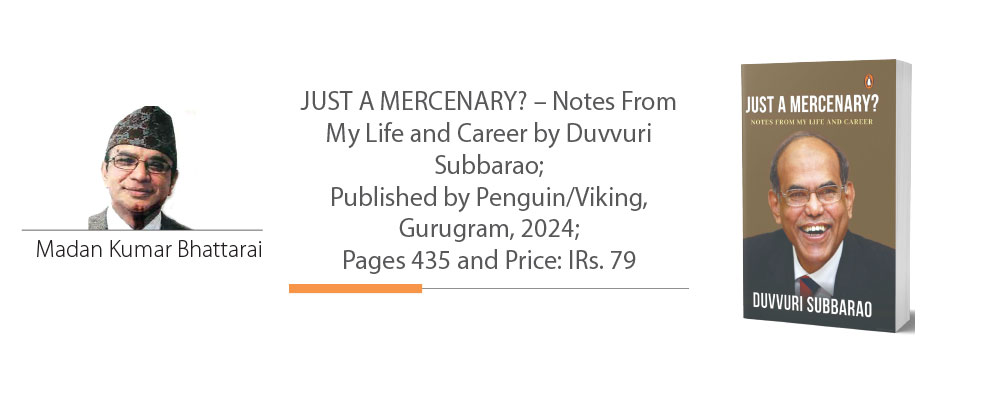

It is generally assumed that top civil servants provide brain, blood and muscle to their political masters to undertake any initiative or make policy decisions. This applies more in the case of some key sectors like foreign affairs, finance, home and defence as governments have to take quicker decisions and make initiatives for reforms, changes and adjustments, or roll back decisions taken earlier found not appropriate in the changed circumstances.
Despite their crucial roles in the art and craft of governance, bureaucrats all over the world are normally recipients of brickbats rather than bouquets, as whatever positive things happen as a result of their advice or suggestion are immediately taken by their political masters as credit and blamed for failings squarely put on the heads of the civil servants. There are also allegations that, in many cases, civil servants simply suggest alternatives or pose questions that provide no durable solutions.
It is in this category that a recent book by a top Indian bureaucrat may be read seriously, as it offers considerable insights into both the machinery and working patterns of the government. The author, Dr. Duvvuri Subbarao, has all the credentials that can be called exemplary. A topper of combined civil services examinations for entry into the Indian Administrative Service (IAS) and Indian Foreign Service (IFS) of 1972, he is a true amalgam of academic brilliance and an envious record of career trajectory, including some of the most sensitive assignments both in and outside the purview of the government.
While his first option was IFS (Indian Foreign Service) and he was keen to join it, he changed the stream in favour of IAS within the 10-day time limit after gentle persuasion from his father. After 50 years, he thought he made the right decision and had no regrets for not joining the IFS. His service records include stints as Secretary to the Prime Minister's Economic Advisory Council, lead economist in the World Bank, Finance Secretary, Andhra Pradesh government and Joint Secretary, Department of Economic Affairs, Ministry of Finance of India, before taking over as the Finance Secretary of India.
After serving as Finance Secretary, the author was in the striking range of becoming Cabinet Secretary, the highest position in Indian bureaucracy. He was instead appointed Governor of the Reserve Bank of India (RBI) that he calls the most significant transition in his career. He was the 22nd RBI Governor after his superannuation, only to leave it prematurely as an accumulated expression of inconvenient moments with two well-recognised finance ministers, Pranab Mukherjee, who later became the President of India, and P. Chidambaram.
An acknowledged expert and prolific writer on public finance, decentralisation and fiscal reforms, Subbarao also has experience with issues of public finance in several countries of Asia and Africa. His highly impressive and varied academic credentials include top positions at both BSc (Physics) and MSc (Physics) from two of the best institutions of India, IIT, Kharagpur, and IIT, Kanpur, respectively, MS (Economics), Ohio State University, and PhD in Economics from MIT.
He has devoted a whole chapter (five) to his PhD saga, depicting the travails and tribulations a serving civil servant has to bear in the course of doctorate research in terms of leave and other provisions. In addition, it was delayed by his elder brother's suicide, leading to his abrupt return to be with his parents at the worst hour. Taken as one of the first IITians to join the civil service, his book has an equally interesting and even thought-provoking title, JUST A MERCENARY? – Notes From My Life and Career. The voluminous book has 18 self-contained chapters with 8 snippets/op-eds that are inserted in various chapters instead of being separate treatments on their own.
While the book is highly readable with significant insights into the working of the government of India, the author leaves the answers to his title to the readers, stating that the answer to this question will always be a matter of elusion for him. Another beauty of the work is that he has summed up his true feelings in the last chapter, which is sort of a concluding observation.
The last chapter, entitled Letter to My Mother is both in the form of a coda and the most emotional attachment he had with his mother, with profound tributes for so many things and sacrifices she made for her dear son. He concludes that despite putting all efforts for the service of the government, the moot question always remains, whether the civil servant is just a mercenary or something more.
The book depicts a change of preferences in India in terms of civil service career options, as he finds that in earlier days, people used to prefer IFS to IAS, but that is not the case now, as people opt more for IAS. He also gives a succinct overview of the training modules India adopts in training bureaucrats, as they come from a heterogeneous area of schooling, background and discipline.
The second aspect is that the private sector has grown and attracts talent more these days than earlier, when civil service used to be the only preferable pursuit for career development. The third important aspect of the Indian civil service is that more and more women are now joining, making it what the writer prefers to call a steady stream rather than a trickle in earlier years of Indian independence.
The fourth and last point the author has highlighted is the preponderance of people from backgrounds other than civil service making entries into the service, as children of bureaucrats used to flock to the civil service examinations in earlier days. This may indicate both the impression of the plight of their parents in civil service and the emergence of other attractive avenues for career development as India grows in terms of socio-economic development, with special stress on management, technology and service.
One chapter (seventeen) is dedicated to the author's self 'desanitising' endeavours relating to his post-retirement stints at top academic institutions like Yale Jackson School of Global Affairs at Yale University, Lee Kuan Yew School of Public Policy and National University of Singapore Business School.
In a nutshell, Duvvuri Subbarao deserves accolades for the most comprehensive presentation as it lucidly combines memoirs and the real-life situation of India.
(Dr. Bhattarai is a former foreign secretary, ambassador and author. kutniti@gmail.com)