- Sunday, 3 May 2026

The World In An Age Of Staged Reality
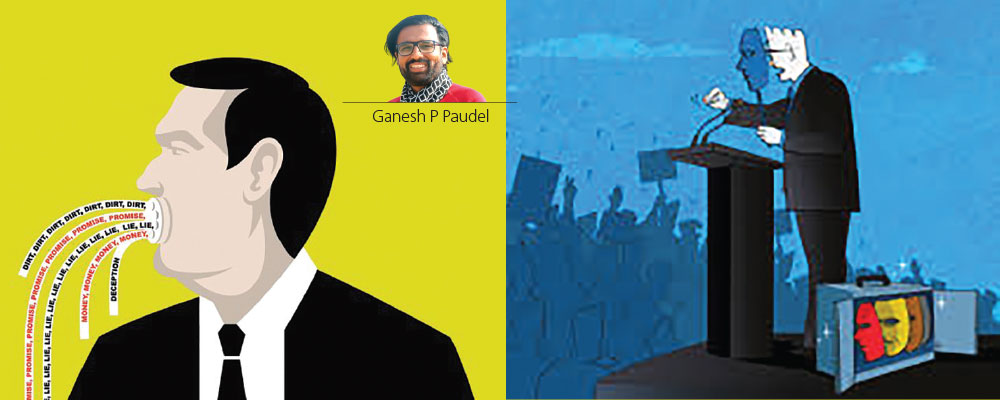

In every society, the powerful constitute a small minority, yet they occupy an extraordinary space – physical, political, and moral. The rest of us, the vast majority, live relatively unmasked lives. Our actions are judged plainly, and the law – however imperfect – touches us without ceremony. But for those in command, truth functions differently. It becomes negotiable, shape-shifting according to convenience, image and ambition.
In Nepal, this contrast is neither new nor subtle. It is woven into our everyday political culture. The landscape may have changed since the tumultuous years of conflict and constitution-writing, and even in the age of AI, but the performance of leadership remains strikingly the same. We continue to witness ministers driving past traffic rules with confidence that accountability is meant for others. We hear pledges of reform from leaders who have held office long enough to implement at least a fraction of what they preach. We have almost normalised the dangerously unaccountable and unethical practice of political leaders and government authorities lying in public.
Disowning misdeeds
They routinely get away with disowning their misdeeds or – more recently – dismissing them as AI-generated fabrications. Yet, the public listens, nods, and then quietly files these promises and political shenanigans away in the growing archive of disillusionment. The emboldened speeches and unfazed demeanour of the leaders of the party troika, who faced debacles during the Gen Z uprising, serve as testimony to this argument.
This gulf between rhetoric and reality is not an exclusively Nepali phenomenon. It mirrors a global trend in which political authority is increasingly theatrical and less ethical. Around the world – from South Asia to the Middle East, from Washington to Moscow – leaders craft carefully curated narratives. “National interest,” “security concerns,” “development priorities,” and other official phrases often mask uncomfortable truths. During the Syrian conflict, for instance, I still remember then president Basar Al Asad attempted to redefine the civil war, which later ended up claiming more than three hundred thousand civilian lives, as a “new kind of war”. It revealed a broader pattern: language can be weaponised to obscure responsibility.
What makes hypocrisy so persistent – both at home and abroad – is that it thrives where power concentrates but accountability thins. Political leaders, corporate magnates, bureaucratic elites, and even self-appointed moral guardians often operate under the assumption that principles are optional and consequences negotiable. And whenever this assumption is left unchallenged, impunity spreads quietly but swiftly.
Yet the Nepali case carries a particular poignancy. We are a pretty young republic, still groping for the meanings of the vocabulary of citizenship, federalism, and civic responsibility. Our politics, still in transition, is remarkably crowded with leaders who began as idealists – many forged in revolution, jail time, or grassroots struggle.
But somewhere along the ascent from the streets to Singha Durbar, many discovered that power offers comfort, and comfort demands unscrupulous means. The revolutionary fire dims, replaced by coalition arithmetic, factional battles, protocol vehicles, and speeches fine-tuned for applause rather than honesty.
The irony is sharp: those who once promised transformation often become guardians of the very structures they sought to dismantle. But hypocrisy is not solely a political ailment. It leaks into institutions, workplaces, civic organisations, and even spiritual communities. I once had a senior employer whose public persona radiated humility, detachment, and the discipline of Vipassana meditation. He spoke frequently of impermanence and compassion, yet wielded corporate influence with manipulation and selective truth. This contradiction was not personal alone; it mirrored a broader tendency among the powerful to preach virtue while practicing forced decency.
He failed to provide the festival bonus to a few employees, which he, during the time of recruitment, had promised with great rapture. When principles become performance, the meaning of ethics collapses–whether in a boardroom or a Cabinet room. This raises a deeper question: Why do the powerful lie so effortlessly? Not because they lack intelligence, but because they operate within systems that reward perception more than sincerity. In such systems, polished narratives secure votes, investments, and influence; candour, on the other hand, invites scrutiny. Thus, hypocrisy becomes not merely a moral failure but a strategy–one that thrives across continents.
Still, the consequences are not uniform. In fragile democracies like Nepal, where institutions remain vulnerable, the effects are acutely felt. Public faith erodes. Citizens disengage. Cynicism replaces hope. Politics becomes a spectacle rather than a service. And once cynicism becomes normalised, even sincere leaders – rare as they already are – struggle to gain traction. Yet history teaches that nations do not decay because ordinary people fail; they decay when their most powerful actors abandon restraint. The philosopher Vaclav Havel once wrote that the struggle of the powerless begins with “living in truth.” Perhaps the inverse is also true: the decline of societies begins when the powerful stop "living in truth".
As Nepal navigates new geopolitical currents – balancing neighbours, negotiating development, coping with mass exodus, brain drain, and confronting environmental vulnerability – leaders with integrity are not optional; they are essential. But they must be more than symbolic. They must be willing to step beyond scripted compassion, beyond hurried promises of “good governance,” beyond the security of political theatrics.
Crucial juncture
For the world’s powerful – whether in Washington, Beijing, New Delhi, Brussels, or Kathmandu – the mask of hypocrisy may be convenient, but it is unsustainable. Power without conscience eventually corrodes not only institutions but the very idea of a healthy and functioning society. And when that happens, it is ordinary people – those without masks – who bear the brunt heavily.
Nepal today stands at a crucial juncture. Our citizens are more informed, more connected, and more impatient, filled with the sense of pretence than ever before. If our leaders continue to choose spectacle over sincerity, showmanship over utility, and expediency over principles, the future will echo the frustrations of the past. The Gen-Z movement was the case in point. But if even a few choose differently, the moral arc of leadership – long bent in the lack of rectitude –might yet straighten.
(Author mentors students in creative writing at Sanskar Pathshala Dang. ganeshprasadpaudal@gmail.com)