- Friday, 29 May 2026

Will UML Regain Its Turf

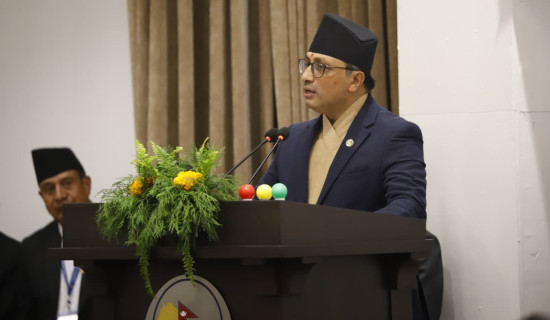
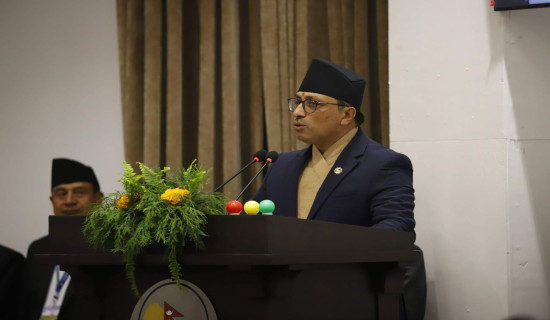
The Communist Party of Nepal-Unified Marxist-Leninist (CPN-UML) successfully held its 11th convention last week. According to UML sources, the inauguration assembly drew the presence of over 100,000 people, though the independent sources project a more sobering estimate of 30,000 to 50,000 people. The national congress is the highest regular body of the party, which assembles every five years to assess and correct the party's ideological direction and elect a new set of leadership for five years. This time, however, it drew special public attention and curiosity because it was taking place in a tense political situation of a brutal onslaught it received during the Gen Z revolt. The national conference of the UML was, therefore, necessary to deliver a message that it is still a force to reckon with and will be around to dominate the chessboard of national politics.
The massive presence at the inauguration assembly demonstrated that despite the phase of unpopularity it is passing through, the UML is still l a formidable political force. With nearly 700,000 active members, a strong organisational presence from central down to the ward level. It is in a position to project power more effectively than the Nepali Congress and other communist parties, which appear in a state of torpor following the shock delivered by the Gen Z revolt. In sharp contrast, the resilience shown by the UML in the immediate aftermath of the revolt and the visible activities it organised at different locations of the country proved that this party is way ahead of other political organisations in matters of mobilising the people.
The UML has played a historical role in unifying the divided left movement in the past. At its early period, it projected itself as a genuine communist party with Marxism and Leninism as its guiding ideology. Through its clear goal to overthrow feudalism, semi-colonialism and comprador capitalism, it was able to gain traction among the diverse sections of society. This party provided successful leadership in several historical movements that took place from 1970 to 1990. It was behind the student movement of 1975, the referendum of 1978 and also the People's Movement of 1990. Its legendary leader, Madan Bhandari, formulated People's Multi-party Democracy based on the experience of prolonged revolutionary movements.
The 1990 People's Movement overthrew the Panchayat system and gave legal status to political parties that were clandestinely operating during the Panchayat system. The old generation leaders like Krishna Prasad Bhattarai, Ganesh Man Singh and Monamohan Adhikari, Madan Bhandari were icons of moral standards for the people. Following the death of Madan Bhandari in 1993, a culture of hero worship was institutionalised, ideologically sound leaders, met high ethical standards and were away from the temptation for power and pelf, were systematically sidelined or disgraced, with pseudo revolutionaries occupying the central stage.
The UML began to lose its moral terrain in 1981, when it marginalised its founding general secretary, CP Mainali, in the first serious inner-party polemic. Ever since, groupism and unholy alliances have become treasured tools for acquiring leadership posts. Parliamentary elections lost the sanctity of fairness, giving free rein to money and muscles as tools of winning elections and mustering a majority in the parliament. Those who won the election or were appointed ministers underwent a class transformation, as described by Yugoslav communist intellectual Milovan Djilas in his famous book The New Class.
The much-touted socialist democratic values of evolving collective leadership, using criticism and self-criticism as a tool for settling differences and practicing democratic centralism, were flung to the wind. The failure of this party to practice democratic principles, flouting rules and stifling inner-party democracy created a space for the emergence of a superman within the party. The educated, well-informed youth population was expressing its discontent through aggressive social media posts. But the elite group of leadership continued to project the cult-like image of KP Sharma Oli as an ineluctable fate of the country.
Naturally, Oli's deification came at a cost. As a powerful coterie deified him, thousands of honest, dedicated and ideologically committed party members and lower-level party leaders were persecuted, sidelined, replaced or disgraced. The case of Bhim Rawal, Karna Bahadur Thapa, Tanka Karki, Binda Pande, and Usha Kiran Timsena can best explain the organisational terror that was unleashed within the UML.
Inner-party injustice
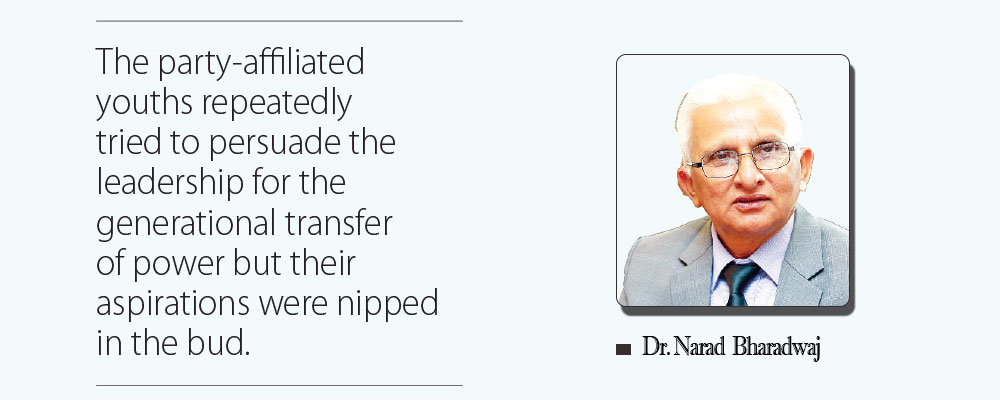
The party-affiliated youths repeatedly tried to persuade the leadership for the generational transfer of power but their aspirations were nipped in the bud. When the inner-party injustice crossed all limits, the wider society started to make scurrilous remarks against not only leaders but also the servile party workers who did not dare to call a spade a spade. Finally, Gen Z revolt came like an avalanche and demolished the edifice of the false value system
The UML has suffered a serious dent in its armor. But instead of seeking vengeance, it should take this as an opportunity to dust itself off, reassemble and reclaim the moral high ground it once occupied. The mega mass assembly that took place on the inauguration day of the 11th national congress has provided this party a much-deserved facelift. But it is only a psychological part of the visible battle; it will have to subject its inner party life to scathing review and achieve a new level of party unity to claw back the turf it has lost in the Gen Z revolt.
(Bharadwaj is the former ambassador and former chairperson of Gorkhapatra Corporation. bharadwajnarad@gmail.com)