- Saturday, 6 June 2026

Youth As Active Agent Of Peace

The identity of youth marks the dynamic population of Nepal. Out of the nation’s 29.6 million population, it shares 40 percent. This demographic bulge is vital to propel the nation’s progress. With proper education, training, job and disposition, they can make democracy vibrant. National Youth Policy of Nepal 2015 aims to engage them in nation building by enabling them to become self-reliant through their education, health, jobs and leadership growth. Nepali youths retain a liberal attitude to civil liberties and peace. Their traits are: commitment to national unity and sovereignty, altruistic attributes to the society’s weak and ready to sacrifice lives for democracy, progress, and peaceful change.
One irony is that the potential of Nepali youth stands underutilised except in reaping remittance, which contributes 28 percent to national income, vital to keep up livelihood. Huge migration of Nepali students, workers, nurses, doctors, engineers, and entrepreneurs abroad shows the deficiency of a favourable national environment. This saps national human capital vital for nation-building. Nepali youth’s role in productive life, trade, and innovation is central to building national capacity to ensure stability and social peace.
Revolt
The recent peaceful revolt of Gen Z for digital freedom, governance reforms, corruption control, space for opportunity and intergenerational justice marks an exit from their earlier cynicism toward politics and fatal lure to consumerism and the virtual world. Now, they have realised how to use their creative energy and autonomy beefed up by the state’s youth-friendly policies and become relevant to national resilience. The state of grinding poverty, joblessness, inequality, alienation, etc., has sensitised them about the nation’s future and has assumed responsibility to bear the national heritage, duty, discipline, and daring to animate the economy and democracy.
The long escape of Nepali youth into depoliticised private educational institutions with a concern for only job prospects in the market is now flattened. They view that the usual Nepali politics that treats youth as a means to acquire power and the economy that dubs them as workers have robbed their lives of possibilities. The Gen Z revolt is its outcome. Still, they, from both public and private educational institutions, require a deep dose of civic and vocational education. The first is essential to instil moral values, enable the ability to think, infuse patriotic feelings and national duty, while the latter is critical to foster their ability to compete in the job market, become entrepreneurs, innovators and modernisers of the nation.
Habits of reflection and social awareness can enable them to engage in civic life and plan their productive future. Education of youth for peace is more than training for jobs. The economics of peace is founded on production, exchange, and distribution of essential goods in a just manner so that it can fulfil Nepalis' subjective need for happiness, objective needs for their continued existence and ethical value to live with others. Nepali youth have to stabilise state-society unity, long hit by structural and direct violence, social struggles, and political protests of many forces.
Their vigilance and orientation to peace can shape Nepal’s stable future. Transition from protest to peace is a key to this process. Likewise, Nepali youth are struggling to democratise leadership and act as a bridge builder across social, political, and cultural fronts to heal societal wounds wracked by disruptive politics. During earthquakes and other misfortunes, they have pivoted their aptitude in volunteering in rescuing and rehabilitating victims, building connections and communities, and managing the risky effects. The civic virtues of youth can build trust between the state and people, animate enduring unity to combat the vices induced by powerful economic and political actors’ selfishness, self-indulgence and grumbling.
By infusing human feeling, solidarity and compassion for the good life of people and reducing structural violence, they can animate their vision for good governance. Recognising their vitality in peace, the UN Security Council has adopted the Youth, Peace and Security Agenda to articulate their voice in many areas such as youth participation in peace building, protection of conflict-affected people, prevention of conflict-breeding causes, partnership with peace-related associations, cheering disengagement in conflict activities, and reintegration of victims in society. In January 2022, the Virtual Global Conference on Youth underlined the Inclusive Peace Process with the mission to uplift the Youth, Peace and Security Agenda, focusing especially on girls in the peace process to uplift their education, health and safety.
Nepal has embraced these measures. Great equality in the distribution of development indicators requires bridging and bonding opportunities and policy innovation for the youth of rural areas. Even in urban areas, they are victims of organised violence, as the second day of the revolt indicates. Their efficiency for collective action is exhausted by division. Their relative unity yielded a 10-point accord with the government, which offered positive payoffs to reform the nation’s
condition. But a buffer is vital to fend off its enemies who hate to drive change through fair elections.
Capacity enhancement
Nepal has set up an industrial policy for capacity enhancement, skills and entrepreneurship for marginalised youths. Agricultural policy seeks to uplift rural youth through employment benefits. Likewise, National Employment Policy, Labour and Employment Policy, National Youth Policy, National Youth Vision, Action Plan on Economic Development and Prosperity revolve around the youth’s overall personality development and progress. They bear noteworthy effects in building confidence and self-esteem. The Ministry of Youth and Sport has diversified its plans to a wide range of areas: education, employment, health, sport, etc. These plans and policies have to link each youth to the national spirit, overcome institutional and resource deficits and offer scientific, rational and moral education and training to realise their self-worth.
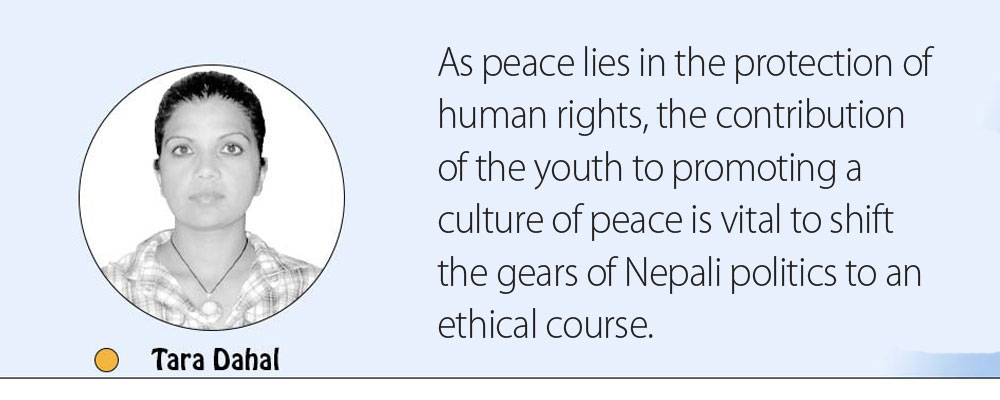
Youth fronts of political parties have long served as vanguard forces for regular stirrings. Now they are awakened to their due duties. Still, they need to learn the democratic path of demand handling. It requires them to acquire civic skills and temper that uproots their instrumental use and orient to value-based politics. The peace accord of Nepal is exactly crafted to bring peace dividends for the people. As peace lies in the protection of human rights, the contribution of the youth to promoting a culture of peace is vital to shift the gears of Nepali politics to an ethical course.
(Dahal holds an MA in Peace and Conflict from Otto-Von Guericke University, Germany)