- Sunday, 3 May 2026

Attack On Bangladeshi Media Distressing

As unrest in South Asia appears to be increasing day by day, violent attacks against mainstream media and journalists are also on the rise, posing a grave threat to democracy and human rights. The shrinking space for independent journalism in the region is deeply worrying, particularly at a time when societies are grappling with political uncertainty, social unrest and misinformation.
Recent developments in Bangladesh, sparked by the killing of a popular youth leader, Shariff Osman Hadi, who had played a key role in ousting the Sheikh Hasina government in 2024, have once again raised serious questions about the stability of the country. After the incident, I spoke with several Bangladeshi academicians, journalists, and activists, all of whom echoed a deep sense of shock and emptiness among the general public, but requested not to be named. Following Shariff’s killing, violent protests erupted across Bangladesh, with a series of attacks, vandalism, and arson reported in Dhaka.
Shockwaves
Prominent newspapers Prothom Alo and The Daily Star were targeted and burned, while the President of the Editors’ Council, veteran journalist, and Editor of New Age, Nurul Kabir, was physically assaulted. As the attacks unfolded, friends in Bangladesh began sharing images of the violence, sending shockwaves across the journalism fraternity worldwide. These acts were not merely attacks on individual media houses but on the very principles of free expression and press freedom.
The most pressing question remains: why were these two newspapers attacked? Both Prothom Alo and The Daily Star had been under surveillance during the former Sheikh Hasina government and were not allowed to report freely. Several journalists associated with these media houses had been arrested during that period. The student protests that lashed out against the Hasina government accused it of corruption and of maintaining a quota system for jobs based on nepotism and favouritism. These protests claimed to be aimed at re-establishing democracy and press freedom, which many believed had been suppressed during the Hasina regime. Against this backdrop, the targeting of these newspapers appears deeply contradictory and troubling.
Southasia Peace Action Network (SAPAN) and several journalist organisations from across South Asia have released strong statements condemning the attacks on journalists in Bangladesh. “It is disturbing to hear that more than 100 journalists in Bangladesh have been detained and remain behind bars without trial. We demand their immediate and unconditional release,” SAPAN stated firmly. The statement also refers to recent attacks on Nepali media during various protests, highlighting that this is a regional pattern rather than an isolated incident.
In Nepal, too, the vandalism of The Kathmandu Post, Nagarik Daily, Annapurna Post, Avenues Television, and Image TV, among others, has been observed with increasing frequency. There appears to be a growing finger-pointing attitude among sections of the ruling establishment and even among the youth towards media houses and journalists. This is deeply concerning, as journalists have been relentlessly raising the voices of those who have been suppressed and have worked consistently to safeguard democracy, both within their countries and across the region.
Media Action Nepal, in its annual Press Freedom Report 2025, notes a “troubling trend of escalating threats against journalists in Nepal.” According to the report, between May 4, 2024, and May 1, 2025, there were 32 documented incidents of press freedom and freedom of expression violations, impacting 40 individuals and media houses. Two journalists, Suresh Bhul and Suresh Rajak, were killed in incidents fuelled by public unrest and mob violence. These figures reflect the increasing risks journalists face while carrying out their professional duties.
The growing trend of attacks on the press and journalists during protests, particularly those initiated or supported by the youth, is an alarming phenomenon. It signals the erosion of democratic values and human rights in these countries. As the world witnesses a rise in wars and conflicts, attacks on the media in countries like Nepal—generally known for being peaceful—are counterproductive to national progress and development.
Bangladesh has a turbulent political past, and the student revolt of 2024, which succeeded in removing a deeply entrenched and corruption-riddled government led by Sheikh Hasina, came as a beacon of hope for many. However, following recent judicial developments, including death sentences handed down to Hasina and the Home Minister, among others, during her tenure, dissatisfaction has been voiced by the Awami League, the party she led for decades. Although the Professor Muhammad Yunus-led government has slated February 2026 for elections, many within Bangladesh remain sceptical about whether these elections will take place as planned.
Since the student protests of 2024, there has been a gradual shift towards right-wing Islamic ideology. With student elections in universities increasingly being won by such groups and more radical voices emerging, human rights activists, journalists, and academics have expressed serious concern. Many shared with this writer that these developments are detrimental to the restoration of democracy in Bangladesh.
Misinformation
As digital media expands, the spread of misinformation and disinformation has grown like wildfire. At such a time, the role of journalists and well-established media houses that report, investigate, and present facts to the public becomes even more crucial. Yet, there is a growing global trend—particularly in South Asia—of silencing journalists. New laws governing digital information sharing and electronic transactions, being formulated in countries like India, Nepal, and others, include clauses that can restrict free and fair journalism. These laws often compel journalists and media professionals to self-censor out of fear of attacks, legal action, or fines they may not be able to afford.
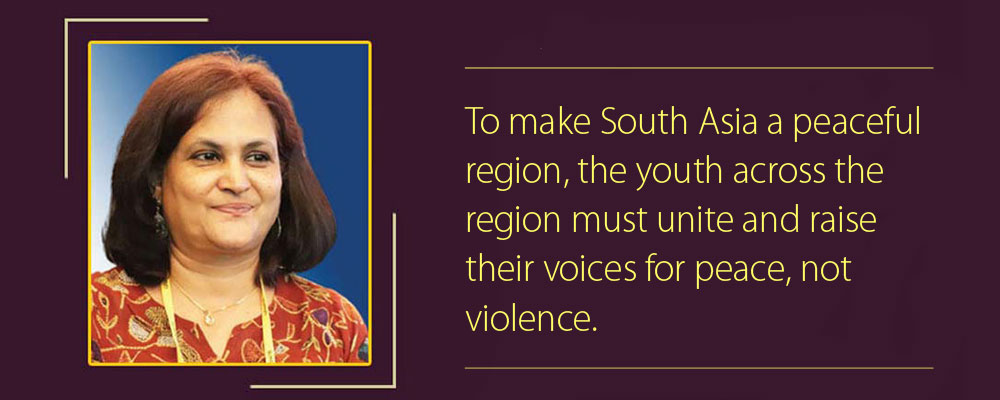
The youth must understand that vandalising media houses and attacking journalists is not a path towards democracy or the protection of human rights. Governments must conduct sincere and transparent investigations to identify perpetrators and bring them to justice. Impunity for crimes against journalists and human rights defenders must end; otherwise, countries like Bangladesh and Nepal risk sliding into deeper instability. To make South Asia a peaceful region, the youth across the region must unite and raise their voices for peace, not violence.
(Sharma is a senior journalist and women's rights advocate. namrata1964@yahoo.com X handle: @NamrataSharmaP)