- Sunday, 3 May 2026

Stakeholders' meeting on polls,Everyone wants elections: PM Karki

By A Staff Reporter,Kathmandu, Dec. 23: Prime Minister Sushila Karki has said that the government is ready to face sustained criticism from both political parties and the younger generation to safeguard national interests.
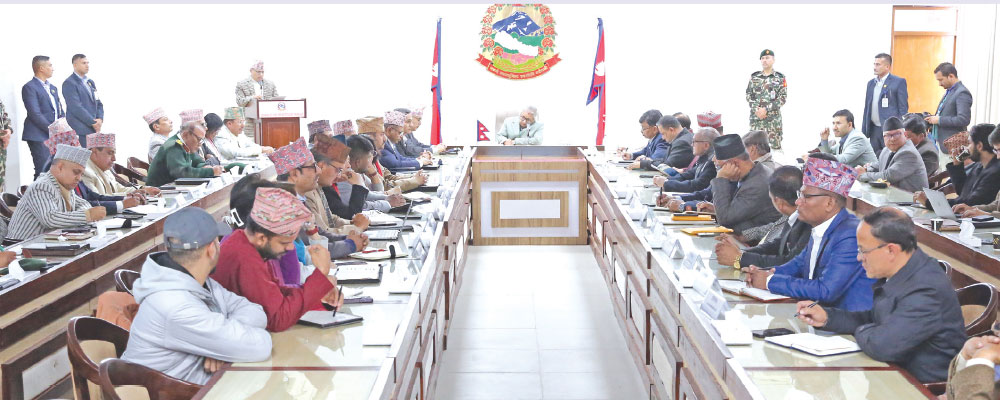
Speaking at a multi-stakeholder discussion among the government, political parties, the Election Commission and civil society leaders at the Office of the Prime Minister and Council of Ministers Singha in Durbar on Monday, Prime Minister Karki said the interim government has become the target of attacks from all sides, but it is well prepared to endure them for the country’s sake.
The Prime Minister stressed that the people are the ultimate authority in a democracy. She said parties exist solely to serve the public and must reform themselves if citizens demand changes.
Referring to the movement of September 8 and 9, which included killings and the deaths of youths, she said those events were the result of past political mistakes and weaknesses, and her government was bearing the public wrath arising from them. She said after the Gen-Z movement, the nation realised that there was a need for a change.
She warned political parties against venting their internal disagreements and power-sharing frustrations on the public, noting that such behaviours only harm the citizens. Emphasising the need to understand the sentiments of Gen-Z and the younger generation, she said ignoring their demands and clinging to rigid positions would not lead the country forward.
The Prime Minister clarified that her government had not come to power to enjoy privilege at the cost of young people’s blood. She argued that if all political parties genuinely sought peace and unity, no individual or group would be able to create unrest.
She said that she found that almost all parties and stakeholders were in favour of elections. “No one spoke against the polls,” she said.
Prime Minister Karki also said that merely praising political parties would not lead to national development, stressing that progress requires concrete action and patience, as change cannot happen overnight. Without mentioning anyone’s name, she said that while the law allows suspects to be arrested for investigation, it does not permit extrajudicial killings.
She said that the government was proceeding strictly according to the rule of law. Since her administration took office, the Commission for the Investigation of Abuse of Authority has registered 40 cases, and the Crime Investigation Office is carrying out work that had never been done before. She urged all sides to participate peacefully in the electoral process and support stability and development.
In the meeting, eight civil society leaders, 14 representatives of the political parties, and two Gen-Z representatives expressed their views. Most of them expressed their views in favour of the elections, the PM said in her concluding remarks.
Participating in the meeting, former lawmaker Radheshyam Adhikari, who is also a legal expert, said that whether Nepalis living abroad would be allowed to vote, the provision for temporary voters to vote, and (No Vote) would be possible only by formulating new laws.
He said that laws are mandatory on all three issues and that the March 5 election should not be pushed back in the name of making laws.
He also said that making laws would increase further confusion about the March 5 election, and that it was not easy to make laws about it when the proportional list is to be submitted in a week.
Civil society leaders opined that moving forward on election-related issues without discussing them with the major political parties would lead to accidents.
Civil society leader and journalist Kunda Dixit stressed that there should be an investigation into the destruction of September 8 and 9 incidents.
He also said that it should be clear whether there were any discussions with foreign countries on whether Nepalis living abroad should be allowed to vote.
‘Whether there is any other reason to postpone the election on March 5,’ said Dixit, referring to the issue of restoring the parliament. ‘If we go for restoring the parliament, Nepal will enter a path of further confusion.’
Another civil society leader and former minister Bidyadhar Mallik said that No Vote can be arranged and that this should be arranged in this election.
Acting Chief Election Commissioner Ram Prasad Bhandari said that the Commission was fully prepared to conduct the elections on March 5, 2026, in line with the government’s stated priorities.
“More than four and a half months have passed since the government announced the election date, and we now have only about two months remaining. Except for a few procedural tasks, the Commission has completed all necessary preparations,” Bhandari assured.
Stating that failure to revise security policies immediately after the filing of nominations could create problems during the election period, he urged security agencies and the Ministry of Home Affairs to make timely preparations.
Bhandari informed that procedures, directives and the code of conduct required for the election have already been drafted. The code of conduct would be enforced in coordination with the government and with consensus among political parties, he added.
The Ministry of Home Affairs informed the stakeholders that it has initiated the process of amending four election related existing acts to grant voting rights to Nepali citizens living abroad and to make arrangements for inter-district voting.
Making presentation on the government’s preparation for March 5 elections, Joint Secretary and Spokesperson for the Ministry of Home Affairs Ananda Kafle briefed that the election-related laws were being amended based on the Supreme Court’s verdict and demands from various parties.
“After the formation of the current government, the government has initiated the process of amending four acts in collaboration with the Election Commission to grant voting rights to Nepali citizens living abroad, to allow direct or proportional voting from inter-constituency, and to include the option of not supporting any candidate,” he said.
He also informed that a security plan for the upcoming House of Representatives member election has been prepared and is in the implementation phase.
Also, speaking in the discussion, Election Commission’s Joint Secretary and Spokesperson Narayan Prasad Bhattarai said the final list of voter lists will be published on December 30. So far, the number of voters has increased by 5.65 per cent, he said.
According to him, the number of political parties registered with the Election Commission for the House of Representatives member election has reached 114. In 2079 election, 87 parties participated in the election. Nepali Congress Joint General Secretary Mahendra Yadav said that his party was moving forward to participate in the elections. Yadav said, “The Nepali Congress has officially decided to participate in the March 5 elections.”
He reiterated that the country will not find a way out without elections. He added, “We also urge the government to hold elections on scheduled date without any ups and downs.”
Also, CPN-UML Secretary Mahesh Basnet said that his party has, in principle agreed with the March 5 elections and the agreement reached between the Gen-Z government.
‘In principle, we are in favour of the elections. But our conclusion is that there will be no elections because of today’s environment and the fact that this government has gone to the Supreme Court to declare the restoration of parliament unconstitutional,’ Basnet said.