- Sunday, 3 May 2026

Meditation For Inner Peace
 Samina Sharma
Samina Sharma
Samina Sharma
In today's fast-paced world, silence has become rare. We wake up to alarms, scroll through screens, and our minds are always busy. We think about studies, work, family, money, future, and many other things. Because of this constant mental activity, we slowly become tired from the inside, even when everything looks fine on the outside. Inside, we may feel heavy, confused, and restless.
Meditation is a simple way to return to inner peace. It is not something complicated, nor is it only for saints or monks. Meditation is for every human being who wants to live with clarity, balance, and peace. In such a time, meditation is no longer а luxury or a spiritual trend; it's a necessity for maintaining mental balancе, emotional health, and inner stability in everyday life.
In simple words, meditation means being aware. It is sitting calmly and watching our breath, thoughts, and feelings without fighting them. We observe the waves of the mind and physical sensations rather than trying to stop thoughts. Meditation teaches us to accept everything positively and gently. Just a few minutes of silent practice each day can bring real change. When we walk with awareness, eat with presence, or work with full attention and joy, they too become meditation. Over time, this awareness naturally blends into daily life, and meditation becomes a part of who we are.
Many people have wrong ideas about meditation. Some think meditation makes people weak, that it is only for old people, or that it helps people escape from life. Others believe it gives immediate results. These are common misunderstandings. In reality, meditation makes us mentally strong. It helps us face life with courage and clarity. The results may come slowly, but they are deep and lasting. When practiced correctly, meditation does not distance us from life; it helps us live more fully and consciously.
Most of our inner pain comes not from the world but from our own reactions, such as anger, fear, jealousy, sadness, and overthinking. These emotions exhaust the mind. Meditation helps us recognise these emotions without being controlled by them. When we become aware, anger loses its grip, fear softens, and sadness becomes lighter. Many people wrongly think meditation is connected to religion. On the contrary, it is a science of awareness. Modern science agrees that meditation benefits the brain by improving memory, focus, and emotional balance, reducing stress hormones, and creating mental clarity and peace.
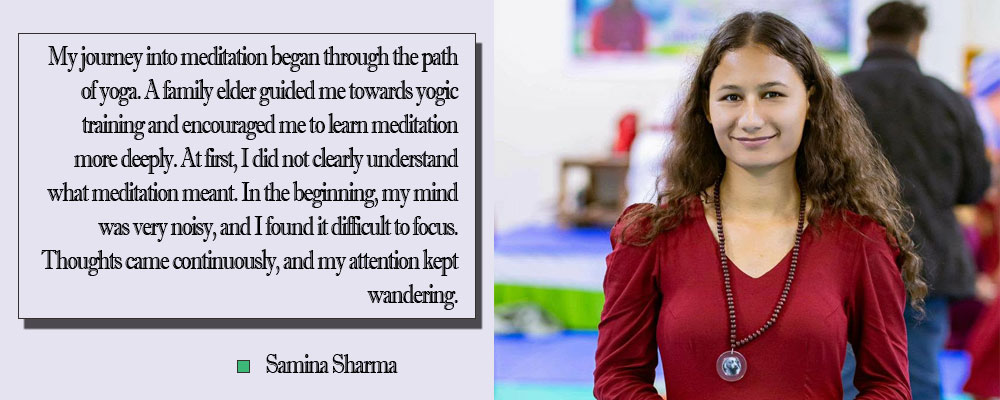
My journey into meditation began through the path of yoga. A family elder guided me towards yogic training and encouraged me to learn meditation more deeply. At first, I did not clearly understand what meditation meant. In the beginning, my mind was very noisy, and I found it difficult to focus. Thoughts came continuously, and my attention kept wandering.
Slowly, with regular practice, I began to notice positive changes. I became more aware of my thoughts and emotions. I felt calmer and started understanding myself better. Meditation taught me how to stay with myself without fear. By observing the mind daily, it gradually became more balanced, and I started feeling lighter from within. This personal experience has strengthened my belief that meditation is not separate from daily life. Meditation is not about changing yourself; it is about understanding yourself. Meditation gives the mind and body a chance to relax, reset, and heal.