- Saturday, 6 June 2026

Changing Art Of Democratic Governance

Nepal is in the centre of the communication revolution. Once marginal social groups detached from everyday political life, Nepali youths have suddenly seethed and surged as democratic innovators. They have challenged the circle of old political classes, retaining the status quo of septuagenarian leadership and stoking contradictions in party politics. It symbolises a general pattern of regime change in many Asian, African and Latin nations against the waning capacity of political classes to keep the spirit of constitutionalism, political stability, economic dynamism, supply of public goods and adapt to the zeitgeist. General frustration of youth against the governing classes produced a climate of doubt about the efficacy of majority rule, electoral legitimacy and the validity of their statecraft.
Critical mass of attentive public has found their leaders lured to the pleasure of their private life in show-business through their connection to special interest groups and overlooked to animate their public responsibilities. Nepalis have found that the constitutional promise of the creation of an egalitarian society is hijacked by their neo-liberal consensus on policy that demanded the withdrawal of the welfare state from the intervention in economic policies. As a result, the fair distribution of power and wealth characteristic of the welfare state has suffered the reverse. This institutionalised people to civil society, political parties and the government and eroded their loyalty to the state.
Crisis of welfare state
The crisis of welfare politics drifted Nepali democracy into a pre-democratic era as septuagenarian figures converted political parties into a patronage machine and failed to respond to growing demands of technology-driven youth and wage-earning people for democratic quality and justice articulated in the Nepali constitution. Growing scandals of political corruption, commission and rent-seeking of political classes and impunity for criminals and deep state marked an entropy of democratic values and concern for the public goods. This has contributed to the growth of negative activism by the media, non-partisan civil society and public intellectuals and several cause groups who lent support to the recent youth revolt as a light of change in haste to atone for its vague outcome later.
Democratic imagination loathes the persistence of undemocratic reality. It has created a paradox: increasing mass participation in electoral and crowd politics without the negative effects of eroding the society-state coherence. Democracy can constantly overcome its deficiencies of power lust of leaders against community welfare through its self-corrective mechanisms of power checks and balances. In Nepal, it has fostered individual freedom and leadership entitlements without shoring up the capacity of people and the state to demolish hallucinations of progress. Only a strong state is capable of fulfilling its constitutional duties and realising the positive aspect of human aspiration for inalienable rights to work, liberty, justice and dignity. In a feeble order of the state, it is not democracy but geopolitics that runs wild.
Civic institutions, voluntary associations, non-partisan civil society, independent media, courts, critical opposition and public intellectuals outside the establishment are institutional safeguards to protect the negative liberties of Nepalis. They enable them to organise their lives in society and achieve self-governance. Democracy, by its very nature, averts extremism, radicalism and populism of all kinds and brings politics to the virtues of moderation, compromise and common ground whereby all Nepalis have a voice, visibility, political autonomy and a life of choice. But in Nepal, extremism has subverted both democratic organisations and the experience and evolution of progress in a non-linear way. The domination of money in all aspects of life has left the poor and nature without choice but to succumb to its values, which has crippled the smooth political and cultural evolution of the nation to a vibrant participatory democracy.
One key problem of septuagenarian leadership is to postpone the resolution of problems. Problem solving capacities of various layers of institutions are essential to a transition to information-driven participatory democracy with equal justice and equal opportunity to all Nepalis. The other is the gift of rhetorical communication without substance. Nepali government has to expunge all those institutions created to foster patronage politics which remains a fiscal burden on the state. Similarly, the onerous administrative and political structures and classes must be trimmed down to make the lumbering governance smart and useful so that it can function in public and national interests and muster public trust and legitimacy.
One crucial point is that Nepal needs to create a level playing field for political parties of all hues, allowing them to compete on policy matters and produce positive political outcomes for all people, regardless of their social distinctions. This means that party funding by corporate elites and media support to big parties should not skew the opportunity for small parties. Nepal’s political history shows that with the articulation of proper issues, small parties can become big parties, while loss of public issues and arbitrariness can cut their size. Likewise, personalisation of electoral politics reduces the choice of voters who do not build a stake in its outcomes. A rich array of options for people’s participation in politics can expand democratic space.
But mature participation in electoral, political and development affairs requires continuous civic education to people of all generations who can exercise their conscience and select wise leadership capable of cultivating civic culture. This can question any lure to political fundamentalism, ideological indoctrination and illuminate them to the growth of panoptic art of democratic governance played beyond the binary code of friend and foe. Democracy is not like dramas where shots are called not by the actor but by the director.
Nepali youths have shown willingness to take risks essential for regime change but not sufficient in order to achieve modification in prejudices, practices and manners of negation, syndicate and an impulse to the irrational part of human nature. They keep on sniveling and whining in the public sphere to reform king Midas touch politics that stresses on material possession rather than the cultivation of political morality and nurture leadership art to live up with their political vocation of promoting the good life of Nepalis. Nepal’s native intellectual culture of indifference to greed and a high savor to community spirit are conducive to the art of democratic rule. Civic virtues are essential for rational political life and harness an inner-party democracy, democratisation of society and promotion of a culture of peace.
The new politics of youth demands the primacy of popular sovereignty over their marketisation and addiction to consumerist culture against the constitutional spirit of the welfare state, which requires corresponding art of statecraft. Nepali leaders must be able to resolve the dialectical relationship between the egalitarian virtue of the constitution and the operation of its opposite, neoliberalism. The grip of neo-liberalism has abridged the class consciousness of Nepali parties. Nepali youths have provided extra-parliamentary and extra-constitutional energy for regime change but they lack coherent ideas, policies and leadership to emerge as a different political class away from the establishment circle to shape the future of the nation, respond to the national political predicament and avert the looming specter of anarchy.
Information-driven social movements are seeking to replace the monopoly of the closed world of old political classes emerging from electoral mandates for their inefficiency to enable the Nepali state to constitutionalise the society, economy and sub-national organisations, control politics from being manipulated and formulate public policies beneficial to the entire people. The information-driven classes have yet to link themselves with the rest of society and clearly understand and underline public policy issues so that constituencies of change can be created for broad-based participatory democracy.
Nepali youth also to transform their diverse networks into a social solidarity to become a potent force of democracy. Their solidarity with cause movements and the young generation of party leaders can add civic vigor to the realisation of their goals in the chrysalis period. The utility of these movements is enhanced by the focus of their attention to the general interest of ordinary Nepalis, unlike the conventional political parties, which have an interest in the domination of all governing positions of the state and political system and keep a disconnect from the extremely weak legislative structure and the people. The financing of caucus groups across party lines, interest associations, pressure groups and youth leaders across political parties by many donors in the past has weakened their legitimacy and efficacy.
Energy for change
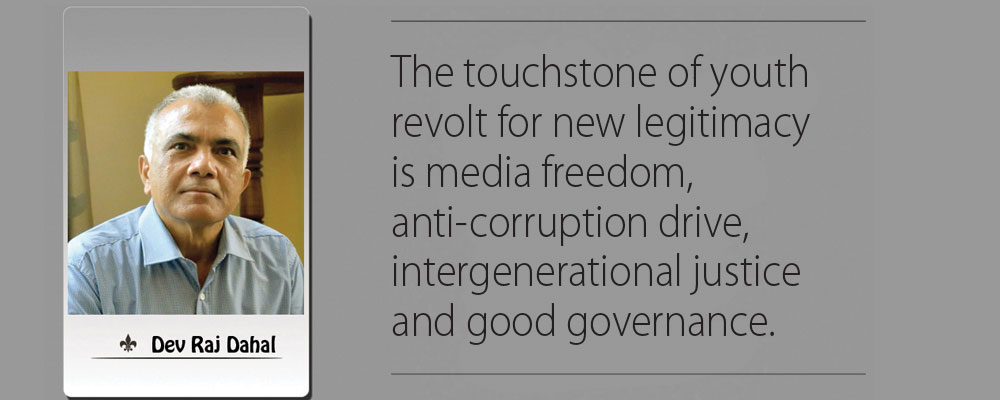
The media exposed their malfeasance, the anti-corruption watchdog highlighted their corruption and the Auditor-General published financial absurdities. Now the youth’s energy for change is infecting all political parties, their leadership, organisational structures and membership patterns beyond the electoral game of politics. The touchstone of youth revolt for new legitimacy is media freedom, anti-corruption drive, intergenerational justice and good governance. The formal concept of majority rule to the inclusiveness of diversity, has expanded the space of democracy in Nepal. There is a shift in legitimacy from the nobility of birth, freedom of acquisition, charisma and rituals of elections to evidence-based performance of leadership.
This means Nepali leadership must find a new balance in intergenerational justice and reciprocity. The current generation has no right to bind the future generations to the obligations of crippling resilience of nature’s cycle, debt, dependence, mis-governance and tilted foreign policy without assuming responsibility. In this sense, public authorities, both elected and selected, must be responsible for promoting public goods as a new art of democratic governance. Democracy itself is a public philosophy that mediates the interests of individuals with the state and enables all intermediary institutions to engage in cooperative action to subdue anomie, pull Nepalis up out of the maelstrom of anxiety and project sovereign national identity abroad.
(Former Reader at the Department of Political Science, TU, Dahal writes on political and social issues.)