- Sunday, 3 May 2026

Fighting Orwellian Bents Of Leaders

Not only history books but also literary texts can represent politics to a considerable extent when they truly capture it. Among others, George Orwell's one of the best-selling novels, Animal Farm, tells the tale of unfair manipulation for political power. This novel is a political satire that recounts the animals’ revolt against their human master, Mr. Jones, who is supposed to look after Manor Farm. As the story goes, Mr. Jones of the Farm is so lazy and drunken that he forgets to feed his livestock. Thinking that the master is insensible to the needs of his livestock and fails to meet their requirements, they hold a meeting and decide to drive him out of the Farm.
The following rebellion, under the leadership of the pigs, Napoleon and Snowball, vows to eliminate the terrible inequalities of the farmyard between animals and humans. The renamed Animal Farm is organised to benefit all who walk on four legs against the injustice meted out by those who walk on two legs. But after a short while, the ideals of the rebellion are corrupted, and the needs of the general animals are ultimately forgotten. The initial promise “All animals are equal” turns in no time to “all animals are equal, but some animals are more equal than others”, placing the pigs in a superior position to the horses and donkeys in an inferior one. Consequently, something new and unexpected emerges.
Nepali revolutions
The narrative in Animal Farm can be likened to the Nepali revolutions. It can reasonably be argued that the democratic ideals practiced in the aftermath of the 1990 revolution were allegedly corrupted, leading to further rebellion against the constitutional monarchy and the establishment of republicanism. Opposing the unjust inequalities of the ruler and the ruled under the Rana regime and the autocratic Panchayat system, a democratic movement occurred. No sooner had the democratically elected government been formed than intra-party turmoil in the ruling party ensued in the mid-nineteen-nineties, and the governments that were constituted afterwards were not stable either.
Even after the advent of republicanism, inter-party unfair competition and intra-party feuds have discredited politics itself, let alone the credibility of prominent leaders of each party. There must be grave reasons for what is happening. That if one is true, the other is wrong is an axiomatic truth. In this sense, if the disgruntled voices reverberating in the ears of the Nepali people are right, the epoch-making revolutions in Nepal have gone wrong. On the contrary, we have been assuming that both are true even if they are mutually exclusive. Despite prominent leaders’ defense of their revolutionary cause, discordant voices continue to be heard.
It looks like the leaders are defending the indefensible while the people are tolerating the intolerable. For a successful revolution, they should not be contrary, yet we are witnessing a series of these misfortunes. It is more than embarrassing that the leaders’ defenses are at odds with the people’s voices. Like political discourse, a literary text is also not without ideology. Orwell might as well be ideologically loaded, his ideology being democratic socialism, as he hinted that Russian Stalinism was corrupt under the leadership of Joseph Stalin, the prototype of Napoleon in Animal Farm. In the European context of the mid-1950s, democratic socialism was in the offing, which Orwell seemed to favour.
It was fair to oppose a totalitarian form of government as it existed in the then Soviet Union. Still, it was simultaneously unfair to be silent about Nazism, led by Hitler, and Fascism, led by Mussolini slightly previously, for a staunch supporter of democratic socialism. Despite Orwell’s claims, it would be presumptuous to accuse each executive of corruption without ample evidence, but we cannot deny that people are resentful. What has created dissatisfaction among them is not simply financial corruption as such, as many thinkers claim, but the ambition of a few leaders that has marred the beauty of democracy, not to name anyone, lest there be mere accusations by an unauthoritative person.
Still, there is something behind the angry reaction of the youths in the name of Gen Z that recently erupted in the Nepali streets. It is rather the inherent ambition of executive leaders to remain in power indefinitely, which is possibly the worst part of our democracy. Another genuine reason for the apparent failure of democracy is the unrequited desire of an aspirant for an undeserved position for sordid personal gain. In some ways, even the executive leaders try to appease the cadres, just as the cadres do the other way round. Almost all parts of the state mechanism are influenced by this malpractice.
We cannot blame the executive leaders alone for what is happening in the present context, however. To a large extent, the servile attitude of the people in general, and party cadres in particular, is also responsible for the current situation. As long as the cadres remain docile toward their executive leaders, and as long as the people, as voters, are willing to vote for a fixed political party in each election, a government fails to fulfill the people's dreams of improving the quality of life and bringing prosperity to the nation.
Terrible ambition
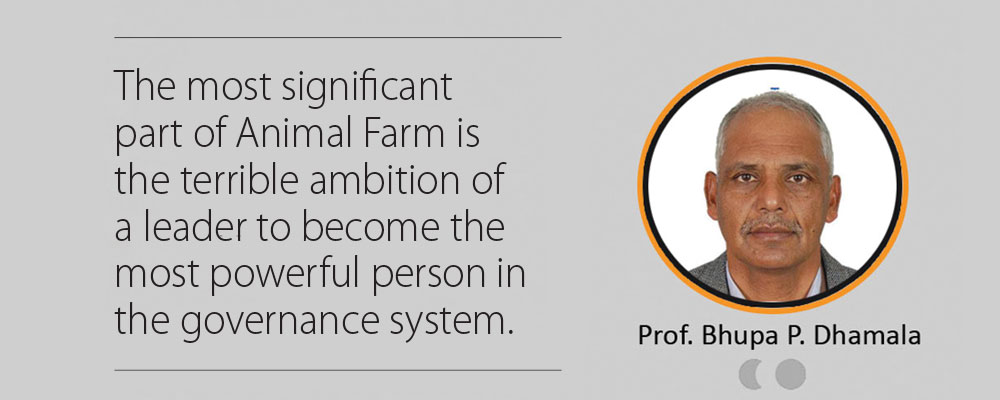
The most significant part of Animal Farm is the terrible ambition of a leader to become the most powerful person in the governance system. The corrupt attitude of the ruling animal may not be like the human leader’s ambition of being powerful; nevertheless, it is no less harmful to the sustenance of democracy. This, in essence, is the message of Orwell’s Animal Farm, which is as valid today as it was seven decades ago. No need to reiterate, it is as valid in the Nepali context as it was in the European context at the time of its publication. The essence of Orwell’s Animal Farm is not merely a hollow political slogan but a meaningful message to human life.
As a matter of fact, each citizen’s individual freedom and the state’s control are always in opposition. Where there is excessive control, democracy hangs overhead, and where there is excessive freedom, anarchy is loosened. A successful leader is the one who keeps them in balance.
(The author is the chairman of Molung Foundation. bhupadhamala@gmail.com)