- Saturday, 6 June 2026

Federalism Helps Fight Poverty

Poverty reduction is a central goal of the development policy of developing countries worldwide, including in the Sustainable Development Goals (SDGs). Over the years, poverty has been conceptualised as not just income deficiency but also deprivation in health, education and participation in governance. In countries with significant social, economic, cultural and geographic diversity, such as Nepal, federalism can provide a governance structure that can enhance poverty reduction by decentralising power, resources, duties and responsibilities to subnational governments. Federalism, as a political and administrative system, ensures that decision-making is closer to citizens, promoting more pro-poor development interventions.
Nepal’s transition from a unitary state to a federal system under the 2015 constitution created three levels of government: federal, provincial, and local. This federal structure is intended to ensure participatory governance, equitable development, and inclusive growth, all of which are critical to reducing all forms of poverty at a faster rate than under the unitary state. Historically, poverty has been concentrated in remote mountainous and hilly regions where access to infrastructure, healthcare, employment, market and education is limited. For instance, provinces like Karnali and Sudurpashchim consistently have higher poverty rates than the Koshi or Bagmati. Marginalised groups such as Dalits, Janajatis, women, and disabled persons are relatively poorer than other groups.
Low productivity
Agriculture dominates livelihoods, yet productivity is low. Limited decent employment opportunities in agriculture, especially for youth, contribute to continued poverty and high dependence on foreign employment. Unequal access to social services such as schools, hospitals, clean water, sanitation and electricity has been perpetuating intergenerational poverty for some families. Natural disasters, climate change, and economic crises exacerbate poverty, particularly in rural areas. Nepal’s national poverty headcount ratio has gone down from 41.76 per cent in 1995-96 to 20.27 per cent in 2022-23. This is about a 22 per cent reduction in the 28 years, just a little more than one per cent per annum.
This is clearly a slow achievement. Only the last seven years (2016-2023) fall under the federal regime, while the rest of the period was under unitary rule. Federalism provides multiple pathways to address various poverty challenges by empowering subnational governments to better respond to local needs. Local governments understand the specific conditions of the poor, available resources and thereby apply a better strategy to counter poverty. The federal system typically has fiscal transfers that allow central governments to provide resources to poorer subnational units as identified by the fiscal commission formula.
Unlike in the unitary system, transfers through grants, subsidies and shared revenues can ensure that disadvantaged regions receive sufficient funds for development and poverty reduction programmes. Indeed, the equalisation grant aims to provide financial resources to less developed provincial and local governments to reduce regional disparities as reflected by the level of development, although local-level poverty data are still lacking. Further, federalism enhances citizen participation by bringing government closer to the people.
Local communities can participate in budgeting, programme design, and monitoring, ensuring that poverty reduction programmes reflect the needs of marginalised groups. The mandatory ward-level consultations on social protection schemes or school nutrition programmes can ensure that the most vulnerable families benefit and overcome their poverty. Similarly, subnational governments can pilot innovative programmes to address poverty rather than top-down under the unitary system. Successful programmes can then be scaled up nationally, creating a flexible system for adaptive development. In doing this, local governments may compete for budgets from the federal government for successful innovative programmes for rapid poverty reduction.
Similarly, a clear division of powers in federalism allows citizens to hold local authorities accountable for poverty reduction outcomes. This is pro-poor development. Transparency in local governance through public budgets and performance reports improves programme efficiency and reduces misuse of resources, facilitating more local development and thereby greater poverty reduction. Accountability tools such as public audit and public hearing provide a voice for the poor and make the local authority more accountable. Despite the above-stated potentials of federalism for poverty reduction, a number of challenges are faced by subnational governments in their efforts to tackle poverty.
First, many local governments lack trained human capital, technical expertise, and planning capacity to design effective anti-poverty programmes. Second, more developed regions are attracting more private resources, investment, and talent, leaving less developed regions behind. Third, poor alignment and coordination among federal, provincial and local policies, programmes, projects and budget allocations have been undermining the effectiveness of anti-poverty programmes. Fourth, local elites have been capturing resources or prioritising political interests over public welfare.
This has also undermined rapid poverty reduction. Additionally, lack of or inadequate accurate local-level poverty data makes targeting difficult, reducing program efficiency and increasing elite capture. The current federalism system must tackle these challenges. For this, they need to invest in local human capacity development through training local officials in local development planning, budgeting, monitoring and participatory governance. Designing equitable intergovernmental fiscal transfer systems, by further reforming the existing system, so that sufficient resources reach the poorest regions, is also equally important.
Holistic development
Integrated, coordinated and holistic development efforts of federal, provincial and local governments in various sectors in collaboration with the private sector and non-government sector are necessary for meaningful poverty reduction. Innovative governance tools such as a participatory approach, evidence-based policy and programme design, and better public service delivery are also required to ensure pro-poor governance. A few local governments have already introduced these measures.
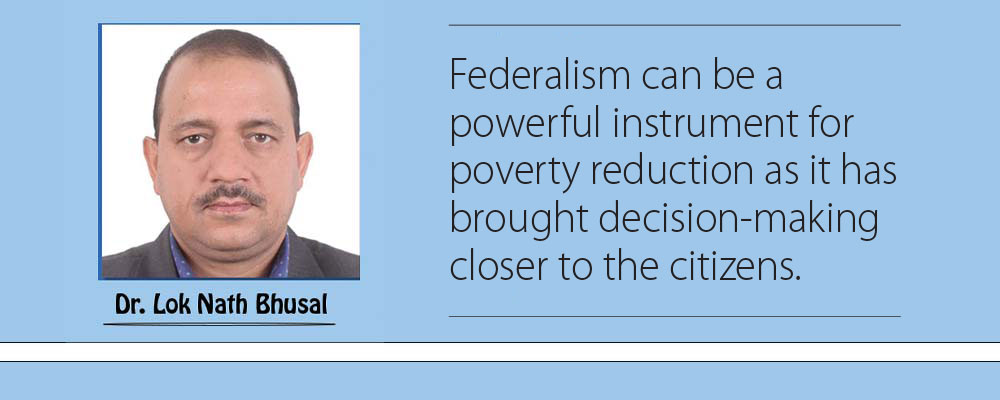
Federalism can be a powerful instrument for poverty reduction as it has brought decision-making closer to the citizens, allocated resources more equitably, encouraged participatory and accountable governance and allowed local innovation and experimentation. There is need to assess the actual contribution of federalism in poverty reduction in the last 10 years with a comparative perspective of the unitary system.
(Dr. Bhusal is a development expert.)