- Sunday, 3 May 2026

Soti seeks recognition for iconic children's song
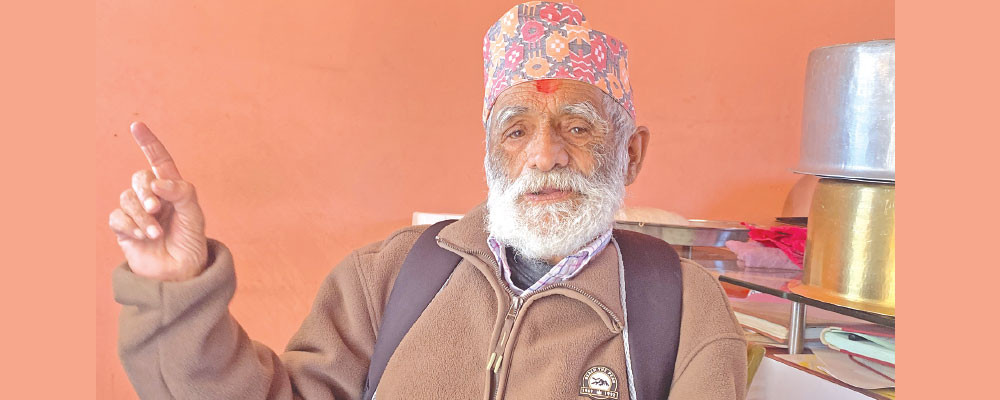
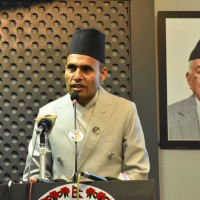
78-year-old poet Deepak Soti

By Bomlal Giri,Nawalpur, Dec. 13: The popular song “Meow Meow Biralo” has been searching for its rightful copyright owner for forty years.
The song has been viewed 166.7 million times on the YouTube channel Nanibabu. A re-upload of the same song on the same channel has garnered an additional 49.3 million views.
Similarly, the version uploaded by Chunumunu TV has 4.7 million views, while the upload by Prashanna BC has 2.2 million views.
Dozens of YouTube channels have uploaded this children’s song sung by various artists, yet none have revealed the identity of the song’s original creator.
Instead, many channels warn that copying or re-uploading their music or videos will result in strict action under prevailing laws.
Only a few people know that the real creator of this children’s song is 78-year-old poet Deepak Soti, a resident of Kawasoti-11, Nawalpur.
He wrote the song in 1968 (2025 BS) and recorded it in 1971 (2028 BS) at Ratna Recording Studio. But his authorship was never acknowledged, and even though the song has been played millions of times on YouTube, his name is still missing.
Not only that, the song is also printed in a Nepali textbook published by Ekta Prakashan—with no mention of his name. This omission has deeply saddened Soti.
The poet worries that he may not receive recognition for his creation during his lifetime, even though the song has brought joy to generations of children.
“I became interested in writing poetry after I won second place in a district-level poetry competition for my poem ‘Naroka Malai’ and received a prize of Rs. 50 from poet Siddhicharan Shrestha,” he said.
He added, “It was a Saturday in June/July 1968. My mother had gone to the farm, and while I was at home watching my younger brother, a cat came and started drinking cow’s milk. I wrote the song after seeing that.”
While walking from Lamjung to Kathmandu in 1971, he met Shyam Das Baishnav, a member of Pragya Pratishthan. Soti recalls showing the song to Baishnav at his home in Dillibazaar while having tea, where he was advised to record it.
Baishnav later introduced him to Bhairav Bahadur Thapa. Soti remembers that the song was recorded at Ratna Recording Studio with music by Bhairav Bahadur and vocals by his 10-year-old daughter, Sangita Thapa.
Soti said the song was recorded on plate number 81 of Ratna Recording, and he was paid Rs. 85. Along with this song, “Main Chhori Sundari” and “Ka Kha Ga Gha” were also recorded.
Senior musician Deepak Jangam, then managing director of Ratna Recordings, confirmed that he personally recorded the song with Soti.
“I have a long association with Soti. I liked the song and recorded it myself, but unfortunately, I can’t find any proof now,” Jangam said. “The only remaining source might be Radio Nepal, where the song has been played many times for years.”
Soti said the song was broadcast not only on Radio Nepal but also on All India Radio, Sri Lanka, and China.
“I was not that attached to the song in the beginning, but later I spent years searching for the identity of my own creation,” he said. “It hurt even more when I learned that it was printed in a textbook without my name.”
Following advice from musician Jangam, Soti approached the then Assistant Minister of Education, Kshetra Pratap Adhikari, and requested proper credit in the textbook. But the request was ignored.
He also raised objections with Ekta Prakashan when they published the textbook in 1993/94 without his name.
They apologised and even offered him Rs. 2,000 in compensation, but his name was still not included, and the lyrics were printed with mistakes.
“Not only did they fail to mention my name, but they also made errors in the original song,” he said. “Now it is all over YouTube, but no one credits me, and I have not received the royalties I deserve.”
After the cassette of the song broke during his move to Pokhara in 1986/87, he has repeatedly visited the offices of Radio Nepal and Nepal Television, hoping to restore his identity as the creator.
“It will be the greatest achievement of my life to be officially credited as the composer while I am still alive,” he said.
Tara Basti, head of the Programme Department at Radio Nepal, confirmed that the song is indeed by poet Soti, and that it has been played dozens of times on children’s programmes.
However, Purna Chandra Ghimire, Chief Programme Officer of Radio Nepal, said they have not been able to locate the original recording, as many old cassettes broke during the 2015 earthquake. “We are digitising all the old cassettes. Only a few remain. I would consider myself fortunate if I could find proof and confirm that he is the creator,” Ghimire said.
At 78, Soti is now preparing for a legal battle to claim copyright.
“I want to secure the copyright in my name. Even at this age, I haven’t lost courage. I will go to Kathmandu again, consult my mentors, and fight legally,” he said.
Poet Soti, born in Kunchha, Lamjung in 1949, remains active in literature. He has published numerous collections of poetry, criticism, elegies, and books such as Narok Malai, Meri Marsyangdi, Pulna Napreneka Phoolharu, Meri Aama Rundi Hun, Dui Batti Nibera, and Jagadamba Kabya.