- Sunday, 3 May 2026

Rukum West students relieve themselves in open
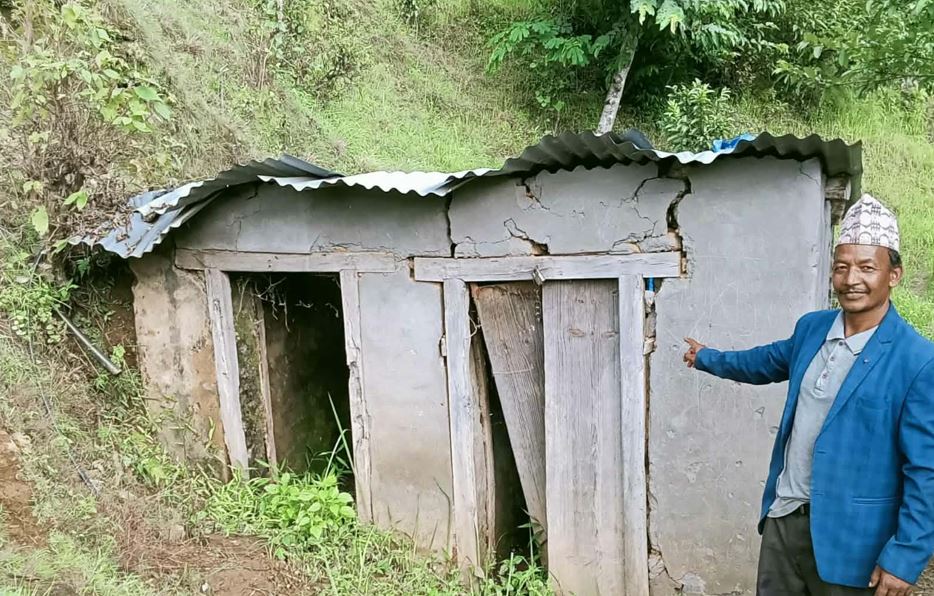
Photo: Raju Lamichhane Ghyankunj Basic School's toilet was damaged by the earthquake.

By Raju Lamichhane,Rukum West, Dec. 12: Students of Ghyankunj Basic School in Ranichaur, Sanibheri Rural Municipality-11, Rukum West, have been using nearby fields, forests and the river for defecation and urination due to the absence of a functioning toilet in the school.
The school’s toilet, already in poor condition, was completely destroyed by the Jajarkot earthquake of November 3, 2023. Since then, students have had no proper place to relieve themselves and are forced to use open areas around the school.
A Grade 3 student said they go to the fields to defecate and urinate because the school does not have a toilet. According to students, they either head towards the river, the forest or nearby farmlands. They also said they are compelled to wipe their hands with leaves instead of washing them with soap and water.
Headmaster Binita Khadka stated that the two-room toilet, constructed approximately nine years ago, was completely damaged by the earthquake. With no toilet, both students and teachers are facing difficulties. Teachers often have to use toilets in nearby houses, she added.
Although a temporary toilet was built using tarpaulin with the help of local organisations shortly after the earthquake, it is no longer usable. Due to the lack of a proper toilet, many students are unwilling to attend school, resulting in a drop in attendance, Khadka said.
The school currently has 38 students from Early Childhood Development (ECD) to Grade 3. Of them, 10 are in ECD and 28 are in Grades 1 to 3.
According to Dayaram BK, Chairperson of the School Management Committee, the school has repeatedly requested support from the local government and various organisations, but no help has arrived. He accused the ward office, rural municipality and education-related agencies of ignoring the school’s problems.
Lack of classroom space
The school has a three-room building constructed three years ago, which suffered little damage in the earthquake as it was earthquake-resistant. One of the rooms is used as an office, while the remaining two rooms accommodate classes up to Grade 3.
Headteacher Khadka said they are forced to run two classes in a single room, placing two blackboards on opposite sides and seating students facing opposite directions. This arrangement, she said, affects students’ concentration and hampers effective teaching and learning.