- Wednesday, 22 April 2026

Banke farmers strive to save Kalanamak rice
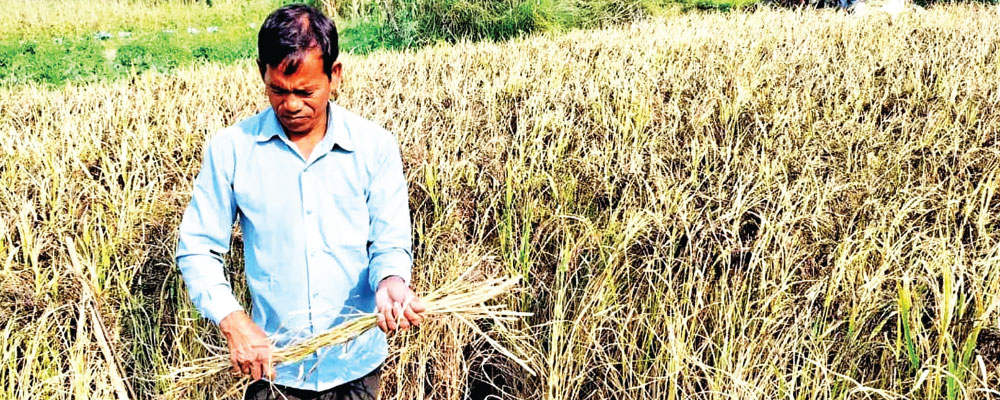
Photo: Siraj Khan/TRN Farmer Ganga Narayan Chaudhary, who is dedicated to preserving the indigenous Kalanamak rice variety through cultivation.

By Siraj Khan,Nepalgunj, Dec. 11: Kalonamak rice, an indigenous variety of rice, was on the verge of extinction due to low returns on investment, prompting farmers to abandon its cultivation.
However, special attention is now being given to its preservation in Banke District, thanks to the efforts of local farmer Ganga Narayan Chaudhary from Titihiriya, Baijanath Rural Municipality-8. Chaudhary has been cultivating this rice variety for the past five years in collaboration with the Agricultural Knowledge Centre.
This year, Chaudhary has grown Kalanamak rice on 32 katthas of land, producing 40 quintals of rice. Although he expected higher yields, he faced challenges from increased infestations of birds, rats, and insects as other rice varieties were harvested early. Despite these setbacks, he stated that the market demand for Kalanamak rice remains strong, with no difficulty in selling the rice.
While other rice varieties sell for around Rs. 3,500 per quintal, Kalanamak rice fetches up to Rs. 10,000 per quintal. Kalanamak rice is planted in the months of June-July and is harvested in November-December.
It requires ample irrigation and is susceptible to disease and pests, which increases the risk of damage, making it a more labour-intensive crop compared to others, said Chaudhary. In Banke, farmers have increasingly turned to hybrid rice varieties like Ramdhan, Radha 4, MP 60, and Gorakhnath, which are more productive and quicker to harvest.
As farmers have shifted towards commercial farming, traditional varieties like Kalanamak rice have slowly disappeared from the landscape.
The increased need for maintenance, irrigation, and the higher risk of pest infestations with indigenous varieties have led farmers to prefer faster-growing hybrid rice, explained Santosh Pathak, Information Officer and Senior Horticulture Development Officer at the Agricultural Knowledge Centre.
In the past, Kalanamak rice farming was common in Banke and Bardiya, but the emergence of new hybrid varieties has shifted farmer interest toward high-yielding crops that provide faster returns.
As the cultivation of Kalanamak rice has almost disappeared from Banke, the Agricultural Knowledge Centre has now initiated efforts to promote and conserve this traditional crop.
The Centre has begun awareness campaigns and introduced Kalanamak rice cultivation among farmers.
The seeds were obtained from the Khajura branch of the Nepal Agricultural Research Council and have been distributed for use in Titihiriya, Baijanath-8, to support the preservation effort.


-original-thumb.jpg)