- Thursday, 4 June 2026

67 families begin collective vegetable farming in Bardiya
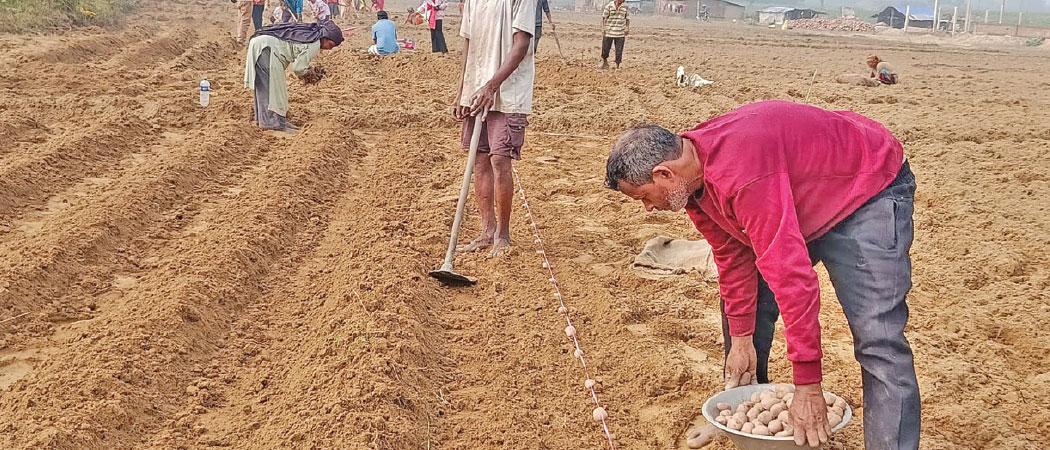

By Our Correspondent,Bardiya, Nov. 16: For the first time, 67 families in Tapara village, located across the Sarjun River in Gulariya Municipality-8, Bardiya, have started commercial collective vegetable farming.
After facing the risk of floods every year, the settlement has now shifted towards organised group-based agricultural production.
Members of the Shiva Agriculture Group and Namuna Women’s Group in Gulariya-8 have rented land together and begun cultivating peas, radishes and potatoes on around 75 kattha of land.
Local, many of whom are flood-affected, said that the initiative aimed to strengthen their livelihoods, and they are enthusiastic about the effort.
The programme is being implemented under the Emergency Livelihood and Safe Housing Construction Project, run by Caritas Nepal Bardiya Field Office with financial support from Caritas Nepal Italiana, and coordinated by Gulariya Municipality.
The area was severely affected in 2014 and 2016 when the Babai River embankment broke. To support long-term self-reliance, affected families have been encouraged to engage directly in agriculture.
Farmers said that they felt relieved after receiving seeds and materials through the project. Balakram Lodh, a resident of Tapara village, said the support has significantly reduced their financial burden.
Rajesh Yadav of Gulariya-7 also said he was able to plant potatoes on 12 kattha of land thanks to the assistance.
Urmila Gupta, Chairperson of the Namuna Women’s Agriculture Group, said that organised vegetable farming has begun this year due to strong encouragement and cooperation among the women in the community. She added that they plan to expand the farming area in the coming years.
According to Caritas Nepal programme coordinator Narendra KC, 67 families have been provided with free seeds, fertiliser and necessary materials to help them become self-reliant.
In the first phase, 48 quintals of potato seeds, fertiliser and irrigation equipment have been distributed. The organisation will also provide seeds for other vegetables, irrigation pipes, pesticides and agriculture-related training in the next phase.
Local believed that collective vegetable farming is helping Tapara, a flood-affected settlement, move towards self-reliance and sustainable livelihoods.
-square-thumb.jpg)