- Friday, 29 May 2026

Does Demonetisation Curb Corruption?
There is talk on and off of banning Rs. 1,000- and 500-denomination banknotes in Nepal. Such talk has arisen in the conviction that demonetisation will remove money earned through corrupt practices from the economy. But the question arises, will this measure produce positive results? Demonetetisation is one of the methods of reforming the economy by getting rid of not only black money but also counterfeit money. It is believed that the Nepali economy has black money and, to some extent, counterfeit money. It is necessary to expunge such money from the economy.
According to the Nepal Rastra Bank Act, Nepal Rastra Bank (NRB) has the authority to demonetise Nepali currency. Section 60 allows the NRB to withdraw from circulation banknotes by giving reimbursement. For this, a public notice needs to be issued specifying the time within which demonetised currency will have to be exchanged for valid currency. Likewise, in accordance with Section 52 (5), the government, on the recommendation of the NRB, can restrict the validity of banknotes to a specific place or office, thus limiting the use of currency.
Austere measure
Demonetisation is an austere measure. When it is resorted to, there may be repercussions on the economy, trade and daily lives of people. There may be short- and long-term effects. There may be immediate cash shortages as high-denomination currency makes up the bulk of cash in circulation and smaller-denomination currency will not suffice for cash transactions in today’s markets. Markets, trade, transport and other sectors may suffer a lot as these sectors depend on cash. Daily wage earners may also be hit hard, as they are usually paid in cash. With high-denomination banknotes banned, people living in border areas and rural areas may find it difficult to carry on transactions.
Remittances being received in cash may also be hampered. What is more, cunning people may take advantage of the situation at the cost of naïve people, who may be swindled out of their money by giving them short change for the banned banknotes they possess. Banks may also be hard-pressed to manage money. People will rush to banks for the exchange of banned banknotes. There will be long queues and tellers will find it difficult to manage the situation. ATMs may be overstretched due to a lack of high-denomination banknotes.
For how long can ATMs run on Rs. 100-denomination banknotes? In fact, banks will have to adopt logistical measures such as modifying and re-coding ATMs and other cash-disbursing systems. Demonetisation is also a costly process because, as a replacement for the banned currency, the government will have to print new banknotes. However, demonetisation will produce positive outcomes. There will be a curb on black and counterfeit money. But there is no guarantee that all the black money will be thrown out of the economy. Shrewd people may convert black money into white money through one means or the other. They may hold assets in forms other than cash.
However, demonetisation will promote digital payment systems. It is easy to transition from cash payment to digital one. Digital payment is becoming popular with young generations in urban areas. But the sticking point is that people living in rural areas and older people may face hassles in using digital payment platforms. Demonetisation may be adopted to ease trade and create currency unions. The European Union adopted the common currency – the euro – in 2002 by demonetising the currencies of the countries that wanted to use the common currency. The demonetised currencies remained convertible at fixed exchange rates for some time to facilitate transition.
Demonetisation may be adopted to fight hyperinflation. In 2015, Zimbabwe demonetised its currency – the Zimbabwean dollar – to combat hyperinflation plaguing the country. The degree of hyperinflation was beyond the wildest dreams: At its peak, the hyperinflation reached a month-over-month growth of 79.6 million per cent and a year-over-year growth of 89.7 sextillion per cent. The basic thrust of the demonetisation was to stabilise the economy.
It would be pertinent to mention that India carried out the demonetisation drive in November 2016. The country demonetised all of INR 500- and 1,000-denomination banknotes of the Mahatma Gandhi Series with an announcement of new INR 500- and 2,000-denomination banknotes. The motive behind this was to curb the shadow economy, promote cashless transactions and reduce the use of illicit and counterfeit money used for illegal activities and funding terrorism.
The move produced bad impacts: weeks-long shortages of cash disrupting the daily lives of people, long queues at banks for the exchange of demonetised banknotes with some deaths reported and a disruption of the economy. The stock market fell by six per cent on the day after the announcement of demonetisation and industrial production and the gross domestic product (GDP) also declined. As much as 86 per cent of the currency in circulation had to be replaced by new currency.
Positive results
According to the Reserve Bank of India (RBI) report out in 2018, INR 15.30 trillion out of INR 15.41 trillion in demonetised banknotes, which represented 99.3 per cent, was deposited in banks. Based on this data, analysts said that efforts on the part of the government failed to remove black money from the economy. However, India achieved some positive results. The demonetisation drive helped reduce terror funding, weaken Naxalite activities and encouraged people to adopt digital payment.
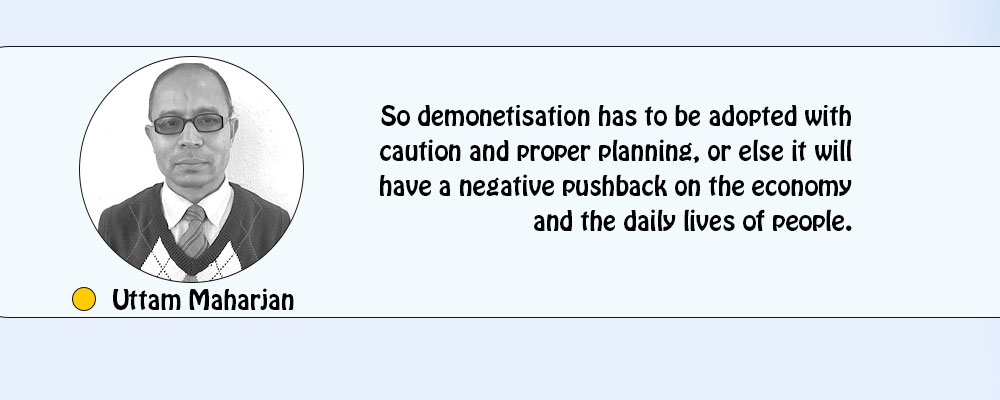
So demonetisation has to be adopted with caution and proper planning, or else it will have a negative pushback on the economy and the daily lives of people. Demonetisation may make it hard for those possessing black money to use it for illicit activities. The election to the House of Representatives has been slated for March 5 next year. The political leaders with ill-gotten money may spend the money during the election, influencing voters in their favour. From the perspective of curbing black money, demonetisation is one of the effective tools. But proper strategies need to be in place before going for demonetisation so as to lessen its impacts on the economy and people’s lives alike.
(Maharjan has been regularly writing on contemporary issues for this daily since 2000.)