- Thursday, 4 June 2026

Bolster Nepal-Russia Ties
 Tikaram Khadka
Tikaram Khadka
Tikaram Khadka
The historical journey of Nepal–Russia relations is long, yet formal diplomatic ties were established in 1956. Following the establishment of diplomatic relations with the then Soviet Union, Nepal received significant support in the field of industrial development, education, culture, science and technology.
During Prime Minister KP Sharma Oli’s visit to the Shanghai Cooperation Organisation (SCO) summit in Tianjin, China, he held a sideline meeting with Russian President Vladimir Putin. President Putin welcomed Prime Minister Oli to visit Russia at any time, while Prime Minister Oli extended a formal invitation for Putin to visit Nepal. Nepal also expressed interest in strengthening cooperation in education, health, industry, and tourism. Discussions included enhancing scholarship opportunities and exploring the possibility of direct flights between the two countries.
Recently, a Buddhist tourist group from Russia's Kalmykia Republic visited Nepal, coordinated by the Russian Embassy. They toured Pokhara and Lumbini, highlighting Nepal’s potential to attract Buddhist pilgrims from Russia. Although Nepal-Russia relations have continued after the dissolution of the Soviet Union, many of their dimensions remain awaiting concrete results. Both countries are believed to have strengthened their ties based on mutual respect, sovereignty, and the principles of a non-aligned policy.
Russia’s greatest contribution to Nepal has been higher education for Nepali youths. Thousands of Nepali students have studied engineering, medicine, science, social sciences, literature, and arts in Russia. Today, Russia-graduated students are occupying leading roles in medicine, engineering, academia and research. Such support has played a key role in raising Nepal’s human resource capacity. Significant projects established with Soviet assistance, such as the Hetauda Textile Industry, Biratnagar Jute Mill, and various technical training institutions, remain memorable today. Russia has also contributed to hydropower studies, geological surveys, and technical training in Nepal.
Nepal’s foreign policy emphasizes adherence to non-alignment, commitment to the United Nations, equal treatment of all nations, safeguarding national interest and sovereignty, regional and multilateral cooperation, and special relations with neighboring countries. Nepal-Russia relations encompass various dimensions. Russia has contributed significantly to Nepal’s development and people-to-people ties. Accordingly, Nepal should have strictly followed its foreign policy principles.
Western nations, led by the United States, have taken strong measures against Russia over its 'special military operation' in Ukraine. US President Donald Trump has taken steps, including his meeting with Putin in Alaska, to end the Ukraine war. Russia claims to be responsive, but a clear framework for ending the war remains absent. Meanwhile, Russia’s frozen assets in international banks, totaling around $300 billion, are being used to support Ukraine. Amid global actions such as cyberbullying and asset confiscation, Nepal has not effectively considered its historical ties or the bilateral dimensions. Nepal’s role should have focused on neutrality and advocating for peace, rather than taking sides, yet this has not been the case.
Critics also point to Nepal’s increasing dependence on the West, which may harm the country in the long term. Nepal and Russia share a long-standing and historic relationship but the two nations have to foster ties in the new context so that they have mutual benefit. Russia’s support of Nepal, the goodwill between the two nations, and instances of mutual exchange all confirm the existence of a special bond. Nepal needs to embrace a clear strategic vision to balance relations with global powers. This requires bolstering diplomatic strength, with competent diplomats, political stability and a foreign policy not driven by partisan interests in place.
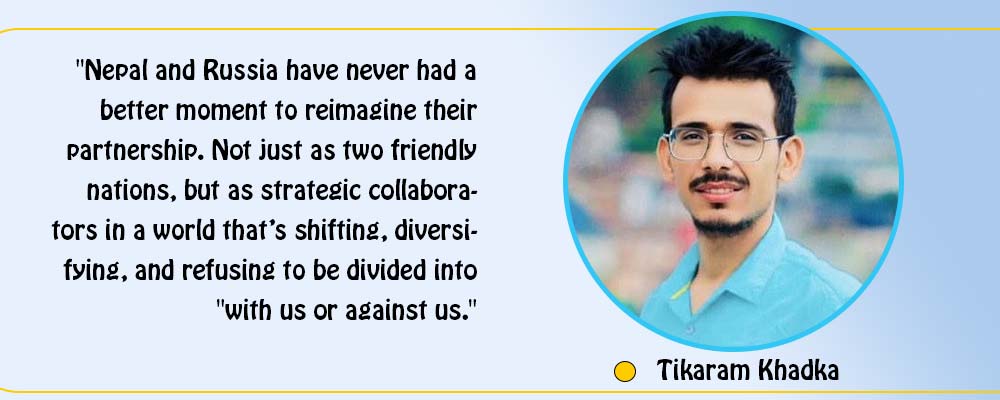
Russian Ambassador to Nepal Aleksei Novikov has praised Nepal’s foreign policy. In an article published in this daily, the Russian envoy commended Nepal's decision not to join Western economic sanctions against Russia. He also emphasised that there are possibilities beyond neutrality. He stated that: "Nepal and Russia have never had a better moment to reimagine their partnership. Not just as two friendly nations, but as strategic collaborators in a world that’s shifting, diversifying, and refusing to be divided into "with us or against us."
As Nepal finds itself increasingly caught in geopolitical crosswinds, it must take the opportunity to explore and revive historical and new dimensions of relationships that serve Nepal's national interests. The challenges Nepal has faced challenges in adhering to its own foreign policy, along with signs of bias in the global power balance.
A situation is emerging where close relationships are being reduced to mere formality. This raises concerns about Nepal’s long-term interests, problem-solving capacity, international presence, and the practice of its sovereignty. These are issues Nepal must address itself. There is no alternative for Nepal but to restore its old and historic relations by advancing its multidimensional ties with Russia, advocating for peace, internationalising its national priorities at the highest levels, and working for the welfare of its citizens.