- Thursday, 7 May 2026

Right policies can tackle challenges of climate change: DPM Paudel
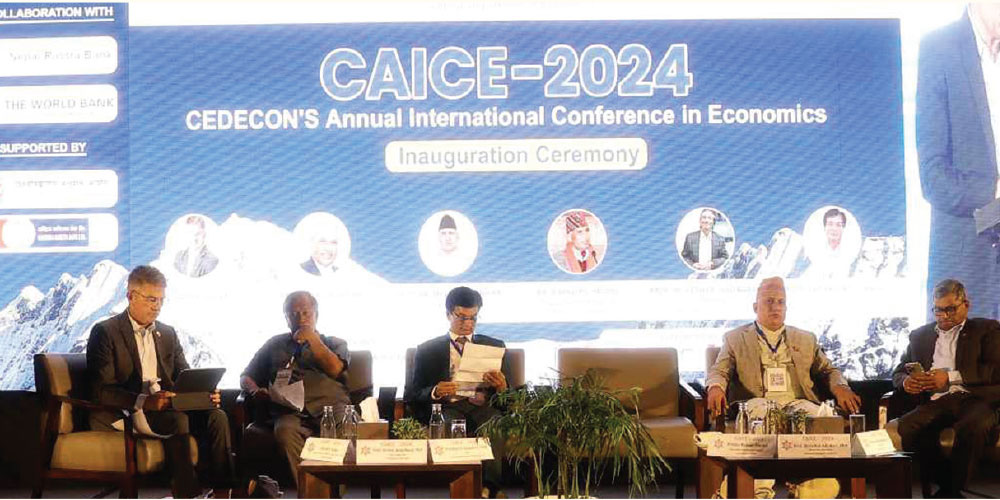

By A Staff Reporter,Kathmandu, Sept. 22: Deputy Prime Minister and Finance Minister Bishnu Prasad Paudel has said that Nepal has huge natural resources that can become the backbone of the green economy.
Addressing the CEDECON’s Annual International Conference in Economies (CAICE-2024) organised by Central Department of Economics, Tribhuvan University in Kathmandu on Saturday, DPM Paudel said that Nepal can contribute to regional stability and economic growth by exporting clean energy to neighbouring countries.
“Nepal has vast natural resources that can form the backbone of a green economy, our hydropower potential is still largely untapped, so by investing in renewable energy, we can not only meet our domestic energy needs, but also contribute to regional stability and economic growth by exporting clean energy to neighboring countries,” he said.
“Sustainable tourism provides a way to utilise our natural and cultural heritage. Eco-tourism, hiking, and conservation areas can create jobs, contribute to revenue, and protect our environment for future generations,” he said.
He further said that sustainable agricultural practices are critical to food security and reducing the risk of environmental damage.
“Practices such as organic farming, agroforestry, and effective land use will help preserve our biodiversity and increase agricultural productivity and production as well,” he said.
He said that the world is facing serious challenges in finding a balance between development and environmental sustainability.
He said that our country in the lap of the Himalayas is one of the most vulnerable countries due to the effects of climate change.
"The problem of melting glaciers, changes in monsoon and increasing number of floods and landslides have become a challenge for our economy, especially agriculture, hydropower and tourism. Similarly, Nepal's rich biological diversity is under threat due to environmental degradation,” he said.
DPM Paudel said that the Tarai forests, Chure hills and rivers are at risk, which not only threatens the wildlife but also the livelihood of millions of citizens who depend on these natural resources.
"Development and the solution to the environmental crisis may not be in conflict with each other. It is possible to protect the environment while growing our economy. The decisions we take today will define the Nepal of tomorrow." However, this requires bold thinking and decision. For this, the collective efforts and cooperation of the government, private sector, civil society, and the educational sector are necessary," he said.
He expressed his confidence that with the right policies, investments, and commitment to sustainable development, we can successfully face the challenges of climate change.
DPM Paudel highlighted the contribution of Tribhuvan University in producing highly qualified and efficient manpower in Nepal.
He said, "Conferences like this, which are organised with the aim of drawing meaningful conclusions after intensive discussions between experts in the respective fields, policy makers and stakeholders, can be useful, focusing on various issues related to the economic development and prosperity of the country."
The main topic of the two-day conference, "Development between environmental crisis and climate change" is important and relevant not only for Nepal, but for the entire world, he said.



-square-thumb.jpg)