- Friday, 8 May 2026

False Information Ecosystem
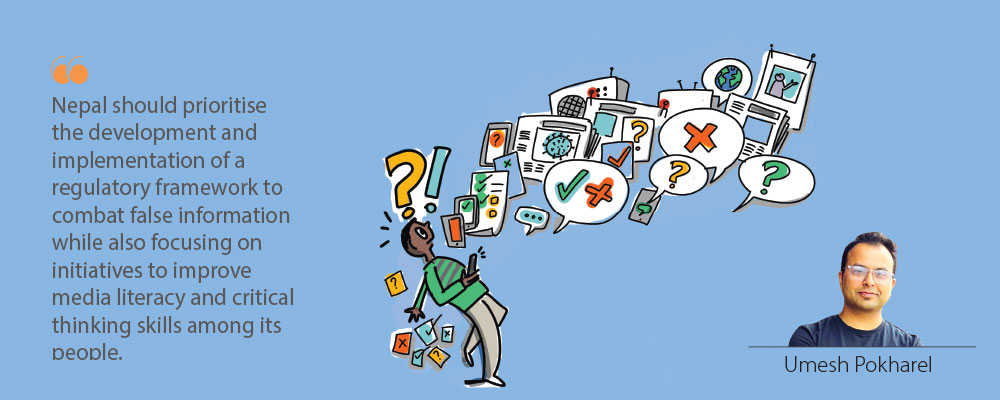

In Nepal, false information has been continuously disseminated through various media and non-media platforms in the form of misinformation (false information), disinformation (deceptive false information), and mal-information (true but harmful information). Such false information undermines public health, destabilises societies by fueling polarisation and unrest, erodes trust in institutions, weakens democracy, and leads to weakened social cohesion. In this backdrop, the article discusses the present situation of the mis, dis, and mal-information ecosystem in Nepal and its impact. Further, it discusses efforts to combat it.
Regulatory framework
Although Nepal lacks a comprehensive national law and policy to address false information, there are some legal provisions, guidelines, and Codes of Conduct (CoC) in place that can be referenced while dealing with misinformation, disinformation, and mal-information. Article 19 (rights to communication) of the Constitution of Nepal 2015 includes prohibitory provisions allowing for reasonable restrictions on acts (communications) that may undermine Nepal's sovereignty, territorial integrity, or harmonious relations between federal units, castes, tribes, religions, or communities. It also restricts acts (communications) of sedition, defamation, contempt of court, incitement to an offence, actions contrary to public decency or morality, hatred towards labour, and incitement to caste-based untouchability or gender discrimination. Similarly, the Electronic Transactions Act of 2063 (2008) prohibits the publication of illegal material in electronic form. Similarly, the Election Commission of Nepal (EAN) in 2077 BS brought ‘Policy on the Use of Social Media in Electoral Management, 2077. Further, the Journalists Code of Conduct issued by the Press Council Nepal (PCN) instructs to avoid misinformation, disinformation, and misinformation, although using different terminology.
Misinformation
The widespread use of social media platforms like Facebook, Twitter, and TikTok drives misinformation. As ordinary people who have lower fact-checking skills convert to media content generators, misinformation proliferation is obvious. A recent survey by the Centre for Media Research in Nepal revealed that over 90 per cent of social media users in the country encounter misinformation online.
Professional content producers, including the media, are also responsible for the increased misinformation. Factual errors in the media occur generally due to competition, lack of details, poor research, and excessive excitement about a story. Apart from this, dependency on false sources, an over-dependence on social media as a primary news source, and a lack of efforts and training to cross-check the facts are other reasons for the misinformation.
Some of the examples of misinformation in Nepal are the media’s incorrect reporting about Rojita Budahacharya receiving a full scholarship to NASA and the false reporting of Bharatpur mayor Renu Dahal receiving an International Mayor Award. Additionally, some online platforms falsely claimed Sweden declared'sex' as a national sport, and there were inaccurate reports about the court's order to close all bank accounts at Laxmi Bank.
Disinformation
Political actors and interest groups have been using the media and social media to spread false narratives to manipulate public opinion. During the November 20, 2022, election, fake news and doctored images were circulated to discredit opponents or sway voters.
Although the frequency is minimal, Nepali media have also been publishing disinformation. An example of such disinformation includes the publication of news on February 7, 2024, alleging that the Armed Police Force had purchased onions costing more than Rs. 4,200,000. This claim was later disproved by Nepalfactcheck.org. Another example of disinformation in international media is that the US media criticised China’s Belt and Road Initiative (BRI), while the Chinese media criticised the US development grant assistance Millennium Challenge Corporation (MCC) in Nepal.
Mal-information
Media outlets and social media users sometimes publish true but damaging information out of context. There are examples where such news has tarnished reputations, incited violence, affected privacy and confidentiality, and breached sensitivity. For example, in February 2022, various media outlets revealed the name of a rape survivor and published her photographs and other personal details in a case involving Paul Shah (Purna Bikram Shah), an actor in the Nepali film industry. Another example is that in May 2022, YouTube and online news portals posted photos, videos, and detailed information about the young woman who accused Manoj Pandey of rape, ignoring the negative repercussions for the lady. Apart from this, there are numerous cases where public figures, activists, and journalists’ personal lives are made public by the media even without their consent.
Impact
Disinformation exacerbates disparities in access to accurate and trustworthy information. As a result, a significant portion of society relies on sources tainted by disinformation. The circulation of misinformation has real-world, harmful consequences, such as violence against ethnic minorities or victimisation of children and young people. More importantly, having mis, dis and mal-informations in media content led people to have a lower level of trust in media organisations. False information ecosystems, according to the World Health Organisation (WHO), cause an infodemic.
Moreover, disinformation can lead to the formation of incorrect perceptions and attitudes, prompting misguided actions in response. The utilisation of unverified herbal remedies and alternative treatments during the COVID-19 period, tension and political unrest, sharp polarisation of people under the guise of the MCC, and distorted communal harmony during the Madhesh movement serve as examples highlighting the repercussions of false information in Nepal. Another significant example illustrating the impact of false information is the Hrithik Roshan Scandal in 2000, where baseless claims of the Indian film star expressing hatred towards Nepal and its people in a TV interview incited riots in Kathmandu, resulting in multiple casualties, injuries, vandalism of Indian businesses, assaults on Indian tourists, and disruption of public transportation. Misinformation has also affected police investigations, as seen in the misguided investigation of Nirmala Panta's rape and murder case.
Mitigation ways
Although inadequate, there are some efforts from the government, non-government, and private sectors to combat misinformation. There is a mechanism in the Press Council of Nepal to register complaints about media content. Utilising the provision, a total of 221 complaints were registered against media in 2079/80 BS, compared to 203 complaints registered in the PCN in 2078/79 and 192 complaints in 2077/78 BS. The PCN has resolved most of the complaints.
Another key player to combat false information in Nepal is South Asia Check, established by Panos South Asia in 2015; Nepal Fact Check, established by the Centre for Media Research in 2020; and Nepal Check, established by Deepak Adhikari in 2022. It is important to mention that many media outlets have corrected their information following fact-checking by these fact-checking websites.
Apart from this, the Nepali government has included some content related to media literacy in the secondary school curricula. Likewise, Accountability Lab Nepal had worked to address the disinformation through the CivActs Campaign (CCC), which disseminates accurate COVID-19 information via a network of youth leaders and various communication channels. Likewise, UNESCO, together with local youths, also put forth efforts to address misinformation.
Way forward
Moving forward, Nepal should prioritise the development and implementation of a regulatory framework to combat false information while also focusing on initiatives to improve media literacy and critical thinking skills among its people. Strengthening accountability mechanisms in the media sector, empowering bodies like the Press Council of Nepal, and fostering collaboration among various stakeholders are other recommended steps. Additionally, investing in and supporting fact-checking initiatives is also a necessity to combat misinformation and ensure the dissemination of accurate information.
(The author is a media researcher.)