- Friday, 5 June 2026

Execute Diplomacy With Prudence

Even after the end of the Panchayat era, Nepal has witnessed two systems: multi-party democracy with constitutional monarchy and the federal democratic republic, which abolished monarchy. We are now experiencing the fledgling Loktantra. To a large extent, Loktantra is regarded as the most liberal and human rights-friendly system. Whether Loktantra is an improved democracy is yet to be seen.
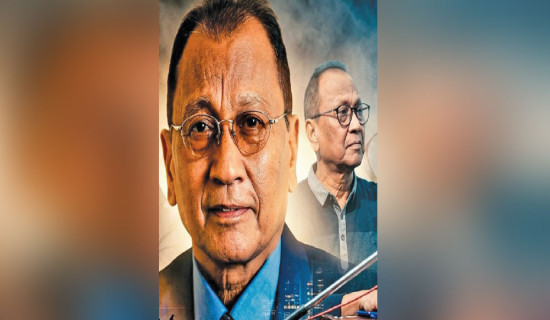
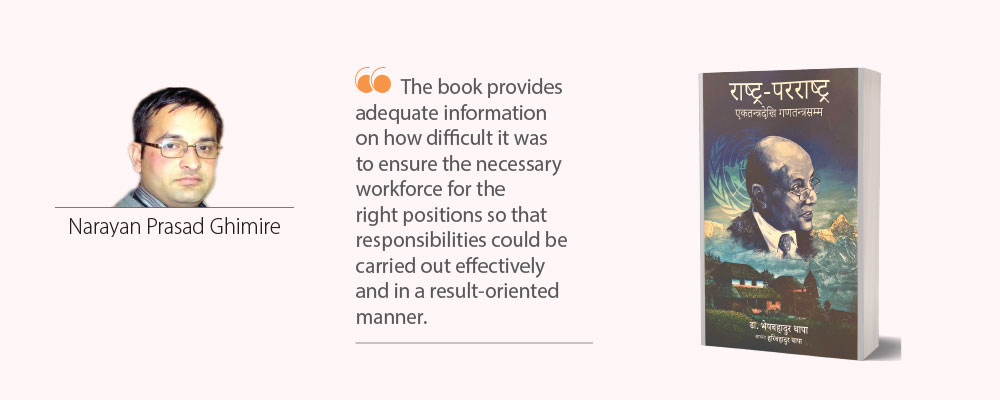
The preceding system, the Panchayat, where monarchy ruled the country, is not a distant past but always warrants study from different angles. For anyone willing to learn this period, a book, 'Rastra-Pararastra: Ektantradekhi Ganatantrasamma' has been brought by an eminent person, Dr. Bhesh Bahadur Thapa, together with journalist Hari Bahadur Thapa.
Although the title largely suggests that the book delves into the time since the Panchayat presented the republic with a focus on the country's internal and foreign affairs, development initiatives, and economic plans, it also gives a glimpse of the past Rana regime. As a memoir, it is a personal account of Thapa, who was born into a military family in a small village, Mejethum, in Tanahu district, and later became an influential person to initiate and decide on the country's development, economy, and foreign affairs.
In the book, writer Thapa has called himself a 'technocrat', who was brought by then king Mahendra from a US university to work on the country's development and economy while he was pursuing higher studies there. He has held plum positions since an early age. There are several references to his early age holding the posts at the decision-making table along with seniors—even those retired from the army—and his assertions on the agenda and the seniors' unease to sit together with him. He was initially given the post of Secretary at the Planning Commission and later the Governor of Nepal Rastra Bank, finance secretary, finance minister, and ambassador multiple times. He also became a coordinator of the Nepal-India Eminent Persons Group (EPG).
The role Thapa played in paving the foundations for periodic development plans and making budget planning evidence-based is worth remembering. Forwarding development projects while keeping in balance foreign and neighbourly relations was critical as it is now.
Similarly, erudition in dealing with foreign relations with diplomatic prowess and prudence is an equally significant reminder. For newcomers and those already dealing with foreign affairs, it can be a cherished text.
The book provides adequate information on how difficult it was to ensure the necessary workforce for the right positions so that responsibilities could be carried out effectively and in a result-oriented manner.
The memoir once again brings to light the role of King Mahendra and is likely to reinforce his image. Interestingly, the comparison between King Mahendra and King Birendra and finding Mahendra more liberal than Birendra can catch a huge section off guard. King Birendra, who handed power to the political parties, ensuring multi-party democracy, is often regarded as a more liberal ruler than the previous ones. To his point, the writer mentions, "The international arena had taken King Mahendra as an illiberal ruler for introducing the Panchayat system, while King Birendra was the liberal one. But reality was reversed. King Mahendra used to think about people's aspirations. Time and again, he asked, "What is the agenda in the discussion at Pipalbot, Newroad?"" (Page 178) The Pipalbot New Road was then an important public square like the present Maitighar Mandal.
The foreign countries were observing Mahendra's rule keenly. When Thapa was ambassador to the US, he gave an interview to the Washington Post. The reporter sought clarity and explanation from him on the panchayat system's characteristics. The reporter, Betty Beale, had asked Thapa on which side—the US, the liberal democracy, or the tyranny like that of Uganda—the Panchayat was heading. Thapa responded that King Mahendra's rule was towards democracy but not the tyranny of Idi Amin, ruler of Uganda. Amin was the notorious tyrant of the 1970s.
Just a mention of 'Idi Amin' in the interview had nearly cost Thapa's post, as the courtiers and employees at the royal palace used to conspire against him. Thapa brings to light a harrowing account of how some people at the palace used to afflict him.
We find another reminder of how the state authority sometimes creates foreign pressure on some sections as a strategic move to subside its impact. In the course of land reform, the writer faced indirect threats. The landlords were then major obstacles to management efforts. "In such a situation, we created international pressure to minimise internal pressure, which was a strategic one." Dr. Thapa, however, does not disclose whom they courted or who were those holding plum posts and obstructing land reform.
The observers worried about political upheaval, especially the suppression of parties including the Nepali Congress and its influential leader, BP Koirala, may wonder why there is little mention of such figures. Is it because the writer repeats himself as a 'technocrat' and wants to skip political issues? However, it is up to him to mention anything or anyone with a highlight or lowlight.
Moreover, the book is useful to learn about Panchayat-era prime ministers, royal ruckus, foreign manoeuvres, treaties and agreements, border issues, and the double standards of political parties. During his stint as an ambassador of Nepal to India, Thapa was impressed by the style and stature of leader Girija Prasad Koirala. "Koirala held talks with Indian leaders with such intimacy and fraternal feeling that the prime ministers since then have lacked it. Utmost intimacy could be reflected while Koirala was talking even on issues of state affairs to Indian leaders." He further views, "Currently, we need towering personalities like GP Koirala to deal with Nepal issues with India (Page 237).
Thapa's suggestions to the politicians, policymakers, and diplomats are quite relevant: He urges them to end the clandestine culture of holding dialogues. "While holding dialogue on issues of national interest, diplomatic manners must be followed. Without diplomatic discipline, agreement is impossible. But Nepal's foreign policy has flouted this rule." It is not only a suggestion but also a strong censure, warranting better handling of foreign relations.
For avid readers, the book provokes them to read further on panchayats and the development and politics of the time. For this, the books by former prime minister Surya Bahadur Thapa, former finance minister Devendra Raja Pandey, and former diplomats can be useful. The book is published by Fine Print.