- Sunday, 10 May 2026

Constitutional Rollercoaster Ride

The street had briefly hosted a lively, humorous scene. Some playful kids chased a cyclist who passionately chanted, 'Ram! Ram!' In jest, they teased his deity by chanting, 'Krishna! Krishna!' They would shout, 'Your bicycle has Krishna!' The rider promptly dumped the bike on the street and chanted 'Ram! Ram!' to lift back his ride with penance, as if his deity alone were superior. This amusing cycle of teasing and penance continued. Onlookers found it entertaining until he finally rode off.
Some individuals might find themselves in a dilemma, the constitution of the Sanatan Dharma being the reason. In fact, Ram or Krishna is the same deity, no less than the other in the unwritten constitution. Chanting any name is equally supreme. The devotee was bold and confident, as were the kids in Jest. This incident is comparable to Nepal’s constitutional journey as a rollercoaster ride. Nepal has cycled through a series of six constitutions over the past six decades. The land is the same, and the people are the same, but the constitution is much like a bicycle, once dumped and then picked up. Now, the constitution has its seventh version. The former six were impeached and overturned, as none had ground reality. During the change, a couple of them had seismic turbulence on the Richter scale. In a democracy, people’s anger and protests often overturn the law of the land. The demise of a constitution is a hypothesis about a nation’s progress.
Thus, Nepal now picks up the seventh law, known as the Constitution of Nepal. Evidently, it promises smooth and good governance for the Republican nation. Hence, the previous six were dumped like lesser deities. This one has come into effect like old shoe pairs replaced successively.
The constitution is democratic, following the practice of general elections. Representatives come to the parliament through the processes. Voters view them as committed to working tirelessly for the nation’s development and welfare. The masses feel that the leaders have experience, ideals, and vision.
Leaders worked under earlier provisions too. They were all lesser gods, though leaders were not dumped. The current constitution now holds the leaders directly accountable.
While leaders take pride in being its architects, they are grappling with complex processes. Critics and the media spark a debate, arguing, 'The nation, landscape, and transition remain unchanged when the constitution changes successively. The same irony echoes until today, seventy years after the Ranas.' The ground reality of leaders and the constitution both prompt an open question: 'Are leaders ineffective?'
Previous constitutions, too, had the same ego. All claimed that they were not lesser but a supreme god for the nation’s overall transformation. Miserably, all were disgraced with no pass score. In that sense, they faced impeachment when the current one had the claim of the least unworkable provisions and was ensured to be positive and effective. Under this practice, leaders are staggering against heavy electioneering expenses.
Nonetheless, the question remains: where is the nation, and where are the trends? An overall review of economic, social, or political contexts is just negative. A likely escape from this situation that leaders claim is, “The nations are in the phase of transition!” The catchword of transition is not new because people know a nation was in transition under all the previous constitutions. It means the transition phase continues until today!
This is a scene comparable to dumping the bike and lifting it again. If the bike is the written constitution, the unwritten part proclaims lesser deities. The unwritten world is one of virtual ethics, commitment, and vision with ground reality. Ethics is an individual leader’s inner quality pointer to being on the ground with the people. In contrast, leaders have set up a different ground. So, two contrasting narratives now come into view. One is Facebook, and the other is BankBook. Facebook symbolises public comments on the present corrupt scenario. The bankbook symbolises record-breaking, disgraced corruption. Such examples are numerous, say nepotism, Bhutan refugees, gold smuggling, Ncell, etc. Now a bigger terror is devouring the nation; her frontiers have turned volatile and vulnerable. Observers ask: How long shall expatriates and remittance workers sustain the nation's economy?
Leaders as well as the masses have the same biting echo: “The nation is off track.” Viewers critically observe that the constitution and leaders have no coordination. Clearly, then, who bears the lapses and who should be impeached? Is it the bike to be dumped or its riders? When the deity the leaders are chanting is supreme, they also have to prove they should not or need not dump the bike.
Keep riding the bike, affirming that the deity they worship is supreme. In this case, the riders (who are leaders) stand questionable. Moral virtues like being clean against corruption, having a vision for the nation, and being committed are just a few examples of an unwritten constitution. If it is said that both the constitution and leaders are immune, then leaders are still its guinea pig. Again, if the leaders say, “We’re clean," they are not subject to being impeached. In that case, the constitution calls for impeachment. But leaders claim, ‘we are the father of the constitution.” This conflict is unending.
In the viewers’ claim, a nation’s transformations so far are time-given, not leader-made. In truth, no bike or its rider could have obstructed them. Transformations as such are like a burst of population, a rise in literacy, education, and awareness, and the absence of jobs. This hypothesis is against those leaders who have turned into Your Majesty against the only monarch on the throne. Therefore, two books are open against them. One is Facebook, and the other is BankBook. But they still shrink back from past ground realities.
By now, they have forgotten about themselves, like who they were before. To know who they were, they could post their photo on the wall before they were into politics. That is their vital statistic today, which displays an ultra-convenient living standard. No other photo of the unprivileged masses is required. The burst of street public is like a volcano erupting in an unwritten constitution.
Assume for a short while that the masses are not against the constitution. Is then a leader subject to being dumped? Besides this, if leaders fail to defend themselves or convince the masses, the constitution itself is the guinea pig. Neither the ruling nor opposition benches have a resolution, although both are found battling with words against each other. The media is there to update this all for the unprivileged masses.
In the party system, leaders are leaders with experience in governance, such as making the constitution, driving party workers, making sacrifices for the nation’s common cause, and having the capacity to unite national forces. Desperately, no final say emerges, and all are conflict-ridden among themselves.
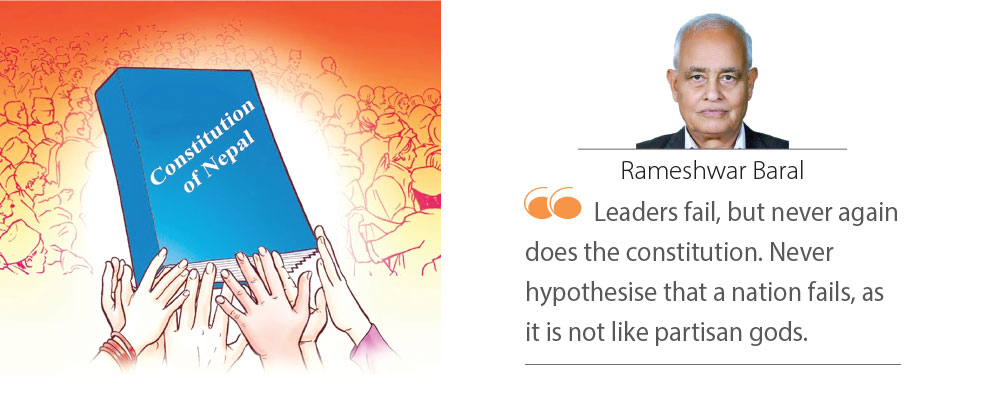
It’s like Anton Chekhov said about a learned prisoner in his story: first catching at one spar and then at another, amidst the wreckage of the ship in the deep sea (The Bet). Leaders fail, but never again does the constitution. Never hypothesise that a nation fails, as it is not like partisan gods. The show continues, though not logically.
(The writer is a retired lecturer of English.)
-original-thumb.jpg)
-square-thumb.jpg)
-square-thumb.jpg)