- Thursday, 23 April 2026

Dearth of potters to make Tihar Palas
By A Staff Reporter, Kathmandu, Nov. 12: Tihar starts Saturday and with it, starts the practice of decorating buildings and localities with colourful lights. Because of this, the sale of electric lights, imported from India and China, skyrockets.
But Tihar is also a time to bask in the natural glow of traditional oil-fed lamps, which is why the demand for clay Palas (lamps or, more accurately, lamp pots) also goes up.
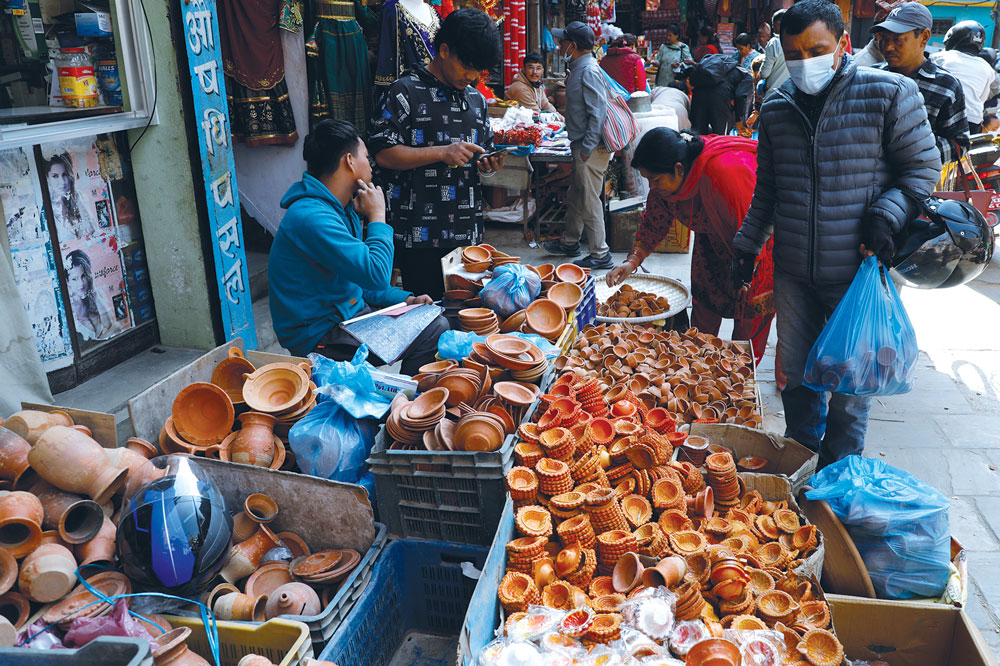
This demand is most visible along Janabahal and Bhedasingh in the core city of Kathmandu where huge crowds of shoppers gather everyday to purchase Nepali and Indian-made earthen lamp pots from traders who have been in the pottery business for generations.
The traders here sell a dozen Nepali Palas for Rs. 50 and Indian Palas for Rs. 30 per piece. Why the discrepancy? “The Indian ones look more beautiful and attractive,” Sabita Shrestha, a customer The Rising Nepal found buying clay lamps, said.
“The Indian oil-fed lamps seem to have occupied a larger share of the market this year as compared to previous years,” she observed. “But I still prefer Nepali lamps.
Businessman Shiva Shrestha felt this could be the case because of a lack of supply by Nepali potters. “I did not get as many earthen lamps as I had ordered. So I had to bring lamps from India to provide to my customers.”
In Kathmandu Valley, Bhaktapur’s Pottery Square is considered a hub for clay items including lamp pots. Members of the local Prajapati caste group have been moulding clay into various objects here for generations. But these days, few families are engaged in the traditional occupation, Mayor of Bhaktapur Municipality Sunil Prajapati, shared.
“Tihar peaks demand for Palas but the lack of manpower active in traditional pottery makes it difficult to meet this demand,” Prajapati said.
It is also getting increasingly hard to source appropriate clay. As Bhaktapur loses its open land to urbanisation, potters here are having to bring soil from faraway places like Sankhu, Panauti and Dhading.
Furthermore, as chimneys used to make clay Palas emit smoke and dust,
establishing clay lamp manufacturing centres in the city becomes difficult. “Modern chimneys that do not pollute as much have not developed in the area,” he informed.
All this has created a situation where not only the colourful oil-fed clay lamp pots but also earthen idols of Laxmi and Ganesh worshipped in Tihar are being brought from India, traders said.
In Hindu culture, clay objects are used in many ceremonies, including Pujas, birth and death rituals, and the festival of lights Tihar (also called Deepawali because of its association with Deep or lights).

-original-thumb.jpg)