- Monday, 11 May 2026

Global Fund To Fight AIDS, TB And Malaria

Over the decades, there have been significant investments to end the epidemics of HIV, TB and Malaria in low-and-middle-income countries where the burden is relatively high. In order to further accelerate the momentum of saving lives from these deadliest infectious diseases, the Global Fund To Fight AIDS, TB and Malaria (GFATM) is a worldwide movement to achieve the social goal of a healthier, safer, and more equitable future for all.
As a global health partnership, the Global Fund is consistently collaborating with a range of partners such as governments, civil society, foundations, development agencies, private sectors, people affected by the epidemics and the communities in order to harness insights and innovation by pooling global resources. There has been a historic progress in ensuring multi-sectoral response to combat the epidemics worldwide.
According to the Global Fund Report- 2023, health programmes supported by the Global Fund partnership had saved 59 million lives and mobilised more than US$ 60 billion as of the end of 2022. The evidence suggests that the combined death rate from the three diseases has reduced by more than half since 2002 in the countries where the Global Fund invests.
Unfortunately, the COVID-19 pandemic has been a major setback which continues to cause huge loss of life, human suffering and economic and social disruption across the globe. The devastating consequences for the poorest and most vulnerable communities are enormously experienced in many parts of the globe. However, the Global Fund partnership regained momentum in the fight against the epidemics in 2022. There has been notable progress in the treatments for HIV and TB. Similarly, distribution of mosquito nets remarkably increased to prevent malaria in the endemic countries.
Additionally, the climate change will continue to affect the epidemiology of existing diseases and facilitate the emergence of new diseases. For instance, changes in the rainfall, temperature and humidity are already shifting the malaria transmission into new areas. Similarly, forced displacement and migration of poor and marginalised populations will further increase vulnerability to HIV and TB.
Considering these ground realities, the Global Fund Strategy (2023-2030) has been instrumental in articulating the critical needs for catalytic investments and leveraging innovations in reducing new infections and overcoming structural barriers for improved health outcomes. By putting people and communities at the centre, concerted efforts are needed to enhance health equity, sustainability and synergic impact on the lives of key and vulnerable populations in low-income countries.
In recent years, more emphasis has been on building resilient and sustainable systems for health which is one of the priority investments to drive impacts against the epidemics. Therefore, national health system aims to enhance integrated and people-centred models of prevention, treatment and care. In order to further strengthen the engagement of the key populations and affected communities, it is necessary to ensure that no one is left behind and the interventions are designed to respond to the real needs and choices of the communities.
Apart from this, the cross-cutting issues of health equity, gender equality and human rights are integrated into community-led response. However, the existing efforts are still inadequate. Therefore, relevant policies, strategies and legislative environments need to be critically reviewed in order to identify the bottlenecks and address the programmatic gaps for effectively responding human rights and gender related barriers in combating the epidemics.
Like many other countries, Nepal established Country Coordinating Mechanism (CCM) in 2002 to ensure country-driven, coordinated, and multi-sector processes for leveraging resources to end the epidemics. The CCM essentially includes representative of all relevant sectors engaged in the response. More importantly, the coordination mechanisms at country and regional level should ensure that constituencies are represented in a fair and transparent manner so that their meaningful participation can raise the voices of the constituencies. There are critical needs to reflect the diverse and competing perspectives of the constituencies in the decision-making processes.
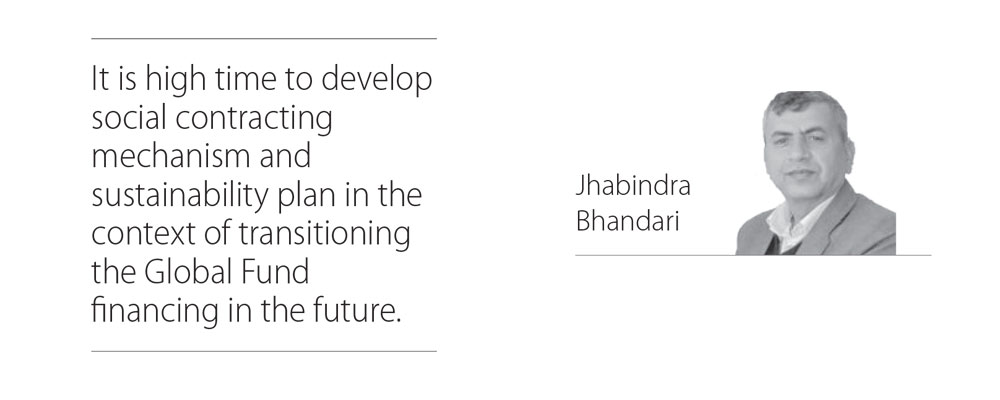
With the support from the Global Fund and other partners such as WHO, UNAIDS, USAID and few others, the technical assistance to the government has been effective in developing policies, strategies, guidelines, monitoring and evaluation framework, procurement and supply chain management, and strengthening community engagement to improve their access to prevention, treatment and care services in the communities. Within the national health system, it is high time to develop social contracting mechanism and sustainability plan in the context of transitioning the Global Fund financing in the future.
In the recent years, the Global Fund encourages all countries to build on their national structures where the coordination mechanisms can be appropriately positioned with the existing health platforms or governance. Hence, the positioning pathway to sustainable health governance will enhance coordination, national ownership, accountability and multi-sector partnerships by ensuring representation, active participation and engagement of governments, civil society, development partners, private sectors, people living with or affected by the epidemics.
In this way, all the constituencies are institutionally anchored in national health governance architecture. Through the positioning pathway, these coordination mechanisms can greatly contribute to the robust national health governance for sustainability. Therefore, the commitment to end the epidemics by 2030 is one of the most concrete targets among the Sustainable Development Goals (SDGs). Investing in the critical components of health systems is crucial to save the lives of the poorest and most vulnerable communities at large. With extraordinary resilience and innovations, we continue to fight these deadliest epidemics confronting humanity for years.
(PhD in global health, Bhandari writes on health and development issues)