- Monday, 11 May 2026

Cash Transfers Help Reduce Poverty

Governments around the world are implementing various cash transfer programmes with the aim of providing support to the individuals and families facing poverty and vulnerability. It has been noted that cash transfer programmes, often known as social safety nets or social protection, are government or non-governmental initiatives designed to provide direct cash assistance to vulnerable and low-income households. Injecting cash to such families has become a vital tool in achieving various developmental results. Such programmes are guided by governments’ social welfare policies aimed at creating welfare state or egalitarian society or social justice or socialism-oriented economy and society.
Political ideology of the sitting government, economic might of the country, knowledge of bureaucracy and citizens’ pressure upon the government determine the length and breadth of cash transfers. Giving cash to the needy is a good idea, but how the cash is spent is very crucial. While many people consider cash transfer as waste of state money, worldwide evidence shows the opposite. In many parts of the world, cash transfers have done wonders in reducing poverty and vulnerability, containing inequality, empowering women and other weaker sections of society, strengthening state-citizen relationship and providing hope for many.
Elderly allowance
Government of Nepal also provides a number of cash transfers to various groups of the population. The elderly allowance is the most popular, extensive and having a long history of nearly 30 years. Started out of the mixture of popularity and international trend, elderly allowance is now provided to people aged above 68 and the benefit amount is 4000 rupees per month. There are no other conditions attached to it. This is called categorical targeting (based only on age) in social protection literature. It has its own merits and demerits, but a few consider that rich people should not get it.
One truth, however, is that if it is provided only to the poor, it is unlikely to continue. This is based on polycentric approach to public policy. This is not to undermine government’s fiscal space and its compelling priorities. Government of Nepal also provides cash to the disabled, some students, some identified poor, children, conflict and disaster affected household and individuals. As in other parts of the world, most of these transfers are doing very well by providing means for upward mobility.
A recent study report from Kenya, a developing country similar to Nepal, has shown that cash transfers have been very instrumental to alleviate poverty and stimulate local economies. These are common problems of almost all developing countries. The study has found that regular cash transfers empower beneficiaries to purchase food and invest in income-generating activities. This helps create a virtuous cycle in the entire national economy. It has been found that “unlike traditional aid programmes, which may involve the distribution of food or other goods, cash transfers empower recipients to make choices about how to improve their lives. This flexibility has proven to be a game-changer in Kenya”.
Monthly cash transfers have lifted many families out of the clutches of poverty and vulnerability. Older persons and persons with disabilities have been enabled to access essential services and improve their quality of life. Their social inclusion and overall wellbeing have been enhanced. These findings are against the conventional notion that cash amount is often wasted by poor and vulnerable people in unproductive activities. Findings further reveal that, for many beneficiaries, cash transfer has been a lifeline, providing them with the means to afford nutritious food, healthcare and basic necessities they once struggled to access.
Such transfers have reduced inequality in the communities and empowered beneficiaries to buy food and invest in income-generating activities, ultimately breaking the cycle of hunger. Children-focused cash transfers have helped alleviate the financial burden on families. They have ensured that children can access education, nutrition, healthcare and a safe environment, giving them the opportunity to build a brighter future. This has indeed been a surest way for human capital formation in the country. COVID-19 recovery has been faster because of these transfers. What is interesting about such transfers is the fact that recipients often spend their cash transfers on local goods and services. This boosts demand and creates opportunities for local businesses to thrive. This economic ripple effect has the potential to transform entire communities, leading to sustainable development by import substitution and export promotion.
Financial independence
The study has also found that cash transfers have also played a pivotal role in addressing gender disparities. It has been noted that “women, who often bear the brunt of poverty and caregiving responsibilities, have benefited significantly from these initiatives.” Other earlier studies from other parts of the world have also revealed that cash transfers empower women to make choices about their families' well-being, from sending their children to school to investing in income-generating activities. They have been good entrepreneurs. As women gain financial independence, they also gain a stronger voice in household decision-making and their communities, leading to a more equitable society.
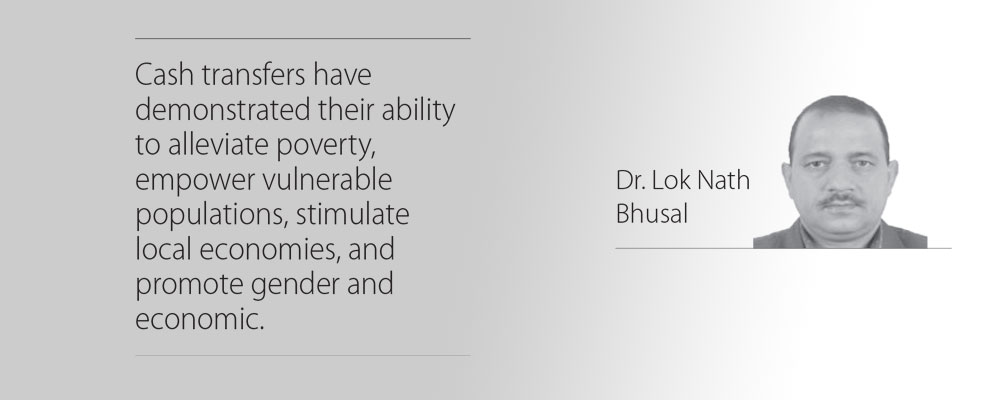
In sum, cash transfers have emerged as a powerful force for positive change in Nepal and other developing countries. Cash transfers have demonstrated their ability to alleviate poverty, empower vulnerable populations, stimulate local economies, and promote gender and economic equality. Indeed, these are our developmental targets. In order to comply with the constitutional mandate of welfare state and socialism-oriented economy, Nepal’s policy makers should recognise cash transfers as basic income for the poor and vulnerable households. They should benefit from the research evidence showing that these transfers are instrumental in lifting the financial burdens of vulnerable households, changing individual lives and reshaping the future the country by offering hope, dignity, inclusion and a pathway out of poverty, inequality and vulnerability.
(Dr. Bhusal is an expert in poverty, employment and social protection.)