- Monday, 11 May 2026

Paradox of Dashain market: Crowds swell but business just as usual
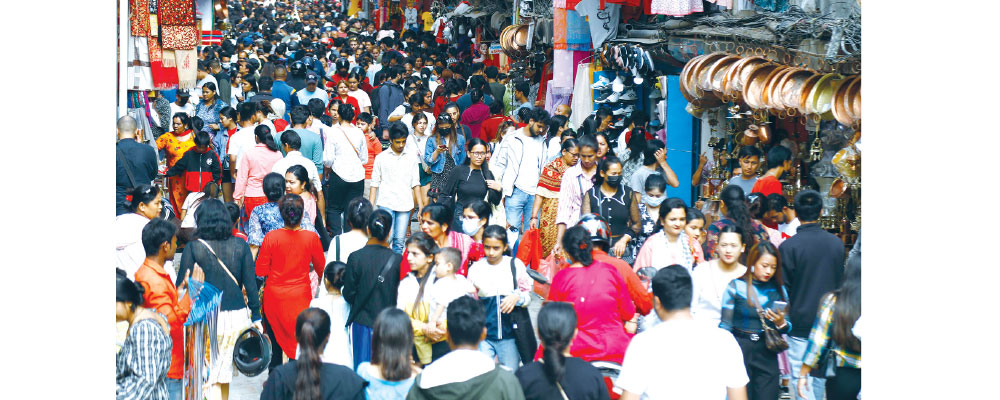

By Laxman Kafle,Kathmandu, Oct. 15: Swelling crowd of people in the market to buy different goods, ranging from edible foods to clothes to wear signals the arrival of Dashain, the great festival of Nepal.
The main markets of the Kathamndu Valley, including New Road, Ason, Bhotahiti, Baneshwor, Koteshwor, and other places, have started drawing crowds of customers, shopping for Dashain targeted goods.
The shops, which have remained deserted for quite a long time seem to have seen an increase in customer movement. But the shopkeepers say otherwise -- there are crowds of people in shops, but only a few of them are buying goods. This has been the biggest paradox of the market this time thanks to the deepening recession.
Again, many shopkeepers argue that the movements of customers are thinner this year compared to past years.
Not much business, only crowds of people
Businessmen have said that although people’s mobility in the market has increased, the main market of Kathmandu this year is not as busy as it used to be in previous years.
The businessmen operating their shops in the Kathmandu Valley, including Thimi of Bhaktapur, do not look happy as they have been unable to do expected business even on the eve of the festivals.
Bibina Shrestha, a retailer of shoes in Ason, said that even during Dashain, the business has not increased like the previous years.There may have been a decline in business due to the increase in the price of all items, including clothes and shoes and the impact of economic recession, she said.
“It is impossible to boost sales until and unless the income of people improves. Price hike on fancy items and shoes has badly affected our transactions,” she said.
Naresh Katwal, founder president of Nepal National Traders’ Federation, said that the business has decreased by almost 50 per cent during Dashain this year compared to the time of pre-COVID-19 pandemic.
It is natural to see an increase in the mobility of people at the shops during the festival, but the daily turnover is utterly low, he said.
“Compared to last year, the movement of people in the shop has not increased,” he said. Gold trader Tej Ratna Shakya also admitted that the business of gold and silver was not as expected during Dashain.
“Gold business has almost dropped by 50 per cent this year’s Dashain compared to last year. It shows that the purchasing power of people has reduced significantly,” he said.
Daily demand for gold stands below 15 kgs at present while it was above 30 kg a day during Dashain last year.
“It is natural for the demand for gold to decrease when there is no trade in cloth and other daily necessity items. People invest in gold only from their savings after spending for essentials. But now, when the purchasing power is reduced, they have difficulty managing expenses even for daily goods, he said.
Recession in market, businessman bothered
This year, there has been a significant decline in aggregate demand. Due to this, the confidence of traders and businessmen has decreased along with the reduction in business activities.
As a result, the businessmen have been worried about the lack of business even during the peak business season like Dashain, said Katwal
Generally, even when there is no business at other times, businessmen expect good business during Dashain, but this year, it is not so.
“Normally, Dashain and Tihar are the times to spend for consumption and wearing clothes and purchasing new devices according to one’s financial situation. They look forward to Dashain to wear new clothes and eat delicious foods, but due to the increase in prices against low income, people are unable
to buy things they need,’’ Katwal said.
“Our economy is going through a recession. During the time of festival, both demand and production have decreased, business has not flourished even in Dashain and consumers, especially middle- and low-income families, are finding it very difficult to afford the expenses,” economist Dr. Chandra Mani Adhikari said.
Even though the central bank has shown that the inflation rate is around 7 per cent, the prices of high-demand items such as clothes, shoes, electronic goods, and food items have increased by more than 10 per cent.
For this reason, consumption has decreased due to the limited income of the middleclass consumers who spend more during Dashain.
The consumption in two months of Dashain, Tihar and Chhath stands at around 30-35 per cent of the total annual consumption. However, due to price hikes, the consumption of goods in terms of quantity will be lower even if they spend more in this year’s festivals.
Above Rs. 50 billion used to circulate from the banking system in the two weeks of Dashain festival.
In the meantime, as a large number of the young people who consume new brand vehicles, electronic goods and other clothing goods have gone abroad, there has also been a decline in the business of such goods.
“When the consumption and production of goods decreases, it affects the overall economy of the country. If the demand and production of goods remain low for a long time, the revenue collection of the government will be hampered and the government expenditure will also be affected. Due to this, the country’s economic growth will also deteriorate,” he said.
Skyrocketing prices, more bargaining
The price of every item ranging from salt to gold has increased significantly over the years which has affected the consumers and reduced the aggregate demand in the market.
Significant price hikes of goods against the limited income after the COVID-19 pandemic is affecting the normal life of people resulting in a hit in economy and business, said Dr. Adhikari.
Many are likely to be more affected during this situation of stagflation as the inflation will increase against low and stable economic growth and the income of the people, he said. The price of food items, including sugar, cumin seeds, oil and rice, among others, also skyrocketed over the year.
According to the traders, the price of goods, especially clothes and shoes, electronic goods has gone up by 10-30 per cent based on products brand over a year. Trader Shrestha admitted that the price of shoes has increased by almost 25 to 30 per cent this year compared to last year.
“ In comparison to last year, a pair of shoes has increased by at least Rs. 300-400 in wholesale. Because the purchasing power of consumers is weak, they not only choose low-priced shoes, but also tend to haggle,” she said.
Usually, customers who used to choose shoes priced above Rs. 3,000, now choose shoes costing Rs. 1,500 to Rs. 2.000. Gayatri Banjara of Mandhyapur Thimi, Bhaktapur, said that the price of clothes has increased noticeably this year than the last year
“I have come to buy the necessary clothes for the children, but the price has increased drastically,” she said.
“After the COVID-19 pandemic, the household income has not increased, but the price of all goods from kitchenware to clothes has increased. People are facing difficulty celebrating the festival this year with limited income,” she said.
“I visited many shops to buy clothes for my children and myself. But I could not buy the clothes as per the needs because of their high prices,” she said.
Not only the clothes, but also other essential goods have become expensive this year, she said, adding that the skyrocketing prices would make it difficult to manage expenditure to celebrate the festivals.
According to her, she spent around Rs. 12,000 to buy general clothes and shoes for her two children.
The income of people could not increase in line with the inflation which hit the purchasing power of people affecting the business.
Aiming to provide relief to consumers during the festivals, the state-owned enterprises -- Food Management and Trading Company Limited, Salt Trading Corporation and Dairy Development Corporation -- have been operating fair price shops inside and outside the Kathmandu Valley.
They have offered discounts in daily essential food items ranging from Rs. 2 to 50 per kg/litre through their sales outlets.
Consumers of footpath shifted to Bhrikutimandap
After the Kathmandu Metropolitan City has forbidden footpath business, low-income families are in trouble to purchase clothes for celebrating Dashain festival.
Generally, according to their income, some of the customers go to the shopping malls, some go to the general stores and others go to the footpath to purchase products as per their needs. The price and quality of products are varying in different places.
With the removal of footpath business, not only the traders who survive by selling goods on footpaths, but also the consumers have been affected severely.
Many consumers who used to buy clothes on footpath earlier are visiting shops of Bhrikutimandap, said Gita Thapa, a shopkeeper there.
“Normally, the flow of customers in the Bhrikutimandap is high during the time of festivals, like Dashain. But, this year, people’s mobility is high and also increased the business compared to the past years,” she said.
According to her, fancy goods are available at a cheaper rate here than the shopping malls and shops due to low shop rent and the consumers who have low income are used to purchase goods here.
She said that low-income customers do not want to go to fancy shops and shopping malls because the prices are high, so they are forced to come to cheap shops, like Bhrikutimandap, to buy clothes as per their requirement.
“There is good business even two days before the Ghatasthapana. So, I expect that the business will grow further after the Ghatasthapana,” she said.