- Monday, 11 May 2026

Nearly 1,000 migrating songbirds perish after crashing into windows
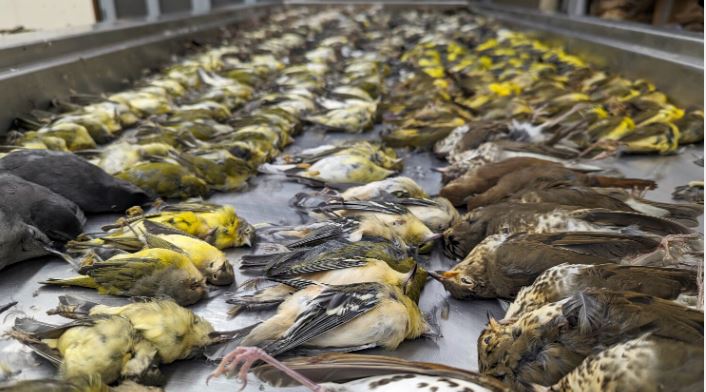

New York, Oct. 8 : David Willard has been checking the grounds of Chicago's lakefront exhibition center for dead birds for 40 years. On Thursday morning he found something horrible: Hundreds of dead songbirds, so thick they looked like a carpet.
Nearly 1,000 songbirds perished during the night after crashing into the McCormick Place Lakeside Center 's windows, the result, according to avian experts, of a deadly confluence of prime migration conditions, rain and the low-slung exhibition hall's lights and window-lined walls.
"It was just like a carpet of dead birds at the windows there," said Willard, a retired bird division collections manager at the Chicago Field Museum, where his duties included administering, preserving and cataloging the museum's collection of 500,000 bird specimens as well as searching for bird strikes as part of migration research.
"A normal night would be zero to 15 (dead) birds. It was just kind of a shocking outlier to what we've experienced," Willard said. "In 40 years of keeping track of what's happening at McCormick, we've never seen anything remotely on that scale."
Researchers estimate hundreds of millions of birds die in window strikes in the United States each year. Scientists with the Smithsonian Conservation Biology Institute and the U.S. Fish and Wildlife Service released a study in 2014 that put the number between 365 million and 988 million birds annually.
Window strikes are an issue in almost every major U.S. city. Birds don't see clear or reflective glass and don't understand it's a lethal barrier. When they see plants or bushes through windows or reflected in them, they head for them, killing themselves in the process.
Birds that migrate at night, like sparrows and warblers, rely on the stars to navigate. Bright lights from buildings both attract and confuse them, leading to window strikes or birds flying around the lights until they die from exhaustion — a phenomenon known as fatal light attraction. In 2017, for example, almost 400 passerines became disoriented in a Galveston, Texas, skyscraper's floodlights and died in collisions with windows. "Unfortunately, it is really common," said Matt Igleski, executive director of the Chicago Audubon Society. "We see this in pretty much every major city during spring and fall migration. This (the window strikes at McCormick Place) was a very catastrophic single event, but when you add it all up (across the country), it's always like that."
Conditions were ripe for a massive wave of songbird southern migration over Chicago on Wednesday evening, said Stan Temple, a retired University of Wisconsin-Madison wildlife ecology professor and avian expert. (AP)