- Wednesday, 3 June 2026

Bode septuagenarians bracing for Nil Barahi dance
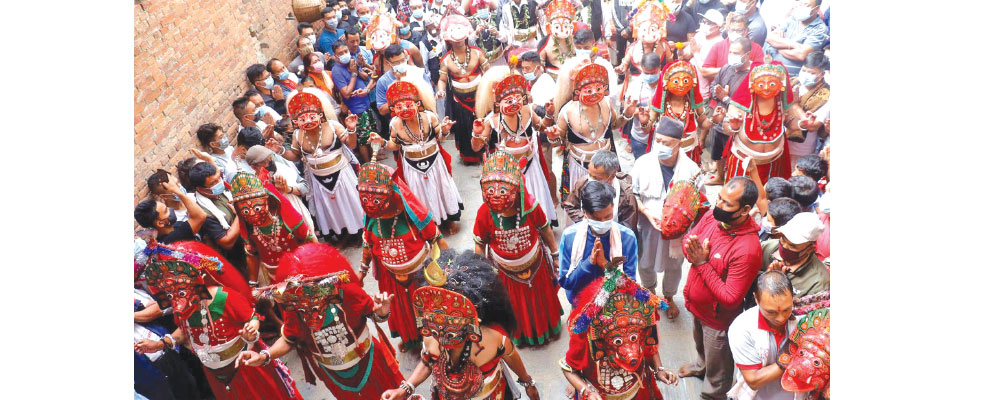

BY A STAFF REPORTER,Kathmandu, Sep.1: Every year, with the start of the Saparu (Gaijatra) festival, the streets of the ancient city of Madhyapur Thimi Municipality are flooded with traditional street dances of different kinds.
The Bode locals are now preparing to parade the traditional street dance of Nil Barahi.
Traditional Bhairav dance, Mahakali dance and Nil Barahi dance are performed in Bode a day after the Gaijatra. The dancers (Devgans) of the Tha Shrestha community of Bode have started rehearsing the Nil Barahi dance, which is performed for four days after the Gaijatra, from Krishna Dwitiya to Panchami.
Prem Chandra Aduwa Shrestha is the main Nil Barahi dancer. At the age of 72, he is preparing to perform the dance for the record 65th time this year. The septuagenarian dancer said they would rehearse for four days.
There are 19 Devgans associated with the Nil Barahi dance. Of them, one performs as Bhairav, four each as Nil Barahi, Kumari, Ganesh and Singh and two as Dwarpal.
The dancers should dance 12 to 14 hours a day in the narrow alleys of Bode. They are not allowed to take food, drink water, talk with anyone and take rest during the whole performance, said Shrestha. When one chooses to become a dancer, he should dance no matter what happens in their life, even if their parents die.
The historical and cultural Nil Barahi dance has been in place since ancient times. It is believed that Nil Barahi herself appeared in front of the locals of the Bode and taught them the current dance style. It is said that the dance was started by King Subarna Malla around 1511 AD (Nepal Sambat 631). It used to be performed by members of the Tha Shrestha community of Bode. However, for the past 44 years, it has been performed by the Aduwa Shrestha community of Lachhi Tole.
The dance begins and ends at Akha, the sacred spot in Lachhi near the Bode Narayan Temple. The dancers go around several religious shrines located in Lachhi Tole, Bishnughat Tole, Bhagu Tole, Khasi Tole and the Layaku area.
The performers of the tantric dance are called Devgans (God’s people). Eight of the 19 Devgans are now in their late 70s, and have to dance even in old age because the youngsters are not interested in partaking in the ritual ballet.
Shrestha said, “Each dancer puts in Rs. 50,000 from their own pocket to conduct the dance.”
However, Madhyapur Thimi Municipality provides Rs. 300,000 every year, but it is nowhere near enough. The Nil Barahi Dance Guthi has been continuing the dance with great difficulty and cannot give anything to the dancers for their efforts, he added.