- Wednesday, 3 June 2026

Spit-free Zones For Cleaner Public Spaces

Spitting culture in Nepal reflects a paradox between tradition and modern challenges. While the country embraces its rich heritage and diverse landscapes, the prevalent spitting habits contribute to pollution and health concerns. Sharing many affinities with our South Asian counterparts, the act of public spitting has become an ingrained, unrefined impulse that conspicuously permeates our culture.
Strolling along the bustling avenues of any Nepali town unveils a panorama of spitters. From drivers executing remarkable arches with their lung power to pedestrians projecting paan-tinted discharges and even elderly women performing the customary hyaa-thoo ritual, along with uninhibited children emulating the elders, the streets showcase this practice openly. Criticism against public spitting remains muted, unless, of course, the target is an unfortunate individual. In the absence of a comparison with "cleaner" nations, public spitting doesn't appear abnormal; for many, it's scarcely even perceived as a problem.
As per the World Population Review's 2022 assessment of the world's cleanliness, Nepal occupies the 162nd spot out of 180 nations, positioning it among the least pristine countries. In contrast, Denmark takes the lead, while India trails behind. The Environmental Performance Index, which scrutinises indicators concerning ecosystem robustness and environmental well-being, is used to gauge these rankings.
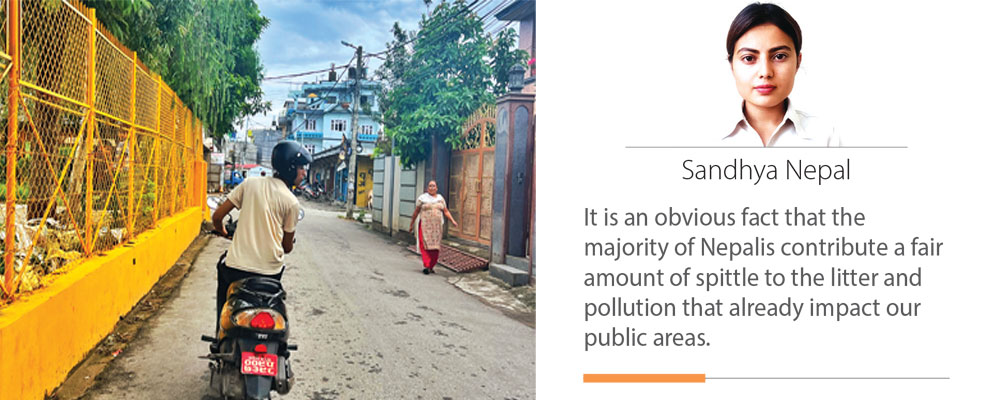
Is public spitting bad? Well, if we employ communal sensibility, of course it is. Spits are known to transmit diseases like tuberculosis, hepatitis, and many other airborne diseases, including COVID. Therefore, it is certainly a heinous practise to spit in a public space. The act of spitting could easily put people at risk of catching communicable diseases. It is an obvious fact that the majority of Nepalis contribute a fair amount of spittle to the litter and pollution that already impact our public areas. Spitting extends beyond a physiological reflex, often embodying our attitudes and moral values. This is exemplified by Kamal (name changed), an expatriate with "Western sensibilities," who, despite years abroad, has adopted the undesirable habit of public spitting. When questioned, Kamal attributed this transformation to his environment and surroundings.
Kamal further noted that the prevalence of public spitting among locals made it seem like an accepted practice. However, when directly asked if he'd continue this behaviour upon returning, he firmly responded with a "never." The distressing normalisation of spitting in public spaces highlights a cultural lapse, exposing the shortcomings of our societal preferences.
Currently, the legal framework in Nepal does not explicitly address the issue of spitting in public places, leaving it largely unregulated. The National Penal (Code) Act 2017 has no specific clause related to public spitting, although clause 112 prohibits polluting the environment, stating "No person shall generate, transmit, release, or stockpile wastes in such a manner as to cause a significant adverse impact on the environment". But this seems to be the least enforced and honoured clause since there is not a single case registered against pollution. The 5-year comparative analysis chart for crime in Nepal shows no dedicated bar for the crime against pollution. The open data available for the crimes in Nepal from 2068–71 B.S. shows no single crime reported under the heading of pollution, let alone public spitting. This also indicates how insignificant (if at all) the matter of health, hygiene, or pollution is in Nepal.
There are many countries with serious anti-spitting laws. Countries like Japan have effectively tackled the issue of public spitting through cultural education and stringent regulation. Singapore is famous for its public-spitting regulations, where an individual can be fined up to S$5000 for the offense. Even though there has not been much inspiration to draw from our South Asian neighbours in this matter up until now, we could always demonstrate the change ourselves. The absence of specific regulations contributes to the perpetuation of this unsanitary practice. It is high time we set up some serious anti-spitting regulations and educate our communities to make them more responsible for the environment they live in.
Spitting should be prohibited, and strong legal action should be taken to ensure that violators face consequences to deter imminent offenses. Legislation alone would not be sufficient to end public spitting. Civic responsibility becomes apparent as a key factor in shaping society's behaviour. It takes time and constant effort to gradually change cultural norms and mindsets. Society needs to work together to change people's perceptions of spitting in public places. We can minimise the practice by implementing media campaigns, community involvement, and educational programmes. By prohibiting public spitting, we can set an example for future generations. In this regard, education for good manners should start from families and schools.
Beyond issues with sanitation, hygiene, and cleanliness, encouraging spitting goes against moral standards. Spitting with vocalised pride may continue, but it is wrong to put other people's health, comfort, and safety at risk. The combined attitudes and behaviours of a society's members are what drive societal advancement. Addressing this issue head-on is essential in our quest for growth since it will promote a cleaner and healthier Nepal. After making significant progress in improving conditions for open defecation, encouraging responsible spitting is now another step in the right direction.
(The author is a freelancer and has a Master’s degree in international relations and diplomacy.)

-square-thumb.jpg)