- Wednesday, 3 June 2026

Creating Heaven Out Of Hell

René Descartes (1596-1650) and John Milton (1608-1674) put equal emphasis on thinking as the essential quality of human beings in their writings. The former as a philosopher and the latter as a poet of seventeenth-century Europe created far-fetching ripples in Western intellectual tradition. As Descartes said, “I think therefore I am” Milton also said in Paradise Lost, “The mind is its own place and in itself can make a Heaven of Hell, a Hell of Heaven.” There might be something beyond their imagination that propelled them to reflect their ideas about the existence of human beings in the total scheme of things. While the philosopher placed humans at the centre of the thinking process, the poet considered them capable of doing anything in the universe. Both of them put humans above all else.
What these two great precursors said 400 years back still reverberates in our minds as we sit to think about how we can make our earth not simply a moderately livable habitat for human beings but a supremely comforting place for all creatures to live in symbiotic relationships. Despite their primacy for humans, which today is often debated as a merely anthropocentric worldview, they nevertheless opened up new avenues to explore the boundless potential latent in human beings that otherwise would manifest in a congenial social environment. If what they expounded happened on a positive note, our world would become an earthly paradise, a heaven of exquisite beauty.
Convincing reason
There might be no convincing reason to discard them as lopsided thinkers whose ideas would appeal only to their times. Undoubtedly, there are universal principles for the advancement of humanity and for altering the hellish world into a place of heavenly bliss, not in the traditional sense of orthodox religion. As William Blake claimed in the late nineteenth century, no less so contemporary critics do today, Milton was of the Devil’s party without knowing it. The poet professed his aim for writing as to ‘justify the ways of God to men”; nevertheless, he glorified Satan, the enemy of God. At the heart of Milton’s mind, Satan’s loss of paradise meant the loss of Oliver Cromwell’s republicanism. If what he believed continued, his country would be a heaven, as he supposed.
Not to refer back to the ancient world of Plato and the religious scriptures of East and West, Milton’s ideas are oriented toward formulating an egalitarian world where no rebellious non-conformists would raise their heads to disturb peace and order. Unlike in Plato’s sense, the Bible aimed to establish a sinless world where Almighty God would punish the wicked and reward the virtuous. Milton would like to strengthen God by glorifying God’s ways to men, as he claimed in his epic poem. Milton was not overtly on the side of Plato, who advocated for an ideal republic, but on the underlying level, he was a staunch follower of republicanism.
The democratic leaders of the contemporary world do not seem to follow their predecessor’s principles. They often proclaim that democracy is an ideal system where everybody can enjoy the rights to “life, liberty, and pursuit of happiness,” as Thomas Jefferson (1776) claimed in his Declaration of Independence. This system assumes citizens can express their ideas and live without economic exploitation and social discrimination. If democracy is practiced sincerely, no other system can be in need. But the democratic practices have gone awry. They have failed to make a heaven of hell.
Being utterly dissatisfied with the democratic system, some thinkers proposed alternative governance systems. Possibly following his principles, Karl Marx, in the nineteenth century, demonstrated republican ideas in his advocacy of communism. He thought communism could not sustain without republicanism. Marx must be well versed in any form of republicanism, whether of Plato or of Cromwell, which he would synthesise into scientific socialism. No matter whether in the form of the quintessence of dust, Marx demonstrated a tinge of colour to side with his preceding thinkers. In this respect, Marx’s aim was to establish an egalitarian society which is another form of heave. Marx believed that human beings are capable of making a heaven of hell.
Unlike Charles Darwin and Herbert Spencer, Marx was an interventionist who thought society could be altered with hard human effort. He meticulously explained that philosophers have only interpreted the world so far, but the issue is to alter it. For him, the nineteenth-century world was rent by capitalism which the working-class people could overthrow due to class struggle. However, Marxian principles seem to have gone awry if we closely look at the contemporary world situation. Although some orthodox Marxists are sticking to the central idea of the proletariat dictatorship, the practices in several countries contradict the basic Marxian philosophy.
Psychological traits
Nobody dares to discard socialism, not least communism, but it has been a matter of fierce debate whether Marxian socialism is ever practicable in the practical world. Human beings live in the physical world and share almost the same temperament. So we can imagine no human of blood and flesh completely disinterested in their works. It is tough, if not impossible, to deplete the fundamental emotions and psychological traits of desire, greed, avarice, and temptation from their minds. So they tend to make a little heaven into a big hell instead of making decent heaven of hell.
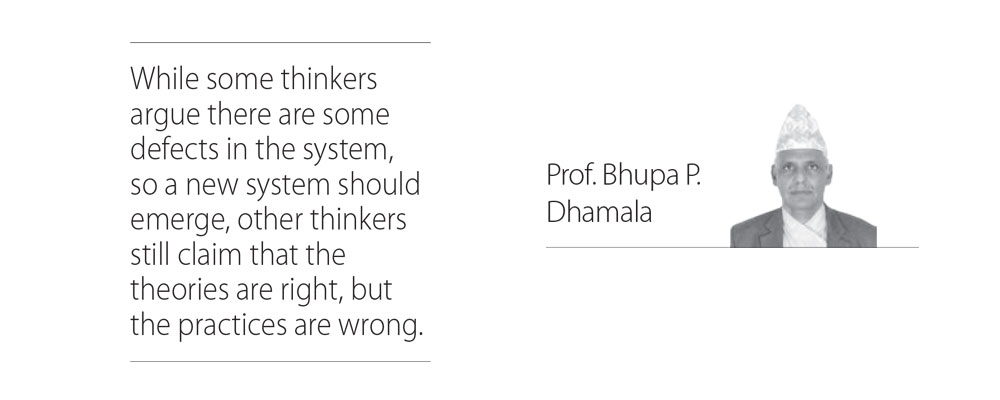
It has become a general practice that once leaders come to power, they seem to forget their promises and derail their path. What causes the failures or at least setbacks to even the best systems that have evolved out of the best human experiences? There are two contrary opinions in this regard. While some thinkers argue there are some defects in the system, so a new system should emerge, other thinkers still claim that the theories are right, but the practices are wrong. No matter which claim is true, our motto must be to make a heaven of hell if humanity is to continue.
(The author is the chairman of Molung Foundation. bhupadhamala@gmail.com)