- Wednesday, 3 June 2026

Climate change may force farmers to consider irrigation
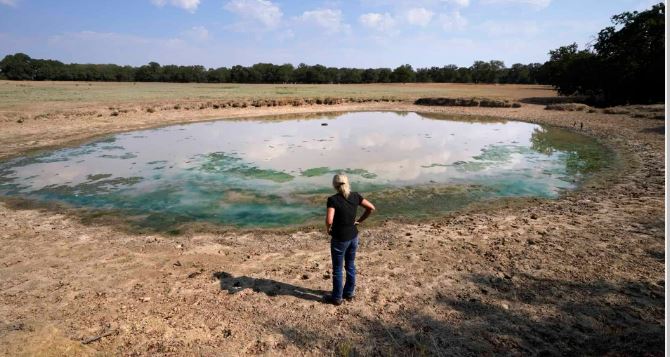

New York, Aug. 25:The Texas ranch where Gilda Jackson trains and sells horses has been plagued by grasshoppers this year, a problem that only gets worse when the hatch quickens in times of heat and drought.
Jackson watched this summer as the insects chewed through a 35-acre pasture she badly needs for hay; what they didn’t destroy, the sun burned up.
Irrigation might have saved Jackson’s hay, but she and her husband rejected the idea about 10 years ago over the cost: as much as $75,000 for a new well and all the equipment.
But now — with an extended drought and another U.S. heat wave this week that will broil her land about an hour northwest of Dallas for days in 100-degree-plus temperatures — Jackson said she is “kind of rethinking.”
Many other farmers and ranchers in the U.S. might be forced to do the same in coming decades, according to recent research into the expected effects of the rising heat and more frequent weather extremes associated with climate change.
That’s if they even can. Some places in the U.S. are already struggling with groundwater depletion, such as California, Arizona, Nebraska and other parts of the central Plains.
“There’s no surprise that in the future when it gets hotter and there’s more demand for water, people are going to be using more water,” said Jonathan Winter, an associate professor of geography at Dartmouth College and an author on a new study on future U.S. irrigation costs and benefits in Communications Earth & Environment.
Winter and his team used a computer model to look at how heat and drought might affect crop production by the middle and end of this century, given multiple scenarios for the emissions of warming greenhouse gases.
In places like California and Texas where “everyone is dropping their straw into the glass” of groundwater, as Winter put it, current levels of irrigation won’t be viable in the long term because there isn’t enough water.
But use of irrigation may grow where groundwater supply isn’t presently an issue.
In much of the Midwest, including the corn- and soybean-rich states of Iowa, Illinois, Indiana and the Dakotas, farmers might see a benefit in the next 50 years from installing irrigation infrastructure.
That’s an expensive investment, and whether it will pay off may depend on humans’ ability to stem the worst effects of climate change. A worst-case scenario would involve one generation investing in costly irrigation equipment, only for the next to see them fail to keep crops alive through extreme heat and weather.
There are many irrigation methods for row crops, but the most common is pivot irrigation — the long strands of pipes mounted on wheels that are pulled in a circle around a water source to sprinkle water onto a field. (AP)

-square-thumb.jpg)