- Wednesday, 3 June 2026

Fair organised to raise awareness about snakes
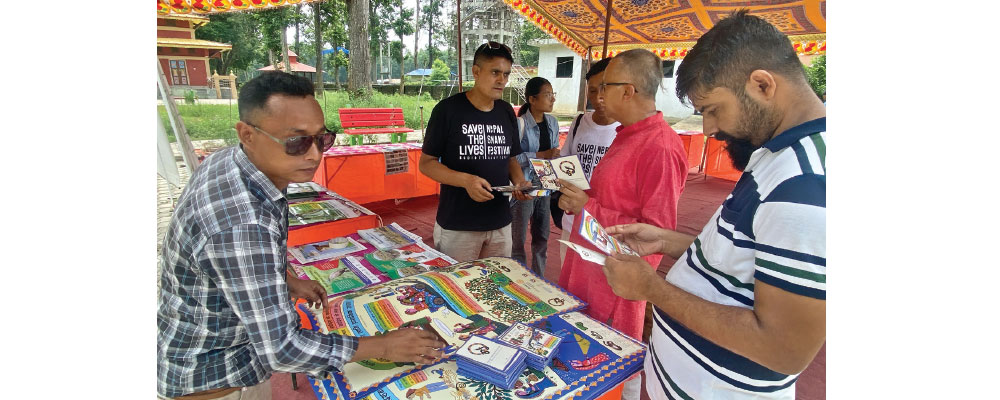

By Bom Lal Giri,Nawalpur, Aug. 21: A fair has been organised on snakes for the first tim e in Nepal. The two-day "Nepal Snake Fair" started in Nawalpur on Sunday.
The fair is being ogranised by Nepal Toxinology Association (NTA) in coordination with Division Forest Office, Nawalpur, and Madhyabindu Multiple Campus.
"There are still stereotypes related to snakes. Lack of awareness has led to deaths due to snakebites. This fair aims to raise awareness about snakes and reduce human-snake conflict," said Kamal Devkota, director of the fair's organising committee. The fair has been organised to mark the occasion of "Naag Panchami", a Hindu festival when snakes are worshipped. The festival falls on August 21 this year.
The fair has several stalls providing descriptions and information on different snakes found in Nepal and preventive steps against snakebites. Live snakes are also kept on display for visitors.
The stalls also have information on ways to identify venomous and non-venomous snakes and steps to take when a venomous snake bites someone.
Venomous snakes in Nepal
Health experts suggest that individuals should not be frightened when bitten by a snake. "It is because a majority of the snakes in Nepal are non-venomous," said Dr. Krishna Prasad Acharya.
Dr. Acharya, who is a senior consultant and snakebite management focal person at Bheri Hospital, said, "Of the snakes found in Nepal, only 20 per cent are venomous. Moreover, one should not worry a lot after a snakebite because it can also be a dry bite," he added.
A dry bite is a bite by a venomous animal in which no venom is released. Dr. Acharya said that around 20 per cent of venomous snakes do not release venom upon biting.
Steps after snakebite
There are currently more than 100 snakebite treatment centres across the country. "If an individual bitten by a venomous snake is brought to a treatment centre soon, chances of death is minimal," said Dr. Acharya.
Before the expansion of snakebite treatment centres, snakebite mortality stood at 10-12 per cent. Recently, the mortality rate has been reduced to 2 per cent, Dr. Acharya informed.
Experts suggest that identification of the snake behind a bite is essential and individuals living in snakebite-prone areas should have proper knowledge of snakes.
"One should not cut the area of snakebite and never try sucking out the venom. The snakebite area should be covered by a bandage and the individual should be rushed to a treatment centre right away," said Dr. Acharya.
Importance of snakes
Naag Panchami falls on the Shrawan Shukla Panchami of the Nepali Calendar. The date of the festival changes annually, but it mostly falls during mid-August.
Snakes – Ananta, Basuki, Padma, Mahapadma, Takshyak, Kulir, Karkat and Shankha – are worshipped by Hindus on the occasion of Naag Panchami. The festival is being celebrated with joy throughout Nepal for centuries.
Photos of snakes are pasted by priests on the main doors of the houses during the festival.
There are also beliefs that snakes consume venoms in the air and other parts of the environment to prevent other living organisms from getting affected.
Alongside religious importance, snakes are worshipped and respected for their role in balancing the ecosystem.