- Wednesday, 3 June 2026

Nepal-China Cooperation In Potato Production
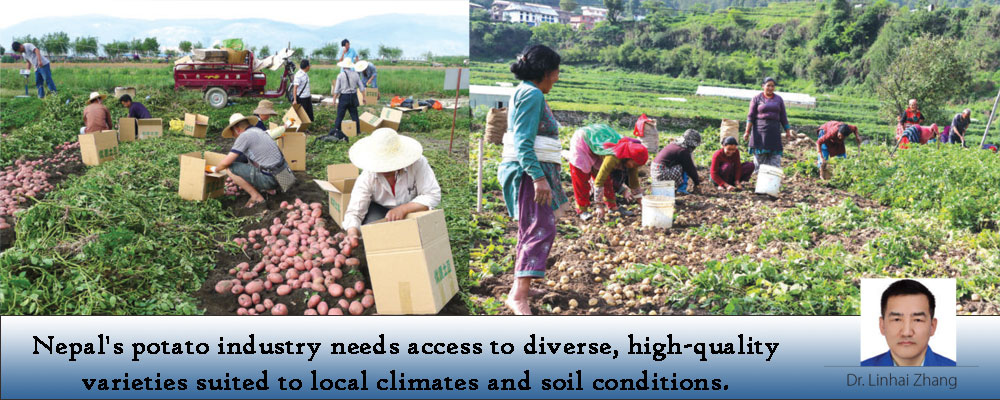

Potatoes are one of the most widely consumed and versatile crops worldwide, and they play a crucial role in food security and economic development in Nepal. Potatoes account for 5.96 per cent of Nepal's Gross Domestic Product (GDP). The diverse topography of Nepal, spanning from lowlands to high-altitude regions, offers conducive conditions for year-round potato cultivation. Nepal's potato industry has been steadily growing. In 2022, Nepal produced 3.3 million metric tonnes of potatoes.
Despite notable progress in potato productivity over the past few decades, driven by the concerted efforts of the Government of Nepal and private companies, Nepal, as the second largest staple crop after rice, still faces challenges in fully realising its potential. These challenges are primarily related to cultivar development, seed supply, cultivation practises, productivity levels, and market access. Addressing these issues is crucial not only for the economy but also for ensuring food security in Nepal. China has made remarkable strides in potato production over the years. As the world's largest potato producer, accounting for approximately 25 per cent of global production, China's success can be attributed to various strategies and initiatives to improve cultivation techniques, increase yields, and improve overall productivity.
Leverage
Nepal can leverage China's experiences in these domains to drive agricultural technology innovation and improve potato yield and quality by learning from China's advances, particularly in genetic improvement and biotechnology applications. To address these challenges, a comprehensive approach is needed that covers various aspects of the potato industry. From the progress of China's potato industry, Nepal can learn several lessons. Chinese potato enterprises can help Nepal's potato industry in many ways.
China's potato industry has placed a strong emphasis on genetic improvement. Nepal's potato industry needs access to diverse, high-quality varieties suited to local climates and soil conditions. Collaborating with Chinese potato research institutions and enterprises can accelerate Nepal's breeding process by developing high-yielding and disease-resistant potato varieties that adapt well to local conditions.
Biotechnology applications, such as tissue culture, have played a vital role in improving potato yield and quality in China. Large amounts of uniform and healthy potato seedlings can be produced through tissue culture, ensuring a consistent supply of high-quality planting material. Collaboration can focus on improving seed supply, which is crucial to ensuring the availability of high-quality potato seeds to farmers. Chinese institutions and companies can help establish seed production and certification systems, quality control measures, and seed storage and distribution networks, allowing Nepalese farmers to access improved potato seeds and improve their crop yields. Enhancing farmers' knowledge and skills in modern agricultural technology and best farming practises is crucial to improving potato yield and quality. Training programmes from their Chinese counterparts can provide Nepalese farmers with valuable information on soil management, irrigation techniques, and effective pest and disease control measures. By adopting these practises, farmers can optimise their potato production.
Potatoes in Nepal are susceptible to various pests and diseases, leading to a loss of yield and quality deterioration. Collaborating with Chinese potato counterparts can help Nepal implement effective pest and disease control measures and technologies. Sharing experiences in pest management, disease prevention, and control strategies can significantly improve Nepal's potato crops' overall health and productivity.
Strengthening Nepal's potato market and marketing system is essential to ensuring effective market channels and brand development. The Chinese potato counterparts have extensive experience in market promotion and brand building. By collaborating with these enterprises, Nepal can improve the value of its potato products, develop strong brands, and explore domestic and international markets. This collaboration can facilitate the exchange of knowledge on market trends, consumer preferences, and the development of value-added products.
Investment in agricultural infrastructure, including irrigation systems, field drainage, and agricultural machinery, is essential to improving the scale and efficiency of potato production in Nepal. Chinese potato counterparts can contribute by considering investment opportunities to establish production bases or cooperative projects in Nepal. Such collaboration would promote technology transfer, resource sharing, and market expansion, ultimately driving the development of Nepal's potato industry.
Collaboration between Nepalese and Chinese potato research institutions and enterprises can be facilitated through various means. First, effective communication channels should be established through regular meetings, conferences, workshops, and the exchange of scientific publications and research findings. Second, both countries can share their research expertise in potato cultivation, breeding, disease management, and post-harvest technologies through joint projects, collaborative studies, and science exchange.
Technology transfer
Third, collaboration can facilitate the transfer of advanced technologies and best practises in potato cultivation and processing, helping Nepalese farmers improve productivity and profitability. Fourth, capacity-building programmes and workshops can improve the technical skills and knowledge of Nepalese researchers, farmers, and extension workers. Lastly, collaboration can focus on improving the seed supply chain by establishing production and certification systems, quality control measures, and distribution networks.
In conclusion, by adopting a comprehensive approach that includes improved seed varieties, embracing modern technologies, promoting mechanisation, implementing integrated pest management, providing extension services, and developing rural infrastructure, Nepal can improve its potato industry with increased yields, reduced losses, and improved overall productivity. Collaborating with Chinese potato counterparts, who have experience in these areas, can provide valuable support in technology cooperation, seed supply, market promotion, investment, and technical assistance.
This collaboration will contribute to the overall growth and improvement of Nepal's potato industry, which will benefit farmers and the economy as a whole. Through this partnership, Nepal can leverage China's success in potato production and create a stronger and more sustainable potato industry that drives national development.
(The author is the Chief Technology Officer for the National Engineering Research Center for Potato (NERCP) and Xisen Potato Industry Group Co. Ltd., China, and an Honorary Member of the Nepal China Academy.)

-square-thumb.jpg)