- Wednesday, 3 June 2026

Wild elephants terrorising Barahakshetra locals
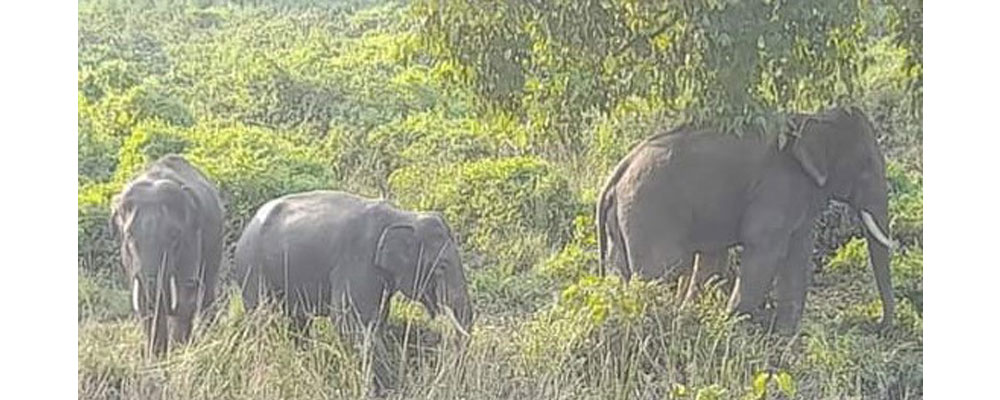

By Baburam Karki, Sunsari, Aug. 10: Krishna Prasad Adhikari of Punarbas in Barahakshetra-2 has been struggling to sleep properly for the past two weeks. Every night, Adhikari spends his time holding a light in one hand and a stick in the other.
He is merely a representative figure, as the entire community faces sleepless nights due to the presence of wild elephants wandering around the locality of the northern village in Charkose Jhadi (forest).
"We are chasing the elephants by carrying lights and firewood from house to house. We have spent numerous sleepless nights in this endeavour. The municipality's fire engines, equipped with sirens, have been assisting us in driving away the elephants," said Madhav Karki, a local resident. He asked, "For how many days and nights must we remain awake to continue chasing the elephants like this?"
Adhikari, a local resident, stated that the elephants residing in the Charkose forest and venturing into the village in the evenings have not only ravaged crops and grains but also brought about distress by damaging the houses.
On August 5, 2023, a group of seven wild elephants entered the village at night and caused damage to the fence surrounding Suresh Pariyar's house in Punarbas Danda Tole of Barahakshetra-2. "The elephants consumed and scattered 50 kilograms of rice that had been purchased just two days earlier. They also consumed some corn," Pariyar said.
In Barahakshetra-2 alone, elephants have caused damage to 25 houses. Ward Chairman Hom Prasad Gautam reported that the elephants have wrecked thatched houses in various areas including Punarbas, Railway Line, Jabdi, Tori Bari, Phokland Tapu, Chauri Bari, and Devi Than. He also said, "If the provincial authorities do not take effective measures for elephant control, there will always be a looming fear of potential harm to local residents and their livelihoods.”
Over the last 22 days, more than two dozen elephants have been marauding the village during the nights. Even though there have been no human casualties so far, the village itself has been obsessed with fear whenever the elephants make their way into the village.
Chairman Gautam said that villagers have been coming together and remaining vigilant throughout the night, with the help of the Nepal Police, Armed Police, and the Baraha Sub-division Forest Office in their efforts to repel the elephants.
Forest Office for elephant control
Sishu Raj Jha, the Forest Officer of the Baraha Sub-division Forest Office, said that the elephants are indeed causing problems. He emphasized that their efforts are focused on both controlling the elephants and preventing any potential harm to humans by actively chasing them away whenever they enter the village. However, the elephants have not yet come under control, he added.
Forest personnel, Nepal Police, Armed Police, local representatives, community forest committees, and residents are collaborating to manage the elephants. Jha added that mobile teams and regular patrols have also been organised to proactively control the elephant terror.
Provision of compensation
According to Jha, a compensation system is in place, applicable only once per season when wild animals, including elephants, cause damage. Under this provision, a farmer can receive a maximum of Rs. 20,000 if their crop damage is verified and approved by forest representatives, local representatives, police, and agricultural technicians.
He also mentioned that there is a framework to provide compensation of up to Rs. 20,000 for individuals who have sustained minor injuries in animal encounters. For those who have suffered severe injuries, the compensation can go up to Rs. 200,000. And the compensation can extend up to Rs. 1 million in case of human casualties.
Experts on elephant control
Ashok Ram, an expert on elephants, said that while it is not feasible to entirely prevent their presence, it can be managed to a certain degree. "Elephants do not like being disturbed. It is advisable not to chase them individually when they are causing damage. Instead, groups of people should collectively chase them, utilising firecrackers," he said.
Typically, elephants tend to flee when confronted by humans at a distance of about 150 metres.
“We have been installing solar fencing in the way elephants use to control them. Instead of enclosing the forest area with solar fencing, the elephant-affected settlements should be surrounded by solar fencing and a road should be kept secure to protect the settlements,” he added.
Ram cautioned against chasing a drunk elephant and going after an elephant in an open area. In such circumstances, elephants can become more aggressive. A lone elephant can cause more harm compared to a group, according to Ram.
Ram said there is a unique custom of chasing elephants in Africa. They are also found to control elephants by keeping beehives of large breeds on the paths from where elephants come. This method is adopted because the bees bite the elephants when the elephants touch the beehives, Ram informed.