- Wednesday, 3 June 2026

As the summer breezes fade, sweltering Europeans give air conditioning a sceptical embrace

Milan, Aug. 3: During Europe's heat wave last month, Floriana Peroni’s vintage clothing store had to close for a week. A truck of rented generators blocked her door as they fed power to the central Roman neighbourhood hit by a blackout as temperatures surged. The main culprit: air conditioning.
The period in which temperatures hit 40 degrees Celsius (104 degrees Fahrenheit) coincided with peak electricity use that came close to Italy’s all-time high, hitting a peak load of more than 59 gigawatts on July 19. That neared a July 2015 record.
Intensive electricity use knocked out the network not only near the central Campo de Fiori neighbourhood, where Peroni operates her shop, but elsewhere in the Italian capital. Demand in that second July week surged 30%, correlating to a heat wave that had persisted already for weeks, according to the capital’s electricity company ARETI.
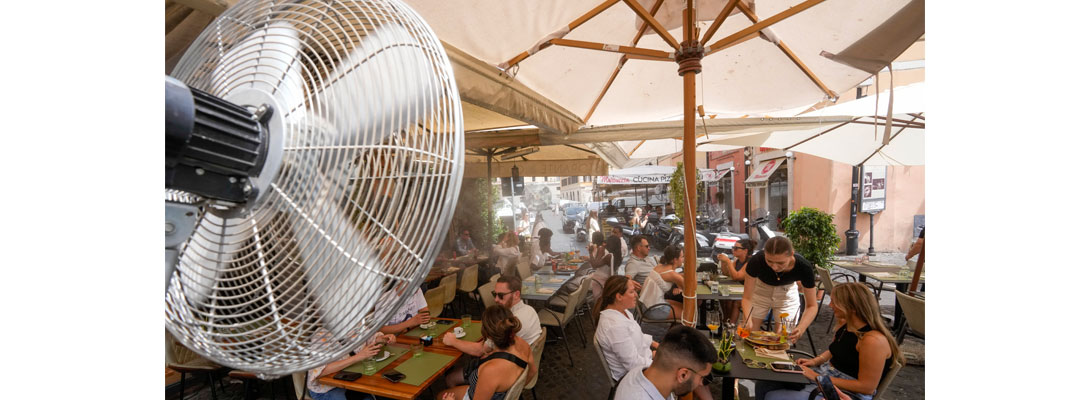
Like many Romans, Peroni herself does not have AC either in her home or her shop. Rome once could count on a Mediterranean breeze to bring down nighttime temperatures, but that has become an intermittent relief at best.
“At most, we turn on fans,’’ Peroni said. “We think that is enough. We tolerate the heat, as it has always been tolerated.”
In Europe, though, that is starting to change.
Despite holdouts like Peroni, rising global temperatures are dropping air conditioning from luxury to a necessity in many parts of Europe, which long has had a conflicted relationship with energy-sucking cooling systems deemed by many to be an American indulgence.
Europeans look with disdain at overcooled U.S. buildings, kept to near meat-locker temperatures, where a blast of cold air can shoot across city sidewalks as people come and go, and where extended indoor appointments necessitate a sweater even in the height of summer.
By contrast, event organizers in Europe may offer hand fans if events are expected to overheat. Shoppers can expect to sweat in under-cooled grocery stores, and movie theatres are not guaranteed to be climate-controlled. Evening diners have typically opted for outside tables to avoid stuffy restaurants, which rarely offer AC.
To deal with the heat, Italy and Spain typically shut down for several hours after lunch, for a riposo or siesta, and most vacation in August, when many businesses shut down completely so families can enjoy a holiday at the seaside or in the mountains. Italians in particular are happy to abandon overheated art cities to foreign tourists, which reduces the urgency for a home AC investment.
Still, European AC penetration has picked up from 10% in 2000 to 19% last year, according to the International Energy Agency. That is still well shy of the United States, at around 90%. Many in Europe resist due to cost, concern about environmental impact and even suspicions of adverse health impacts from cold air currents, including colds, a stiff neck, or worse.
Cooling systems remain rare in Nordic countries and even Germany, where temperatures can nudge above 30 degrees (into the 90s Fahrenheit) for extended periods.
But even those temperate climates may cross the threshold of discomfort if temperatures increase beyond 1.5 degrees C to 2 degrees C, according to a new study by the University of Cambridge. In that scenario, people living in northern climes like Britain, Norway, Finland and Switzerland will face the greatest relative increase in uncomfortably hot days. (AP)


-square-thumb.jpg)